

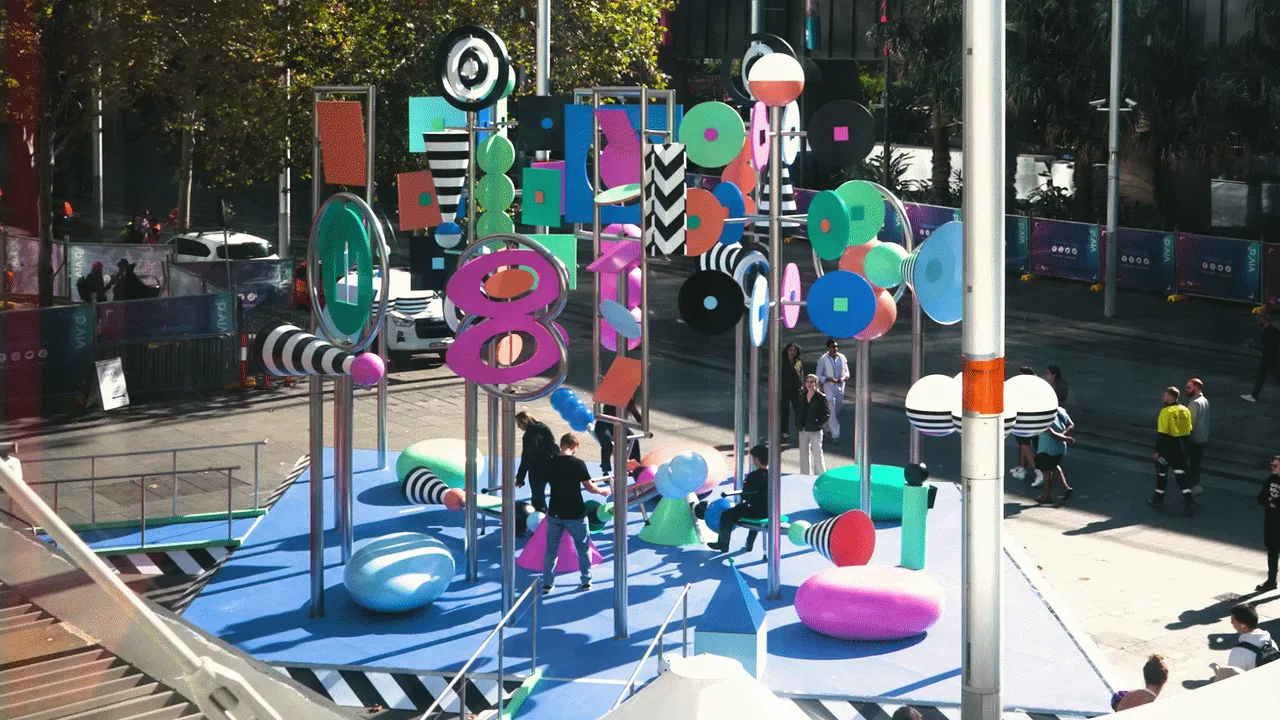
At the heart of Sydney’s iconic Circular Quay, where the bustling urban transit of trains and ferries meets the expansive beauty of the harbor, a new, towering presence has taken hold. Standing 6.5 meters tall, a kinetic sculpture titled “There, Now, Here” invites commuters and tourists alike to pause, interact, and engage with their environment in an entirely new way. Created by the Brooklyn-based artistic duo Wade Jeffree and Leta Sobierajski—collectively known as Wade and Leta—the installation is a masterful blend of playground-inspired engineering, poetic homage, and interactive sound design.
As a centerpiece for the globally renowned Vivid Sydney festival, this installation is more than just a visual spectacle; it is an exercise in public intimacy, forcing a confrontation between the static nature of architecture and the fluid, unpredictable nature of human play.
The Core Concept: Poetry in Motion
The installation is designed to be in constant flux. Powered by a combination of natural wind currents, internal motors, and the literal weight of its audience, “There, Now, Here” spins, twirls, and totters, creating a dynamic silhouette against the backdrop of the Sydney Opera House and the Harbour Bridge.

The aesthetic identity of the piece is rooted in a deliberate, sun-bleached color palette. By juxtaposing stark black-and-white stripes with muted, earthy tones, Wade and Leta have created a visual language that pays tribute to Dorothea Mackellar’s iconic 1908 poem, My Country. The poem, which immortalized Australia as a "sunburnt country," serves as the conceptual anchor for the project.
The artists sought to capture the essence of a landscape shaped by relentless heat. The colors, rather than being vibrant and primary, are faded and soft—as if the sculpture itself has been left to bake under the harsh Australian sun for decades. This "washed-out" aesthetic challenges the traditional expectations of high-energy festival installations, offering instead a sense of nostalgic permanence amidst the fleeting nature of the Vivid Sydney event.
A Chronological Evolution: From Concept to Quay
The journey of "There, Now, Here" began long before it touched the concrete of Circular Quay.

Phase 1: Conceptualization and Design
In the early months of the development cycle, Wade and Leta focused on the physical limitations of a public thoroughfare. Unlike gallery spaces, Circular Quay is a high-traffic transit hub. The challenge was to create something that felt grand in scale but safe for the thousands of pedestrians passing through daily. The see-saw mechanism was chosen as the primary interaction point, effectively gamifying the sculpture and ensuring that the public became a necessary component of its kinetic energy.
Phase 2: Fabrication and Materiality
The fabrication process was a rigorous exercise in structural engineering. To achieve the specific "tottering" movement while remaining structurally sound, the duo worked with engineers to balance the shifting centers of gravity. The materials were selected for their durability against the salty harbor air, while the paint finishes were distressed to achieve the "sun-baked" look required by the artistic vision.
Phase 3: The Sonic Layering
Once the structural design was finalized, the artists collaborated with sound designer Josh Burgess. The sonic component was not an afterthought but an integral layer of the experience. The audio landscape was built over several weeks, involving field recordings from around Sydney, including the specific acoustic signatures of the local rail lines and the unique calls of native wildlife.

Phase 4: Installation and Debut
The final installation took place under the cover of night to avoid disrupting the daytime flow of commuters. Upon its debut at the opening of Vivid Sydney, the sculpture immediately became a focal point, with participants forming lines to engage with the see-saw mechanisms, effectively powering the sculpture through their own collective movement.
Supporting Data: The Anatomy of the Installation
To understand the scale of “There, Now, Here,” one must look at the specifications that allow it to function within such a public space:
- Height: 6.5 meters (approx. 21.3 feet), providing a landmark height that is visible from various vantage points across the harbor.
- Interaction Points: The see-saw base allows for multiple users to interact simultaneously, fostering social collaboration.
- Audio Channels: The soundscape features a multi-layered, reactive audio track that adjusts intensity based on the kinetic activity of the sculpture.
- Materials: Industrial-grade steel finished with high-UV-resistant, weather-treated paints designed to mimic long-term sun exposure.
- Accessibility: The controls for the sonic elements were designed at various heights to ensure they were accessible to children and wheelchair users, upholding the inclusive mission of the Vivid Sydney festival.
The Sonic Narrative: A "Bush Doof" for the City
One of the most compelling aspects of the work is its auditory profile. Josh Burgess, working in close consultation with Wade and Leta, curated a soundscape that acts as a bridge between the urban and the natural.

"If one were to listen closely, they can hear the rush of water on the rocks, the dings of the light rail, the crosswalk signal, and most importantly, the local wildlife," the artists explained in a recent press release.
Perhaps the most ambitious inclusion is a nod to the Australian "bush doof"—the outdoor, grassroots electronic music parties held in remote areas. By layering the complex, mimetic calls of the lyrebird—a species famous for its ability to replicate almost any sound in its environment—over synthesized electronic beats, the artists have created a surreal soundscape that feels both alien and deeply, uniquely Australian. The result is a sonic texture that mirrors the visual aesthetic: something that feels like it has emerged from the earth itself, rather than being imposed upon it.
Official Responses and Curatorial Intent
The inclusion of "There, Now, Here" in Vivid Sydney highlights the festival’s shift toward more tactile, interactive art. Festival curators noted that in recent years, there has been a demand for works that encourage "active participation" rather than passive observation.

"Wade and Leta have successfully translated the feeling of the Australian landscape into a kinetic language," said a spokesperson for the festival. "The piece is not just an object to be looked at; it is a machine that requires a human element to be complete. It perfectly encapsulates the spirit of Vivid—where light, sound, and community converge."
Art critics have similarly praised the work for its restraint. In an era where festival installations are often defined by blinding LED arrays and aggressive scale, the "washed-out" palette and gentle, tottering movements of this piece offer a moment of quiet contemplation. It is an installation that asks the viewer to slow down, listen to the lyrebird, and consider the poem that inspired it.
Implications: The Future of Public Art
The success of “There, Now, Here” suggests a growing trend in public art: the "human-powered installation." By removing the reliance on external power sources for the primary motion and placing it in the hands of the public, the artists have fostered a sense of ownership among the viewers.

The Sustainability Aspect
Beyond the aesthetic and social impact, the installation addresses the growing need for sustainable public art. By utilizing kinetic energy and wind, the installation reduces the overall carbon footprint compared to fully motorized, high-consumption light displays. This approach serves as a potential blueprint for future large-scale festival works, suggesting that the intersection of technology and sustainability can indeed produce profound artistic results.
The Psychological Impact
Public spaces, particularly in busy cities like Sydney, can often feel sterile or alienating. "There, Now, Here" disrupts this. By introducing play—the simple act of hopping on a see-saw—the installation lowers the barriers between the observer and the art. It transforms a transition space (a walk through Circular Quay) into a "third space," where social interaction occurs organically.
Long-term Legacy
As the installation concludes its run at Vivid Sydney, the question of its legacy remains. For Wade and Leta, this is their first major public work in Australia, and it has set a high bar for their future endeavors. The duo’s ability to weave local history, ecological awareness, and modern design into a singular, interactive object demonstrates a sophistication that is rarely seen in temporary festival art.

The installation stands as a testament to the idea that public art should not just sit in a space, but actively converse with it. Through its spinning shapes, its fading colors, and its mimetic soundscape, “There, Now, Here” does not just exist in Sydney—it participates in the city’s ongoing story, reflecting its past, its landscape, and the people who walk its paths every day.
As the festival concludes and the sculpture is dismantled, the echoes of the lyrebird and the image of those sun-bleached stripes will likely remain in the collective memory of those who stopped to play, if only for a moment, under the Sydney sun.









No comments yet. Be the first to join the conversation!