

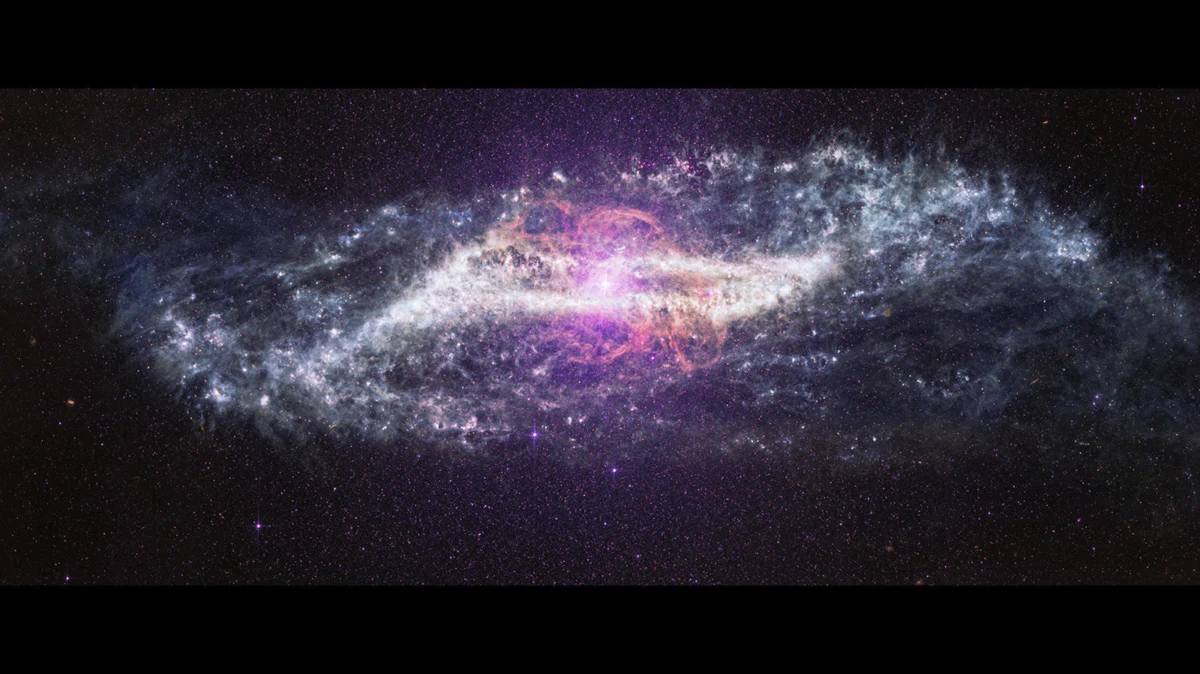
In a stunning celebration of four years of scientific excellence, NASA has unveiled the most detailed, high-resolution imagery of Centaurus A, a nearby galaxy known for its tumultuous history and extreme cosmic activity. Captured by the James Webb Space Telescope (JWST), these images provide a revolutionary perspective on a celestial neighbor that has long intrigued astronomers, offering a glimpse into the chaotic processes that drive galactic evolution.
Main Facts: Peering Through the Cosmic Veil
Centaurus A, located approximately 11 million light-years from Earth, is not your typical, serene spiral galaxy. It is a peculiar, active elliptical galaxy that serves as a vibrant laboratory for studying the life cycles of stars, the growth of supermassive black holes, and the catastrophic impacts of galactic collisions.
The new imagery, released by NASA to mark the fourth anniversary of the telescope’s first operational images, utilizes the advanced capabilities of Webb’s Mid-Infrared Instrument (MIRI) and Near-Infrared Camera (NIRCam). While previous observatories—including the Hubble Space Telescope—were often hindered by the thick, opaque bands of dust that shroud the heart of Centaurus A, Webb’s infrared vision cuts through these layers with surgical precision.
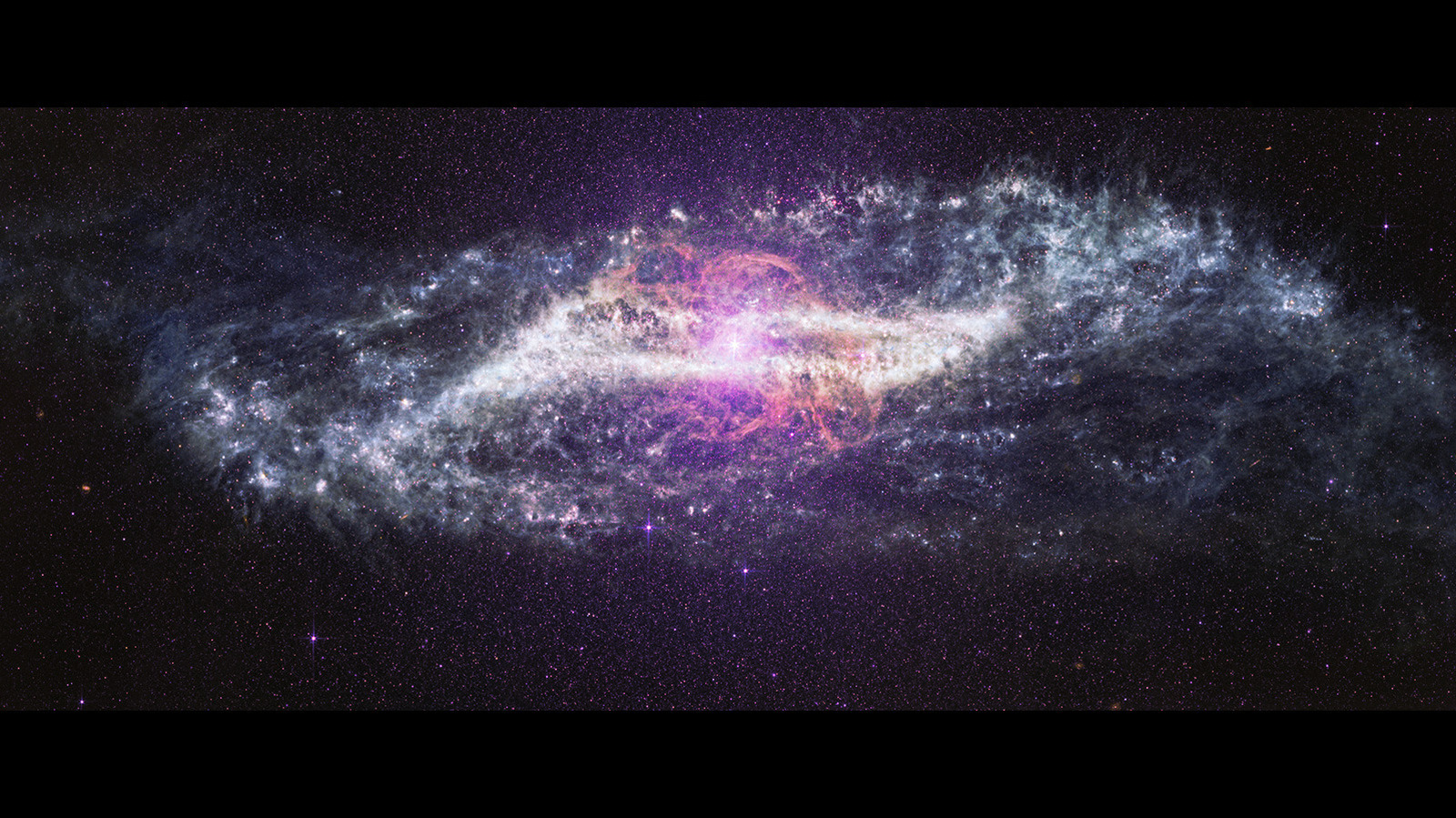
The resulting visuals reveal a tapestry of glowing, reddish-purplish structures that were previously invisible. These structures represent massive "stellar nurseries" and regions where aging stars are shedding their outer layers to seed the cosmos with the materials required for future generations of stars. By mapping these dust structures, researchers are finally able to "see" into the heart of the galaxy, identifying individual stars and complex gas formations that define its current morphology.
Chronology: From First Light to Modern Mastery
The journey to this moment began four years ago, when the world watched in awe as NASA released the first official science images from the James Webb Space Telescope. At the time, that "deep field" image—showing thousands of galaxies in a tiny slice of the sky—shattered records for the deepest, sharpest infrared view of the universe ever captured.
The chronology of Webb’s mission is marked by a series of unprecedented milestones:
- July 2022: The official commencement of science operations, showcasing the capabilities of the telescope to peer back toward the dawn of time.
- 2022–2023: Webb provides groundbreaking data on exoplanet atmospheres, the formation of early galaxies, and the chemical composition of star-forming regions.
- 2024: The telescope shifts focus to more granular investigations of local, complex systems like Centaurus A.
- Current Milestone: The release of the most detailed imagery of Centaurus A to date, demonstrating that the telescope’s performance continues to exceed initial engineering requirements.
This progression highlights a transition from broad surveys of the distant universe to focused, high-definition studies of objects within our own cosmic backyard, effectively bridging the gap between local galactic dynamics and the broader evolution of the universe.
Supporting Data: The Physics of an Active Galaxy
To understand why Centaurus A is such a vital subject for study, one must look at its violent history. Roughly 2 billion years ago, Centaurus A was the site of a major galactic collision. This event effectively "scrambled" the galaxy, resulting in the unusual shape and high level of turbulence we observe today.
The Central Engine
At the core of Centaurus A resides a supermassive black hole with a mass equivalent to approximately 55 million suns. Unlike the dormant black holes found in many galaxies, the one at the heart of Centaurus A is an "active galactic nucleus" (AGN). It is actively feeding on gas, dust, and stars, consuming vast amounts of matter and, in the process, ejecting colossal jets of plasma that extend for thousands of light-years. These jets are some of the most powerful structures in the known universe and play a crucial role in regulating the birth of stars within the galaxy.
The Role of Infrared Imaging
The primary challenge in studying Centaurus A has always been its dust. Visible light, which human eyes perceive, is easily blocked by dust grains. The Spitzer Space Telescope previously allowed astronomers to see the galaxy’s large-scale infrared structure, but it lacked the resolution to resolve individual stars.
Webb’s MIRI and NIRCam instruments change the equation entirely. MIRI operates in the mid-infrared, allowing it to detect the thermal glow of dust particles. NIRCam operates in the near-infrared, which is more sensitive to the light of stars. By combining these, scientists gain a multi-layered view:
- MIRI Data: Maps the cold, dusty gas and the chemical signatures of star formation.
- NIRCam Data: Pinpoints the distribution of stellar populations, distinguishing between ancient star clusters and newly formed groups.
Official Responses and Scientific Perspective
NASA’s announcement emphasized that this imagery is not merely for public wonder; it is a critical scientific tool. "These images mark four years of better-than-anticipated performance and successful science operations," the agency stated.
Dr. Macarena Garcia Marin, a key member of the ESA team involved in the image processing, noted that the detail captured by MIRI provides a "guided tour" of the galaxy’s inner workings. By analyzing the data, researchers can now begin the monumental task of cataloging the stars within the galaxy on a granular level.
"We are moving from a state of observing the galaxy as a blur to identifying its individual building blocks," said a spokesperson for the STScI (Space Telescope Science Institute). The goal is to construct a comprehensive timeline of the galaxy’s evolution—from the moment of the initial collision 2 billion years ago to the current, highly active state of the supermassive black hole.
Implications: Understanding Our Cosmic Future
The implications of the Centaurus A study extend far beyond the borders of that specific galaxy. As a nearby, active, and post-collision system, Centaurus A serves as a "proxy" for understanding how larger, more distant galaxies behave.
Galactic Evolution
Galaxies are rarely isolated entities; they are constantly evolving through mergers and internal feedback. By studying how the supermassive black hole in Centaurus A influences the galaxy’s star formation, astronomers can develop more accurate models for how our own galaxy, the Milky Way, might behave in the future—especially as we head toward our eventual collision with the Andromeda galaxy.
Advancing Astronomical Technology
The sustained success of Webb proves that the engineering decisions made decades ago have paid off. The telescope’s ability to remain stable and provide such high-resolution data four years into its mission suggests that we are only in the early chapters of what Webb can accomplish. The refined imagery of Centaurus A is a testament to the telescope’s longevity and the effectiveness of the calibration efforts conducted by ground teams at the STScI.
The Next Steps
With the data from this observation now available to the global scientific community, the next phase involves cross-referencing these images with radio wave data (such as that from the Atacama Large Millimeter/submillimeter Array) and X-ray observations (from the Chandra X-ray Observatory). This multi-wavelength approach will provide a 360-degree view of the galaxy’s physics, effectively creating a "digital twin" of the system.
In conclusion, the new images of Centaurus A serve as a powerful reminder of how far our observational capabilities have advanced. As we look at these swirling, dust-filled clouds and the bright, newborn stars illuminated by Webb’s infrared eye, we are not just looking at a pretty picture—we are observing the very history of cosmic construction. For the next several years, the data harvested from this single galaxy will likely fuel hundreds of research papers, deepening our collective understanding of the vibrant, sometimes violent, and perpetually evolving universe we call home.











