

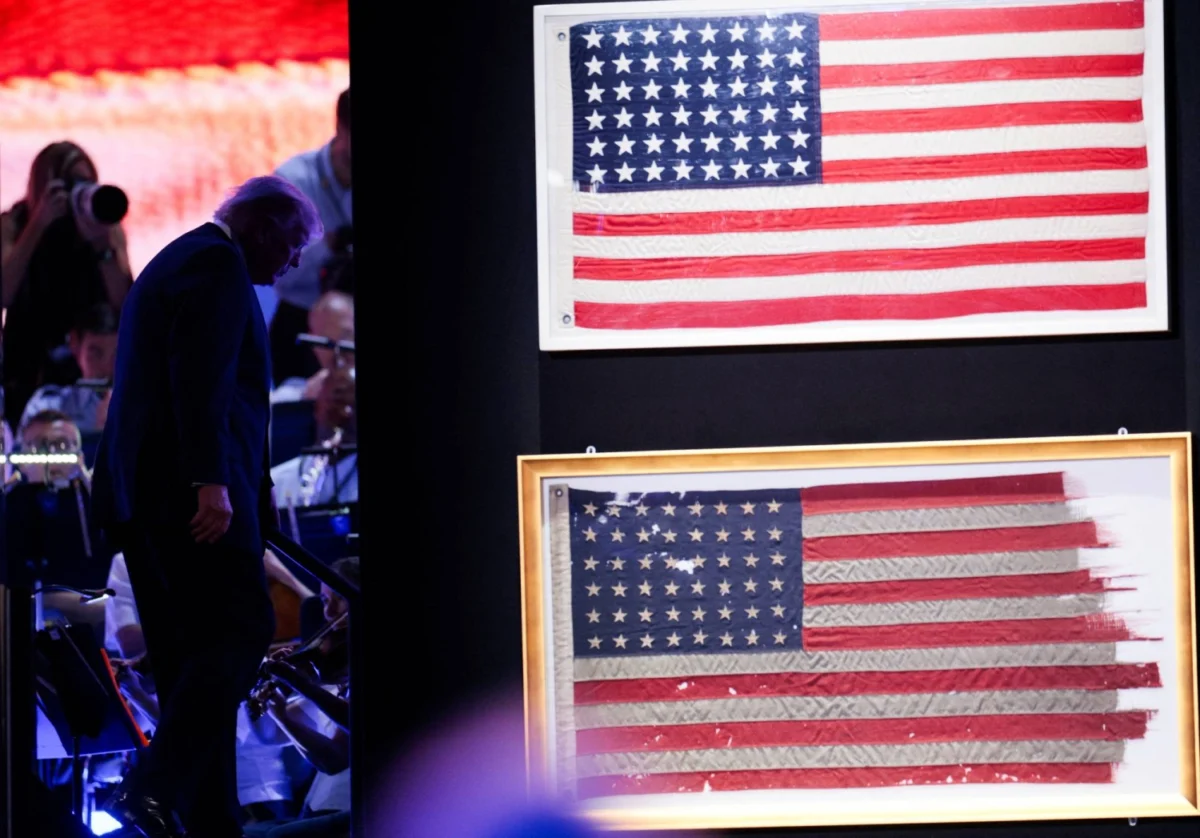
WASHINGTON – As the United States marked its 250th anniversary of independence this Saturday, the National Mall became the stage for a momentous celebration of American history, punctuated by the distinct political rhetoric of President Donald Trump. Speaking before a crowd gathered under the shadow of the Washington Monument, the President lauded the nation as the "crowning achievement" of human history, while simultaneously leveraging the platform to issue a sharp rebuke of his domestic political rivals.
The event, which served as the centerpiece of the nation’s semiquincentennial celebrations, took place against a backdrop of volatile weather and heightened political tension, highlighting the unique challenges and divisions currently facing the United States.
A Storm-Delayed Celebration: The Chronology of the Day
The festivities were significantly disrupted by an aggressive weather system that swept through the District of Columbia earlier in the day. The atmospheric turbulence necessitated the temporary evacuation of thousands of spectators from the National Mall, forcing a hours-long delay in the official proceedings.
The delay, however, did little to dampen the resolve of the administration or the attendees. As the skies cleared in the late afternoon, the crowds returned to the central grounds of the capital. The President, appearing on stage in the early evening, acknowledged the interruption, weaving the day’s weather into his narrative of American resilience.
"We have weathered storms before, and we will weather them again," Trump remarked, transitioning from the immediate logistical challenges to a broader historical assessment of the nation’s 250-year journey. The speech, while occasionally departing into familiar partisan territory, followed a more structured, patriotic arc than some of the more overtly campaign-style events held earlier in his administration.
The Presidential Address: "The Crowning Achievement"
At 80 years old, President Trump delivered an address that framed the American experiment not merely as a political entity, but as a singular success in the trajectory of human civilization. He described the United States as the "crowning achievement" of history, citing the Constitution and the Declaration of Independence as documents that fundamentally shifted the global understanding of liberty.
However, the tone shifted abruptly as the President pivoted to the contemporary political landscape. Echoing themes that have become staples of his rhetoric, Trump characterized his political opposition—ranging from members of the legislative branch to ideological critics—with harsh descriptors. He explicitly branded his opponents as "communists" who, in his view, seek to dismantle the traditional values upon which the nation was founded.
This rhetoric underscores the ongoing "culture war" that has dominated the American political discourse throughout his presidency. By framing the 250th anniversary not just as a celebration of the past, but as a battleground for the future, the President signaled that his political strategy remains firmly rooted in the mobilization of his base through sharp, polarizing terminology.
Supporting Data: A Nation in Transition
The 250th anniversary comes at a complex time for the United States. According to recent demographic and economic data, the nation that celebrates its independence in 2026 is vastly different from the one that celebrated its bicentennial in 1976.
- Demographic Shifts: The U.S. population has grown to over 345 million, characterized by increasing diversity and an aging demographic profile.
- Economic Landscape: Despite ongoing debates regarding income inequality and the national debt, the U.S. remains the world’s largest economy. GDP growth has been a central focus of the Trump administration’s platform, with the President frequently citing trade deals and deregulation as the engines of current prosperity.
- Political Polarization: Public opinion polls from the Pew Research Center and Gallup indicate that American political polarization is at its highest point in decades. Trust in institutional pillars—including the media, the judiciary, and the electoral process—remains fractured, a trend that was on full display during the events of July 4th.
Official Responses and Political Repercussions
The President’s remarks drew immediate responses from across the political spectrum. White House officials defended the speech, arguing that it was a necessary and powerful affirmation of national pride. Press Secretary statements following the event emphasized that the President was merely speaking "plain truths" about the threats he perceives to the American way of life.

Conversely, opposition leaders were quick to condemn the rhetoric. Members of the Congressional leadership criticized the President for using what should have been a non-partisan, national holiday to "dehumanize" fellow citizens. "To call fellow Americans ‘communists’ on the birthday of our democracy is a stain on the office of the Presidency," one senior opposition member stated in a press release issued shortly after the event.
International observers have also taken note. Foreign diplomats stationed in Washington have frequently expressed concern over the tone of American domestic politics, viewing the erosion of civil discourse as a potential long-term risk to the stability of the Western alliance.
Implications: The Road Toward 2028
As the United States moves beyond its 250th anniversary, the implications of this rally are clear. The rhetoric employed on the National Mall suggests that the current administration has no intention of softening its approach as it looks toward the future.
The Permanence of the "Trump Brand"
Despite his age, President Trump continues to exert a gravitational pull on the Republican Party and the broader American electorate. By positioning himself as the defender of a 250-year-old legacy, he effectively frames his opposition as enemies of that legacy. This "us-versus-them" framework is likely to define the next two years of American politics.
The Erosion of National Consensus
The most significant implication of this weekend’s events is the further erosion of a shared national narrative. Historically, Independence Day served as a moment of relative unity. In the current era, it has become another front in a continuous political struggle. If the nation cannot find common ground on its foundational principles, the challenges of the next 250 years—ranging from technological displacement to global environmental shifts—may prove increasingly difficult to navigate.
The Role of Media and Information
The President’s focus on "misinformation" and his own unique brand of storytelling reflect the broader information landscape in 2026. With the rise of AI-generated content and fragmented media silos, the American public is increasingly sequestered into ideological echo chambers. The President’s success in maintaining his narrative, despite the critical scrutiny of the mainstream press, highlights the changing power dynamics of modern communication.
Conclusion: A Milestone Marked by Conflict
The 250th anniversary of the United States was meant to be a moment of reflection and collective pride. While the pageantry on the National Mall succeeded in capturing the attention of the world, the day served primarily as a mirror of the nation’s current state: powerful, enduring, yet deeply divided.
As the fireworks faded over the Potomac, the fundamental questions remained: Can a nation built on the promise of "a more perfect union" reconcile its internal differences, or is it destined to remain in a state of permanent ideological combat? The answer to that question will likely define the legacy of this era far more than the specific policies or legislative victories of any single administration.
For now, the country looks forward. The semiquincentennial has passed, and with it, the recognition that the "crowning achievement" of history is a work in progress—one that requires not just the celebration of its past, but the difficult, often messy, labor of maintaining its future.











