


In the sprawling landscape of city-building simulations, the challenge usually involves finding the perfect plot of land, laying down infrastructure, and managing the delicate balance of a stationary population. But what happens when the ground beneath your citizens is constantly shifting? What happens when your city is a colossal, iron-clad behemoth thundering across a dying world?
Steel Artery, the long-awaited debut from developer SoulAge23, answers that question with a resounding, complex, and often chaotic "Yes." Since its initial reveal in 2025, the title has been a focal point for simulation enthusiasts hungry for a new breed of colony management. Now that it has finally pulled into the station on Steam, it is clear that Steel Artery is not merely a game about building; it is a high-stakes experiment in emergent social engineering.
The Core Concept: A City on the Move
At its heart, Steel Artery is a "train city builder" that blends the granular management of Dwarf Fortress with the environmental pressures of Oxygen Not Included. Players are tasked with managing Steelpolis, the final bastion of a crumbling empire. The train is a living, breathing entity that requires constant maintenance, logistical precision, and a firm, yet indirect, hand in guiding its thousands of autonomous inhabitants.
Unlike traditional city builders where the player acts as a god-like architect, Steel Artery forces you into the role of a facilitator. Your citizens are not puppets; they are independent agents with their own needs, desires, and career aspirations. If you want a job done, you cannot simply click a button and assign a worker. You must create the right incentives, build the necessary infrastructure, and hope that your population finds the motivation to pursue the goals you’ve set.
A Chronology of Development: From Concept to Rails
The journey of Steel Artery has been a multi-year odyssey. When the project first surfaced in 2025, it was little more than a "strange train project" in the eyes of the public. Developer SoulAge23 spent the intervening years refining the simulation, focusing heavily on the "living train" aspect that differentiates the game from its peers.
- 2025: The Genesis. SoulAge23 introduces the concept of a "moving city builder," sparking immediate interest in simulation communities due to the unique constraint of limited, linear space.
- 2026: The Testing Phase. Through closed beta sessions, the developer focused on the "logistical headaches" that define the game’s difficulty curve. It was during this period that the complex AI for individual citizens—who manage their own money, career paths, and leisure time—was finalized.
- May 2026: The Launch. Steel Artery officially hits the Steam storefront. Following years of community feedback and wishlisting, the game enters the market with a polished, if daunting, feature set.
The Simulation Architecture: Why It Feels Like "Emergent Chaos"
What makes Steel Artery stand out is the depth of its simulation. The game treats the train as a series of interconnected ecosystems. Because space is at an absolute premium, every carriage you add to the locomotive must serve a purpose. Whether it is an agricultural hub, a residential quarter, or a specialized production facility, the spatial layout dictates how your citizens interact and, more importantly, how they clash.
The Autonomy Factor
The most significant hurdle for new players is the autonomy of the residents. You might decide that you need more power production to keep the train moving through a treacherous pass. You can set the wages for engineers to be sky-high, but that doesn’t guarantee your citizens will take the job. They may decide that the pay is good enough to retire early, or perhaps they have a personal preference for a different career path entirely.

This creates a layer of "emergent chaos." You aren’t just managing production chains; you are managing a social economy. If you fail to account for the diverse needs of different species—each with their own cultural quirks and requirements—tensions will rise. A mismanaged, multi-species carriage can quickly become a hotbed of unrest, threatening the stability of the entire train.
Resource Logistics and the "Stop" Mechanic
As Steelpolis traverses the map, it must stop at resource-rich regions to replenish its supplies. This is where the game’s tension peaks. You are constantly balancing the weight of the train, the speed of travel, and the depletion of your internal stores. Every stop is a gamble. Do you stop to harvest water, knowing that it will delay your arrival at the next safe zone? Do you risk overcrowding your train to bring on more workers, potentially destabilizing your fragile social balance? These decisions are what define the "Steel Artery experience."
The Reception: A Challenging Masterpiece
Early reviews on Steam currently sit at a healthy 89% positive, a testament to the game’s depth. However, the feedback is consistent: Steel Artery is not a casual experience. It is a game that demands patience, failure, and a willingness to learn through trial and error.
"Not a casual game," one user noted in a top-rated review. "This is the kind of management sim where one bad decision quietly turns into twelve new problems an hour later. I mean that as praise."
This sentiment captures the "Dwarf Fortress effect." The game doesn’t hold your hand; it hands you the keys to a runaway train and asks you to keep it from derailing. For those who enjoy the "catastrophic failure" style of simulation gaming, Steel Artery provides an endless source of both frustration and accomplishment.
Official Response: A Message from the Developer
SoulAge23 has been vocal about the importance of the community in shaping the game’s final form. In a statement accompanying the launch, the developer expressed deep gratitude to the players who supported the project from its inception.
"What started as an idea for a moving city builder eventually became Steelpolis," SoulAge23 wrote. "A living train-city filled with autonomous citizens, production chains, logistical headaches, social tension, and the kind of emergent chaos that only happens when thousands of independent agents are all trying to live their own lives at once."
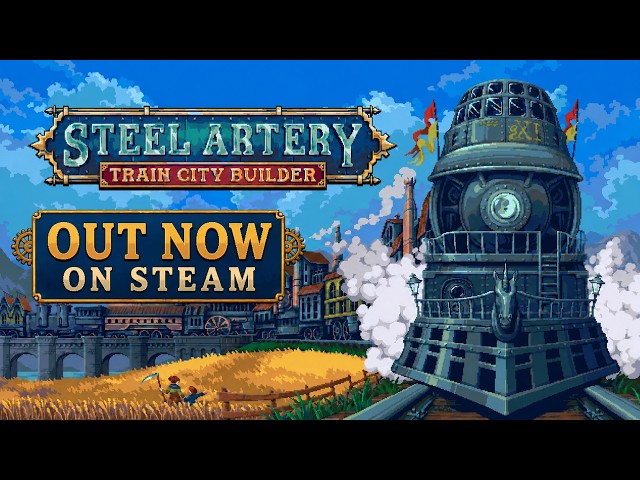
For the developer, the goal was never to create a simple builder, but to create a system that could surprise even its creator. By allowing the AI to dictate the flow of the game, the developer ensured that every playthrough tells a different story.
Implications for the Genre
Steel Artery arrives at a time when the colony sim genre is undergoing a renaissance. By introducing the physical constraint of a moving vessel, it forces players to rethink the "unlimited space" mentality that often plagues city builders. It effectively bridges the gap between the macro-management of city-state simulators and the micro-management of individual-focused colony sims.
If Steel Artery continues to be supported with the same vigor that it was developed, it could very well become a new standard-bearer for the genre. It proves that there is a massive, underserved market for "management simulators with teeth"—games that are comfortable being difficult, complex, and occasionally unforgiving.
Conclusion: Should You Board the Train?
If you are the type of player who finds joy in the meticulous design of production lines, who can handle the heartbreak of a well-planned colony collapsing due to a single, cascading failure, then Steel Artery is essential. Its pixel-art aesthetic is not only gorgeous but functional, allowing players to scan their train-city and identify bottlenecks with a single glance.
The game is currently available on Steam with a 10% launch discount through Friday, May 22. At a price point of $13.49, the barrier to entry is low, but the cost of your time—as you lose hours to the siren call of "just one more carriage"—will be significant.
Welcome to Steelpolis. The train is leaving the station, and the empire is counting on you. Whether you lead your people to salvation or watch your dream collapse in a shower of sparks and broken promises, one thing is certain: it will be a journey you won’t soon forget.












No comments yet. Be the first to join the conversation!