

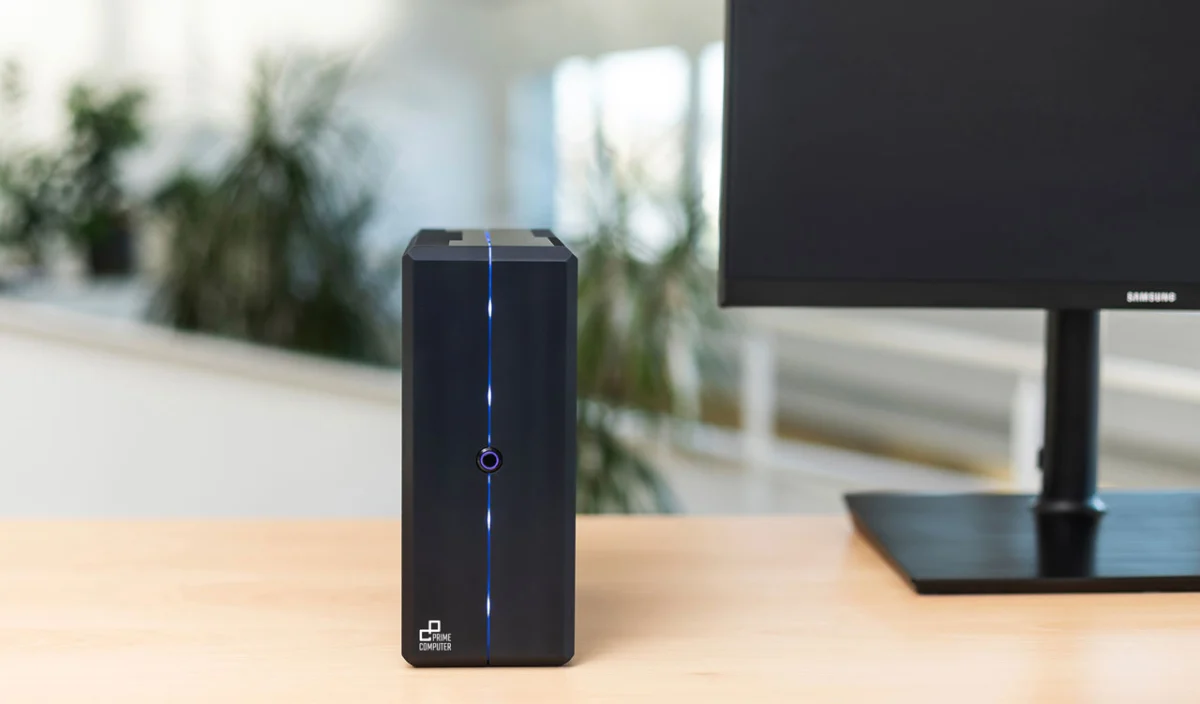
In an era where the computing industry is increasingly scrutinized for its carbon footprint and the pervasive, often intrusive hum of active cooling fans, Swiss manufacturer Prime Computer has staked a bold claim in the high-performance workstation market. The launch of the PrimeStation Pulsar represents more than just a new piece of hardware; it is a statement on the marriage of thermal efficiency, sustainable manufacturing, and uncompromising workstation performance. By eschewing traditional active cooling in favor of a sophisticated passive heatsink design, Prime Computer has created one of the most powerful fanless mini-PCs currently available, all while maintaining a 100% climate-neutral certification.
Main Facts: Engineering the Silent Workstation
The PrimeStation Pulsar is designed for professionals who demand silence without sacrificing the raw computational throughput typically reserved for desktop towers. At its heart lies the AMD Ryzen 7 Pro 5750G, a powerhouse APU that balances 65W of thermal design power with impressive multi-threaded capabilities.
Unlike conventional mini-PCs that rely on small, high-RPM fans prone to dust accumulation and mechanical failure, the Pulsar utilizes its entire aluminum chassis as a giant, finned heatsink. This passive thermal management system draws heat away from the processor through conductive pathways, dissipating it into the environment silently. The result is a machine that operates at zero decibels, making it an ideal candidate for noise-sensitive environments such as recording studios, medical facilities, or open-plan offices where ambient noise is a concern.
Chronology: The Evolution of Fanless Design
The trajectory of fanless computing has historically been defined by a compromise between thermal headroom and performance. Early iterations were limited to low-power, "thin-client" hardware, often struggling with basic multitasking or modern software suites.
- The Early Era (2010–2015): Passive cooling was relegated to Atom or Celeron-based systems designed for digital signage or simple kiosks.
- The Efficiency Shift (2016–2019): Advancements in silicon manufacturing (moving to 14nm and 10nm nodes) allowed for slightly more capable chips to run without active cooling, though TDP limits remained strictly under 35W.
- The Current Wave (2020–Present): With the introduction of highly efficient APUs like the AMD Ryzen Pro series, companies like Prime Computer have pushed the envelope. The Pulsar stands as a milestone, managing a 65W processor—a feat that was considered thermally impossible for a compact, fanless chassis just a few years ago.
Prime Computer’s development cycle for the Pulsar focused heavily on the thermodynamics of the chassis. By optimizing the surface area of the aluminum casing and utilizing precision-engineered heat pipes, the team successfully bridged the gap between a high-end workstation and a silent, compact form factor.
Supporting Data: Under the Hood of the Pulsar
To understand the capability of the PrimeStation Pulsar, one must look closely at the silicon driving it. The AMD Ryzen 7 Pro 5750G is a formidable piece of engineering, built on TSMC’s 7nm FinFET process.

Processor Specifications
- Architecture: Zen 3 (8 Cores / 16 Threads)
- Clock Speeds: 3.8GHz Base / 4.6GHz Boost
- L3 Cache: 16MB
- Graphics: Integrated Radeon Vega GPU (8 cores up to 2.0GHz)
The inclusion of the Radeon Vega graphics core means that the Pulsar is not just a CPU-bound machine; it is capable of handling light-to-medium graphical workloads, including 4K video playback and professional-grade rendering tasks.
Memory and Storage
The system is highly configurable, catering to a range of professional needs:
- RAM: Dual DIMM slots supporting 8GB, 16GB, 32GB, or 64GB of DDR4 3200MHz memory.
- Storage: A flexible hybrid approach featuring one NVMe M.2 port for ultra-fast boot times and a secondary 2.5-inch SATA III bay for high-capacity storage.
Connectivity
Despite its diminutive size, the Pulsar is equipped with an array of ports that would satisfy most power users:
- Network: 2.5Gbps Ethernet, Intel AX200 Wi-Fi 6, and Bluetooth 5.2.
- Display: HDMI 2.1 and DisplayPort 1.4, supporting high-resolution multi-monitor setups.
- I/O: 3 x USB 3.2 Type-A, 1 x USB 3.2 Type-C, 1 x USB 2.0, and comprehensive audio support.
Official Responses and Sustainability Initiatives
Prime Computer has been vocal about its commitment to environmental stewardship. The "100% climate-neutral" label is not merely a marketing buzzword; it refers to the company’s holistic approach to the lifecycle of the product. From the sourcing of raw materials to the manufacturing process and the eventual logistics, Prime Computer offsets the carbon emissions associated with every unit produced.
In official statements, the company emphasizes that a fanless design serves a dual purpose: it reduces the power consumption of the cooling system and significantly increases the lifespan of the machine. By eliminating the mechanical failure point of a cooling fan, the Pulsar experiences less wear and tear, reducing the frequency of hardware replacements—a significant contribution to the circular economy.
Implications: A New Standard for Workstations?
The launch of the PrimeStation Pulsar brings several critical implications to the desktop market.
The Niche of the Silent Workstation
While priced at approximately $2,179, the Pulsar is undeniably a premium product. Its cost reflects not only the specialized engineering required for passive cooling but also the environmental offsets and the Swiss-made quality control. For the average consumer, this price point might be prohibitive. However, for companies looking to outfit a fleet of machines where dust-resistance and silence are mission-critical, the Pulsar represents a long-term investment.
Comparison with "The Beast"
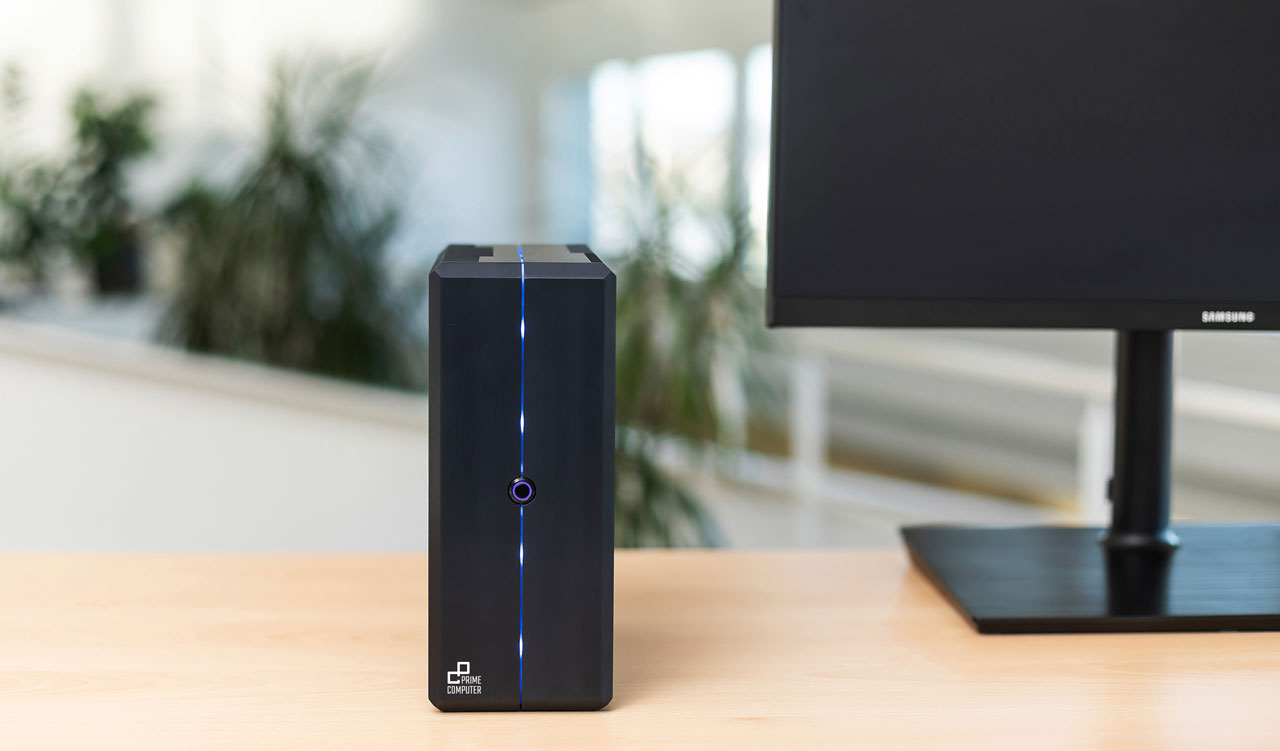
The recent rise of "boutique" fanless solutions, such as MonsterLabo’s "The Beast," highlights a growing divide in the market. While "The Beast" offers massive thermal capacity for high-end GPUs and overclocked CPUs, it occupies a much larger footprint. The PrimeStation Pulsar, by contrast, targets the user who needs a professional-grade machine that disappears into the workspace—a "minimalist-maximalist" device that hides its power behind an unassuming 9.1cm x 22.5cm x 20.3cm frame.
Sustainability as a Competitive Edge
Prime Computer is banking on the fact that corporate buyers are increasingly under pressure to hit ESG (Environmental, Social, and Governance) targets. By purchasing hardware that is certified climate-neutral, companies can integrate the PrimeStation Pulsar into their sustainability reports. This represents a shift where "green" credentials are becoming as important to IT procurement as raw clock speeds or core counts.
Conclusion: The Future is Silent
The PrimeStation Pulsar is a testament to the fact that computing does not need to be loud, clunky, or environmentally destructive. While the price tag puts it firmly in the professional, rather than enthusiast, category, the machine excels in its intended role. It proves that with the right combination of efficient silicon and clever thermal engineering, we can create workstations that are as respectful of the environment as they are capable of handling modern workloads.
As we look toward the future of desktop computing, the success of the Pulsar may well influence other manufacturers to reconsider their reliance on active cooling. For the professional who values a focused, silent environment and a lower carbon footprint, the PrimeStation Pulsar is not just a workstation; it is a blueprint for the next generation of office hardware. Whether it will spark a trend or remain a niche masterpiece, Prime Computer has undeniably set a new bar for what a fanless PC can achieve.










No comments yet. Be the first to join the conversation!