In an era defined by ubiquitous cloud synchronization and centralized data management, the security of our most sensitive digital assets—passwords, private notes, and encrypted files—has become increasingly reliant on the infrastructure of third-party providers. However, recent high-profile security breaches have prompted a shift in how privacy-conscious users perceive the "cloud-first" model. Enter BlindLock, a newly released, local-only security suite that challenges the status quo by stripping away the server entirely, instead hiding your digital secrets in plain sight within ordinary image files.
The Paradigm Shift: Why Local-Only Matters
For years, the gold standard for password management has been the cloud-synchronized vault. Services like LastPass, 1Password, and Proton Pass have streamlined the user experience by allowing seamless access to credentials across multiple devices. Yet, this convenience comes at a significant cost: the creation of a "honeypot." By aggregating millions of encrypted user vaults on a central server, these companies inadvertently create a high-value target for state-sponsored actors and cyber-criminals.
David Domingo, the sole developer behind BlindLock, argues that the inherent risks of this model are unavoidable. "When your vault sits on someone else’s server, you inherit every risk that server carries: employee access, infrastructure vulnerabilities, government subpoenas, supply chain attacks, and the simple mathematical reality that a server holding tens of millions of vaults is a far more attractive target than your laptop," Domingo notes.
The catalyst for this development was the 2022 LastPass data breach, which saw threat actors gain access to vault backups, leaving millions of users vulnerable to brute-force attacks. Domingo’s response was to build a tool that removes the third party from the equation entirely. BlindLock is not merely an encrypted database; it is a philosophy of digital sovereignty that emphasizes device-level security over remote convenience.
Chronology of Development: From Concept to Secure Vault
The development of BlindLock represents a modern response to contemporary cybersecurity failures. While the project is new to the public market, the underlying principles of steganography—the practice of concealing information within non-secret data—have been adapted to solve 21st-century privacy concerns.

- Pre-2022: The rise of cloud-based password managers dominates the market, normalizing the storage of sensitive data on remote infrastructure.
- Late 2022: The LastPass security incident serves as a wake-up call for the cybersecurity community, highlighting the dangers of centralized vault storage.
- 2023: David Domingo initiates the development of BlindLock, focusing on "local-only" architecture and hardware-backed encryption.
- 2024: Public release of the BlindLock beta and full version, introducing the concept of using standard .PNG files as "carrier" vessels for encrypted data.
- Current Status: BlindLock enters the market with a tiered lifetime licensing model, aiming to establish a sustainable financial path that avoids the need for data-mining or subscription-based harvesting.
The Mechanics of BlindLock: Security Through Obscurity and Hardware Binding
BlindLock distinguishes itself from traditional password managers through a multi-layered defense strategy. It operates on the premise that an attacker cannot steal what they cannot see, and they cannot crack what they cannot access.
1. Steganographic Concealment
At the heart of the application is the ability to hide your entire digital vault inside an ordinary-looking image file, such as a holiday snapshot or a cat photo. By utilizing steganographic techniques, the data is not simply encrypted; it is embedded within the pixels of the PNG file in a way that remains visually indistinguishable from the original. To an outside observer or a scanning tool, the image remains a harmless, inert photograph.
2. Hardware-Level Authentication
BlindLock moves beyond simple password protection by enforcing "Hardware Binding." Your vault does not open simply because you have the correct file and the correct password. It requires the presence of your specific hardware’s secure enclave—whether that is a TPM 2.0 module on a Windows PC, Apple’s Secure Enclave, or Android’s StrongBox. Even if a malicious actor successfully exfiltrates your encrypted PNG and manages to brute-force your master password, they are still blocked by the hardware-backed key that is physically tethered to your device.
3. Post-Quantum Readiness
Recognizing the accelerating pace of computational power, BlindLock has integrated NIST-standardized post-quantum encryption components. By employing 256-bit authenticated encryption and Argon2id key derivation, the application is designed to withstand future threats, including the potential decryption capabilities of future quantum computers.
Feature Set: More Than Just Passwords
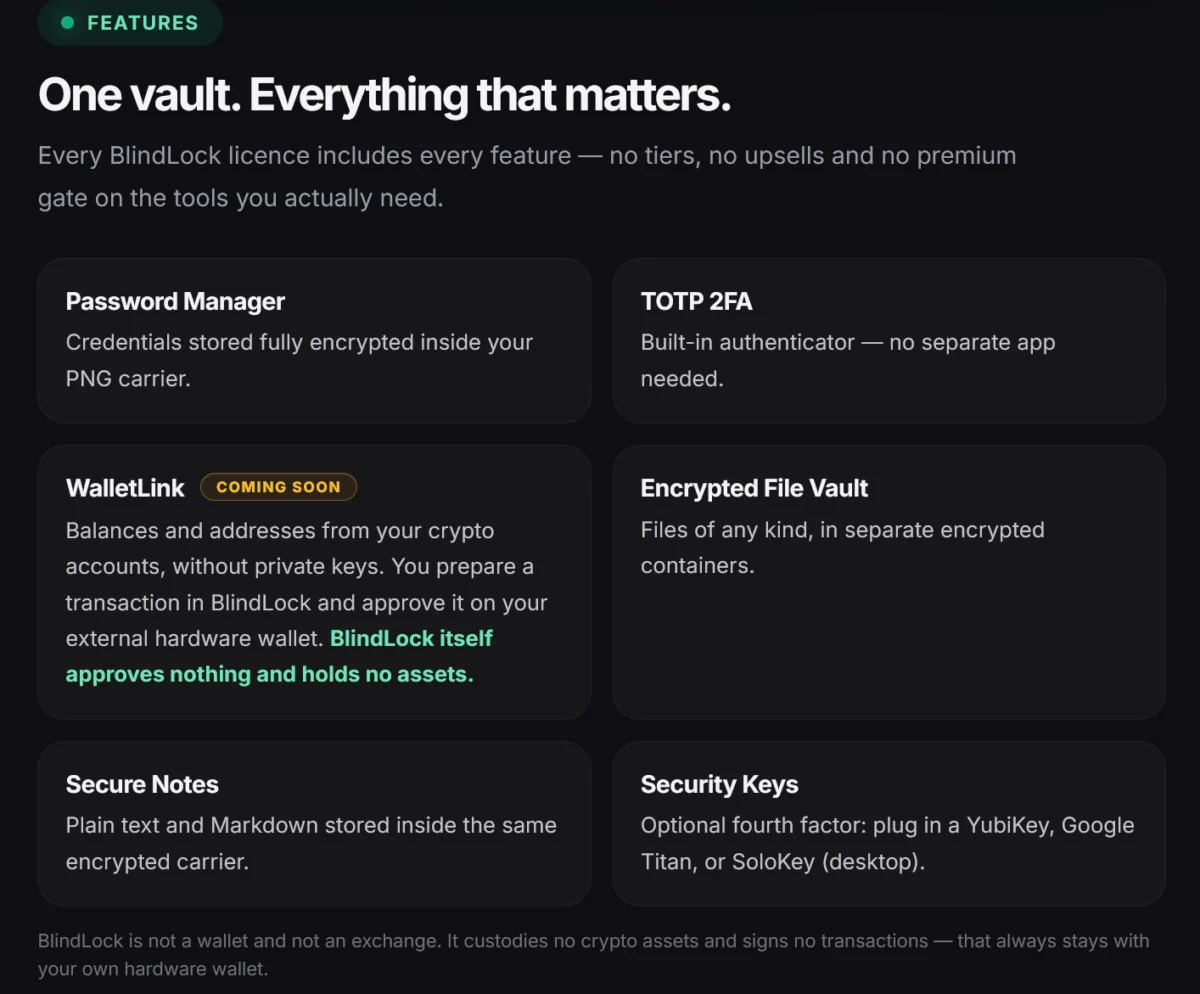
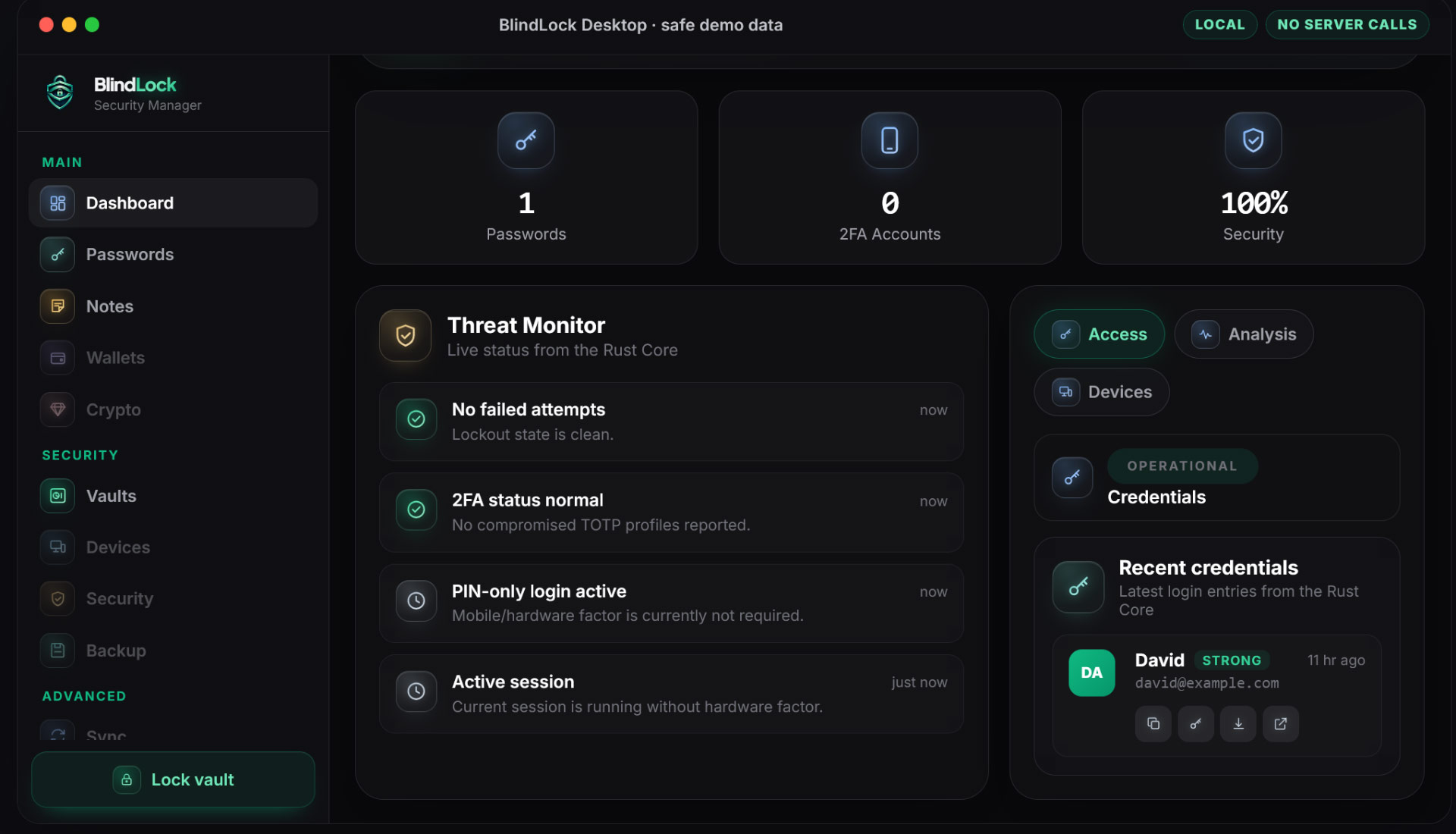
While the "invisible vault" is the headline feature, BlindLock offers a comprehensive suite of tools designed to replace multiple third-party utilities. The feature set includes:
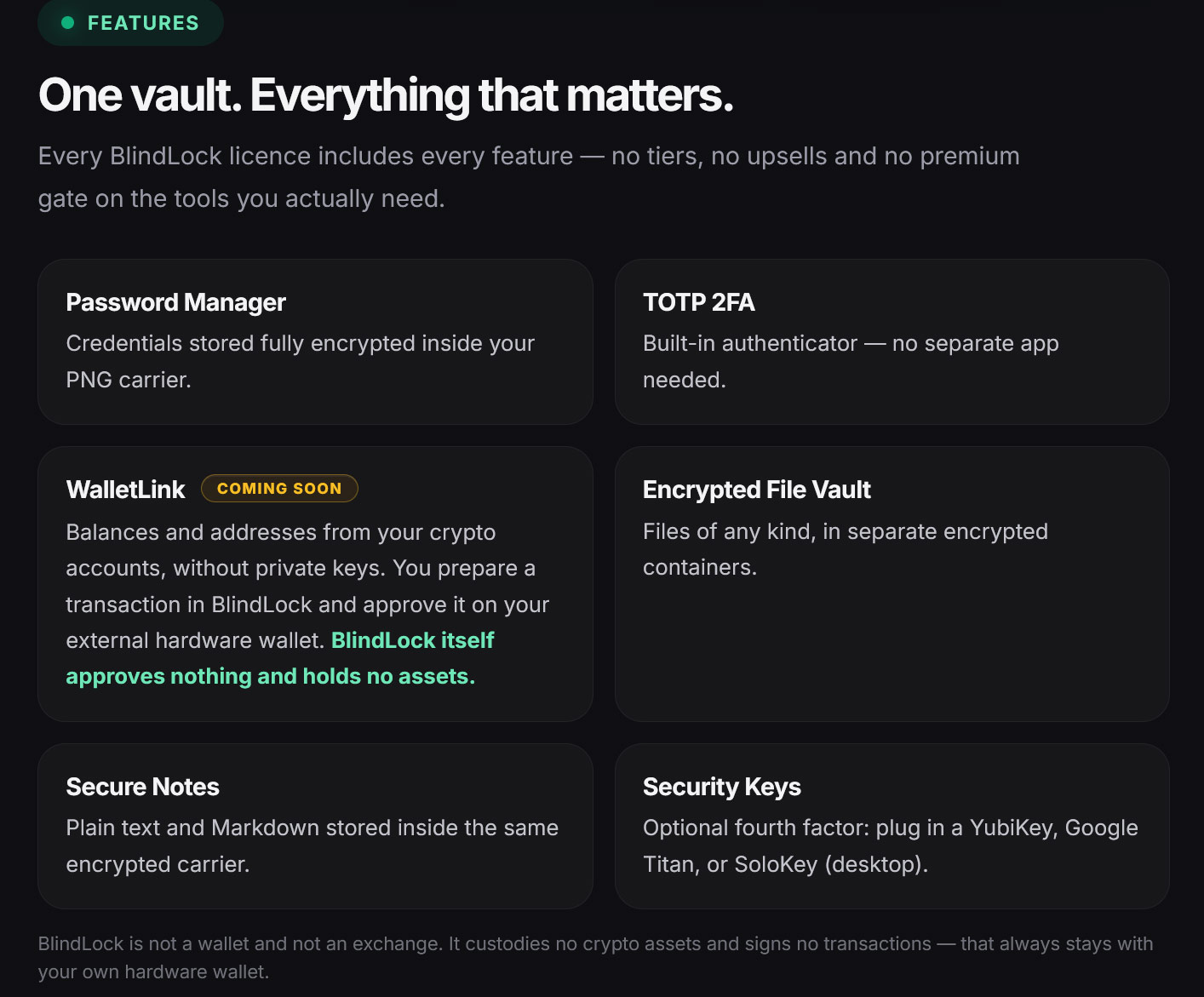
- Integrated Password Manager: Secure storage for credentials with automated generation and organization.
- Markdown-Supported Notes: A secure space for private journaling or sensitive documentation that supports rich formatting.
- Built-in 2FA Authenticator: An internal authenticator that eliminates the need for third-party apps like Google Authenticator or Authy, keeping your TOTP seeds as secure as your passwords.
- Encrypted File Vault: Beyond credentials, users can store sensitive documents, images, or project files within the BlindLock environment.
- Fourth-Factor Security: For users requiring the highest level of assurance, BlindLock supports hardware security keys (such as YubiKey or Google Titan) as an additional, optional layer of authentication.
Implications for the Cybersecurity Industry
The emergence of BlindLock signals a growing fatigue with the "convenience-at-any-cost" model of modern SaaS (Software as a Service) platforms. If a significant segment of the user base migrates to local-only, hardware-hardened tools, the industry may face pressure to rethink how it manages client data.
The "Server-less" Advantage
By eliminating the central database, BlindLock effectively kills the concept of a "system-wide" breach. If a user’s BlindLock vault is compromised, it is an isolated event. There is no master database for a hacker to infiltrate. This design is highly attractive to high-risk individuals—such as journalists, activists, or corporate executives—who require total control over their data footprint.
Potential Challenges and Trade-offs
However, this transition comes with distinct challenges. The burden of backup and synchronization shifts entirely to the user. With traditional password managers, losing your device is a minor inconvenience; with BlindLock, if you lose your device and your backup, your data is gone forever. There is no "forgot my password" link for the developer to reset your access.
Furthermore, the "local-only" nature of the software makes multi-device synchronization complex. Users must manually manage their carrier files across devices, which may discourage the average, non-technical consumer.
Pricing and Sustainability
In a landscape dominated by recurring subscriptions, BlindLock is bucking the trend with a lifetime license model. To build a sustainable business, Domingo has opted for a tiered release:
- First 100 licenses: $49
- Next 350 licenses: $89
- Final 550 licenses: $109
Once these 1,000 licenses are claimed, the developer plans to transition to a subscription-based model. This move is designed to ensure that the project remains funded without the developer having to rely on the venture capital-driven growth models that often lead to "enshittification" or the eventual sale of the company to data-hungry conglomerates.
Conclusion: A Tool for the Vigilant
BlindLock is not for everyone. It is a tool for the digital minimalist, the security-conscious, and those who believe that the only truly secure data is data that you exclusively control. By merging the principles of steganography with modern, hardware-backed encryption, it provides a compelling alternative to the centralized cloud vaults that have become increasingly precarious.
While the learning curve and the management of physical files represent a higher barrier to entry, the peace of mind offered by a "server-less" existence may be well worth the effort for those who prioritize privacy above all else. As the industry continues to grapple with the fallout of centralized failures, applications like BlindLock offer a glimpse into a potential future where the user—and not the server—is the ultimate arbiter of digital safety.