Suro Senen
For generations, Minesweeper served as the quintessential digital pastime—a modest, logic-based diversion bundled with the Windows operating system that turned casual PC users into amateur bomb-disposal experts. Its rules were simple: click a tile to reveal a number, deduce the proximity of hidden mines, and flag the danger zones. It was a game of clean lines and predictable square grids.
However, in an era where modern gaming demands increasing complexity and cognitive dexterity, the humble grid has finally evolved. Enter Minesweeper: Next-Gen, a title that takes the core DNA of the 1990s classic and subjects it to the rigorous, mind-bending mathematics of non-Euclidean geometry and recursive theory.
The Evolution of a Logic Staple
Minesweeper: Next-Gen, currently available in a playable demo format on Steam, represents a paradigm shift for the genre. Developed by Astrophoros, the title rejects the notion that a puzzle board must be a static, two-dimensional plane. Instead, it introduces players to a world where "parts of the map can even contain the map itself."
The fundamental hook remains familiar: clear the board of explosives by interpreting numeric clues. But where the original game operated on a flat, predictable Cartesian plane, Next-Gen thrives on chaos. Boundaries wrap or flip seamlessly; tiles split into smaller, nested components; and regions of the map often mirror or warp into one another. It is Minesweeper as imagined by M.C. Escher, where the geometry of the play area is as much an obstacle as the mines themselves.
Chronology of a Digital Transformation
The history of Minesweeper as a cultural artifact is well-documented. Originally appearing in various forms in the 1960s and 70s—most notably as Cube—it gained global ubiquity through its inclusion in Windows 3.1 in 1992. For thirty years, the game remained largely unchanged, serving as a benchmark for basic mouse-control skills and deductive reasoning.
- 1992: Minesweeper becomes a global phenomenon via Microsoft Windows.
- 2000s: The rise of competitive "Minesweeper communities" begins, focusing on speed-clearing boards.
- 2010s: Indie developers begin experimenting with variants, such as 3D grids and hexagonal layouts.
- 2024: Astrophoros announces Minesweeper: Next-Gen, marking the first major attempt to introduce recursive mapping and complex tessellation as core gameplay mechanics.
The shift from a "flat board" philosophy to a "recursive topology" philosophy marks a turning point in how developers view puzzle design. By moving away from static grids, Next-Gen transforms a game of deduction into one of spatial navigation and abstract reasoning.
Supporting Data: The Mathematics of Complexity
What makes Minesweeper: Next-Gen truly distinct is its utilization of advanced tessellation. Tessellation, the process of tiling a plane with geometric shapes with no overlaps or gaps, is an ancient mathematical art form. By applying these principles to a digital puzzle, the developers have created a system that feels inherently "wrong" to the human brain, which is wired to expect rectangular constraints.
The Complexity Framework
- Non-Euclidean Navigation: Players must learn to navigate boards that do not follow traditional top-down logic. When a tile "wraps," the edge of the board functions as a portal, effectively making the playing surface a torus or a Klein bottle.
- Recursive Structures: The inclusion of recursive tiles—where a single tile can unfold into a secondary, miniature board—creates a "fractal" difficulty curve. This forces the player to manage multiple layers of logic simultaneously.
- Variable Tessellation: The editor allows for over 200 distinct geometric patterns. Whether it is hexagonal, triangular, or highly irregular polygonal shapes, the game forces players to re-learn how to calculate proximity for "neighboring" mines.
Character-Driven Pathos: The Mascots of Misery
Perhaps the most surprising aspect of Minesweeper: Next-Gen is its emotional weight. While one might expect a math-heavy puzzle game to be sterile, Astrophoros has opted for a "personality-led" approach. The interface features two permanent residents: a portly dinosaur, who appears perpetually burdened by sorrow, and a quarrelsome duck, outfitted in human-like gloves and shoes.
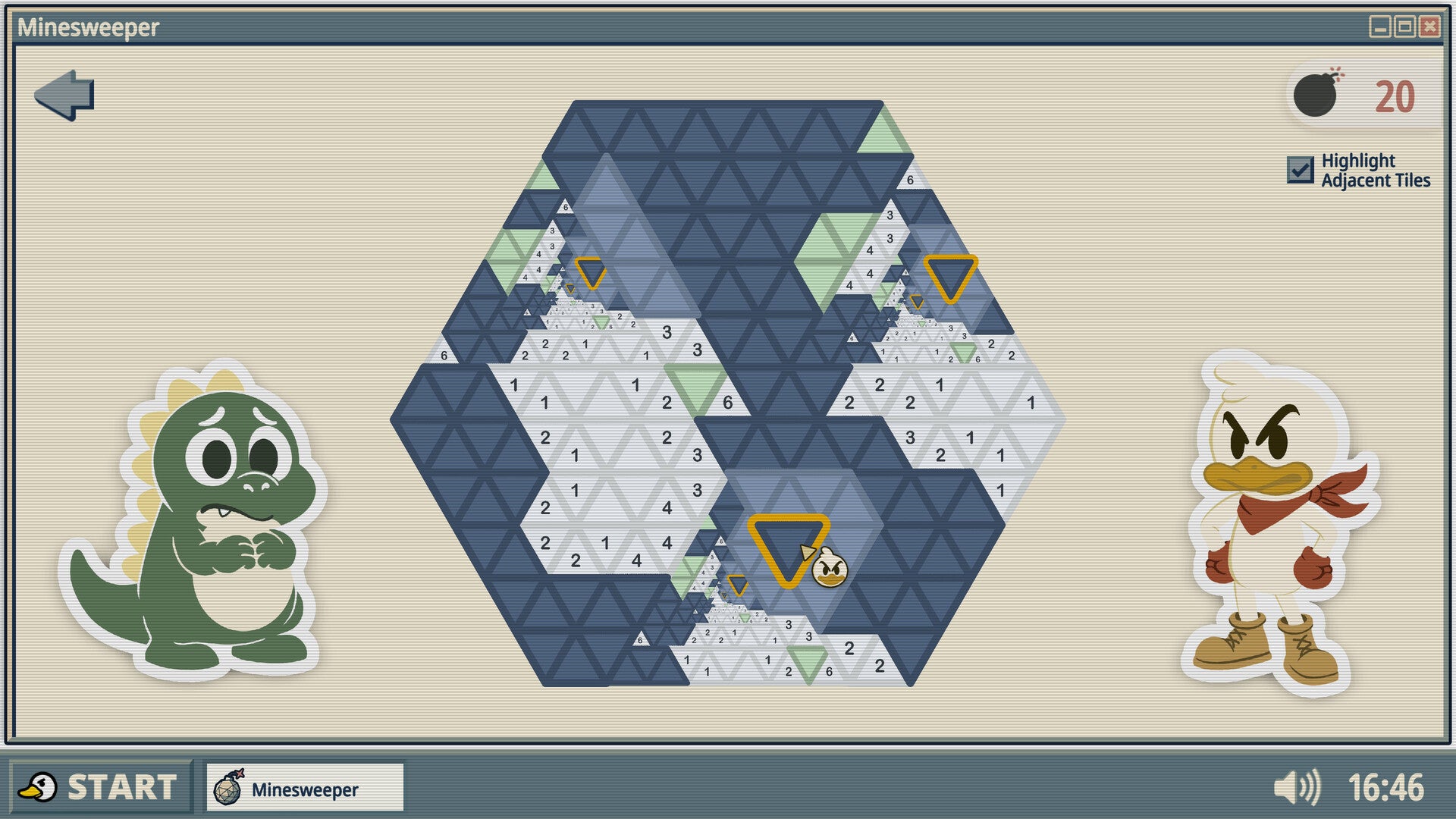
These characters do more than just populate the screen; they provide a narrative anchor to an otherwise abstract experience. As the Steam page notes, they provide hints—though their efficacy is intentionally inconsistent. This ambiguity adds a layer of "pathos" that is rarely seen in the genre. A duck wearing shoes in a dimension-folding puzzle is a surreal image that suggests a deeper, perhaps melancholic, backstory. The contrast between the "boops and pops" of the game’s soundscape and the tense, frustrated expressions of the mascots creates an atmosphere of humorous despair that resonates with the player’s own frustration when they inevitably click a mine.
Official Developer Insights
According to the development team at Astrophoros, the design philosophy behind Next-Gen was to "break the complacency" of the veteran Minesweeper player. In an era of infinite browser tabs and digital multitasking, the developers realized that the average user has developed a higher capacity for "dimension-hopping" and complex information processing.
"These two mysterious little companions will accompany you along the way," the developers stated in their official communication. "Sometimes they offer helpful hints, and sometimes… not so much. Observant players might uncover fragments of their story—though it’s not particularly important, it does add a bit of charm."
The developer’s focus on the user-generated content (UGC) aspect of the game also suggests a long-term commitment to the community. By providing an editor that allows players to customize tile colors with a brush tool and combine distinct geometric rules, the studio is effectively handing the keys of complexity to the players. This move ensures that the game’s lifespan will be dictated by the creativity of the community rather than the limits of the base campaign.
Implications for the Puzzle Genre
The release of Minesweeper: Next-Gen signifies a broader trend in the indie gaming landscape: the "remixing" of legacy titles through high-concept mechanics. As gaming audiences mature, there is a clear demand for "brain-burners"—games that offer the comfort of a familiar concept while simultaneously challenging the player’s cognitive limits.
Broader Market Impacts:
- The Rise of "Logic-Plus": We are seeing a move away from simple logic puzzles toward games that incorporate narrative, aesthetic flair, and non-traditional physics.
- UGC-First Design: The inclusion of an extensive level editor signals that developers are no longer viewing their games as "complete products" at launch, but as platforms for community-driven iteration.
- Surrealism in Puzzlers: The success of character-led logic games—like Dragonsweeper or Next-Gen—suggests that players are looking for a sense of place and personality even in games that are fundamentally about numbers and grids.
Conclusion
Minesweeper: Next-Gen is not merely an update to a 1992 classic; it is a fundamental deconstruction of how we perceive space, logic, and the relationship between the player and the grid. By embracing the chaos of recursive structures and the absurdity of its mascots, Astrophoros has breathed new life into a stale formula.
Whether you are a fan of traditional logic puzzles, a student of mathematics looking for a practical application of tessellation theory, or simply someone who enjoys the sight of a shoe-wearing duck reflecting on the futility of existence, Minesweeper: Next-Gen offers a unique experience. The full launch, expected later this year, promises to solidify its place as the definitive, albeit maddening, evolution of a gaming icon. It serves as a reminder that even the most static rules can be broken—and that sometimes, to solve the puzzle, you must be willing to lose yourself in the recursion.

 Asro
Asro
 Muslim