Sagoh
Sagoh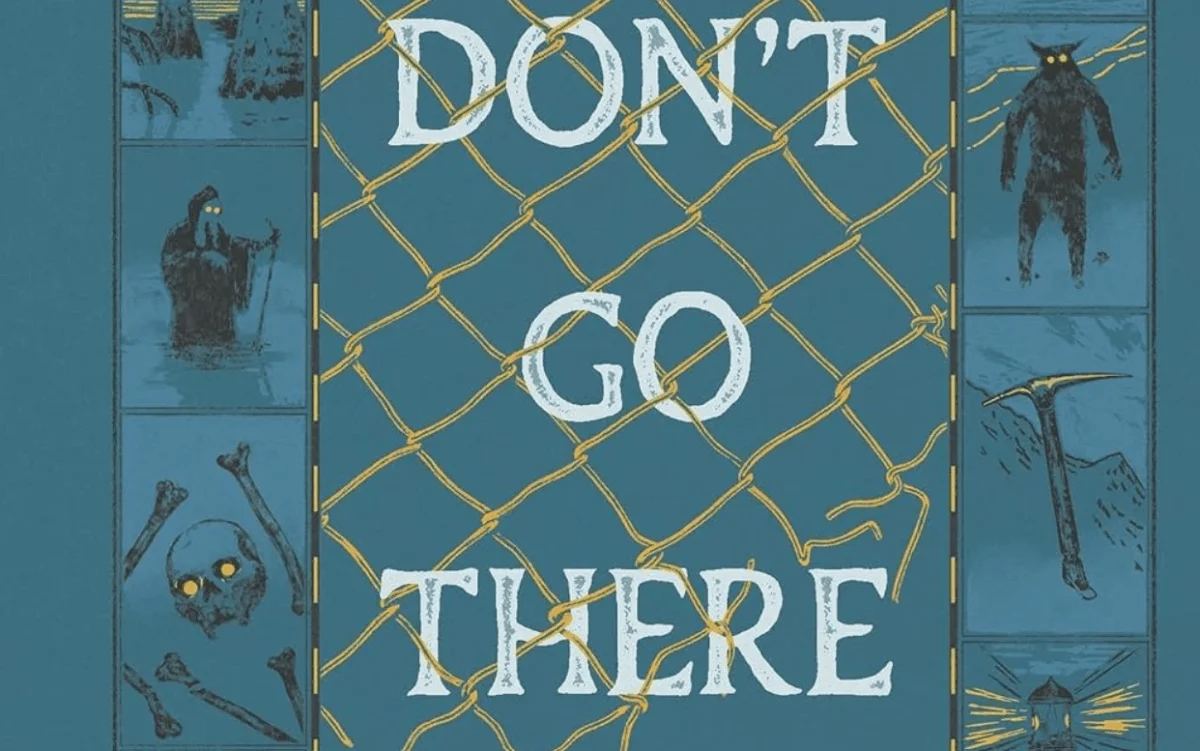
In the cartography of the 16th century, mapmakers often populated the blank, unexplored margins of the world with illustrations of ferocious sea serpents, chimeras, and winged demons. Accompanied by the Latin phrase hic sunt dracones—“here be dragons”—these warnings served as a literal demarcation of the unknown, signaling to travelers that beyond these borders, survival was not guaranteed. While modern satellite imagery and global interconnectivity have effectively erased the “blank spaces” of our planet, the psychological urge to project our deepest anxieties onto the landscape remains undiminished.
In his latest release, Don’t Go There: A Tour of the World’s Most Sinister Spots (Quirk Books, 2026), Edgar Award-winning author J.W. Ocker argues that we have not outgrown our need for monsters. Rather, we have simply refined the locations of our haunts. Ocker’s work serves as a global guidebook to the macabre, curating a list of thirty of the most perilous, cursed, or simply terrifying locations on Earth, proving that the human impulse to label the dangerous as "supernatural" is as potent today as it was in the Age of Discovery.
The Evolution of Folklore: From Cryptids to Cultural Phenomena
J.W. Ocker is no stranger to the intersection of geography and the paranormal. His career has been defined by a deep-seated fascination with the dark corners of the human experience. Following his 2024 work, Cult Following, which explored the sociological underpinnings of fringe groups, and the 2022 hit The United States of Cryptids, Ocker has shifted his scope from national borders to a global stage.
A Brief Chronology of Ocker’s Investigations
- 2020: Cursed Objects: An examination of the cultural weight placed on inanimate items, establishing Ocker’s interest in the intersection of object history and folklore.
- 2022: The United States of Cryptids: A localized study of American regional monsters, establishing the geographical framing device that would define his later work.
- 2024: Cult Following: A departure into the sociological study of human organizations, examining why people gravitate toward high-control groups.
- 2026: Don’t Go There: A synthesis of his previous interests, combining geographical history, folklore, and travelogue into a global tour of danger.
Unlike his previous titles, which often relied on a rigid academic or sociological lens, Don’t Go There is a more fluid, experiential narrative. It functions less like a scholarly thesis and more like a warning to the traveler, cataloging the world’s most dangerous locales under six evocative categories: Fearsome Forests, Wretched Waters, Insane Islands, Deadly Deserts, Risky Ruins, and Spooky Snowscapes.
Supporting Data: When Geography Meets the Macabre
The strength of Ocker’s work lies in his ability to juxtapose the truly lethal with the merely legendary. He explores sites as diverse as the New Jersey Pine Barrens—the stomping ground of the legendary Jersey Devil—and the desolate Lop Nur in Xinjiang, China. Known as the “Sea of Death,” Lop Nur was famously described by Marco Polo as an abode of demons, a reputation that has persisted through centuries of harsh climate and isolation.
Perhaps most unsettling is Ocker’s focus on locations like Roopkund, a Himalayan lake situated 16,500 feet above sea level. While the altitude and climate are lethal enough for any unprepared trekker, the site is defined by the presence of approximately 800 human skeletons. The mystery of these remains, far from being the product of a spectral entity, is a biological and historical puzzle that underscores the reality of death in high-altitude wilderness.

Case Study: The Reality of Risk
Ocker provides a compelling deconstruction of the supernatural by highlighting the mundane dangers that often birth folklore. Take, for instance, Canada’s Nahanni National Park. A UNESCO Natural World Heritage site, it has been associated with a string of gruesome deaths since 1908, often involving headless remains. While amateur cryptozoologists frequently point to a “head-hunting Sasquatch” as the culprit, Ocker points to the harsh reality of the landscape: 12,000 square miles of uncharted wilderness, treacherous rapids, and sheer cliffs. The “monster” is, in this case, the environment itself.
Official Responses and Skeptical Analysis
One of the most refreshing aspects of Don’t Go There is Ocker’s refusal to lean into credulity. He does not demand that his readers believe in skinwalkers or UFOs. Instead, he treats these claims as part of the cultural fabric of a location.
A prime example is his treatment of Skinwalker Ranch in Utah. Now a fixture of the History Channel’s paranormal investigative series, the ranch has become a nexus for theories ranging from interdimensional portals to extraterrestrial visitations. Ocker provides a meticulous account of these claims but concludes with a sharp, journalistic critique: the ranch is perhaps the most monitored piece of real estate in the paranormal community, yet after decades of high-budget research, the evidence remains nonexistent.
This skepticism extends to the tragic Dyatlov Pass incident of 1959. By analyzing the nine skiers who died in the Ural Mountains, Ocker highlights how the natural dangers—extreme wind, avalanches, and sub-zero temperatures—are more than sufficient to explain the loss of life. He suggests that the imposition of a Yeti or a UFO is a human coping mechanism: we prefer a “murderous monster” to the cold, random indifference of nature.
The Sociological Implications of “Haunted” Geography
Why do we insist on mythologizing tragedy? Ocker’s analysis of the Chernobyl exclusion zone offers a profound answer. Since the 1986 disaster, the area has not only been a site of literal radiation and environmental collapse but has also become a fertile ground for folklore. The “Black Bird of Chernobyl”—a cryptid popularized by film and urban legend—has moved from a screen invention into the collective consciousness of those who study the zone.
Ocker posits that humans are biologically wired to fill vacuums of information. When a place is defined by “mystery, sickness, and death,” our brains struggle to process the scale of the tragedy. By creating a narrative—a ghost, a monster, or a curse—we humanize the catastrophe. We turn a place of cold, chemical destruction into a place of story.

The Modern "Hic Sunt Dracones"
Ultimately, Don’t Go There is not just a book about scary places; it is a book about the human desire to make the world seem larger and more mysterious than it actually is. In an age of GPS and instant global communication, we are terrified of a world that is fully mapped and entirely understood.
When we label a site as "haunted" or "cursed," we are effectively placing a plaque on the map that reads hic sunt dracones. We are reclaiming the unknown. We are saying that despite our technology and our scientific advancements, there are still corners of the earth that belong to the imagination.
Ocker’s work serves as a reminder that folklore is not a relic of the past; it is a living, breathing component of our relationship with the environment. Whether it is the radioactive ruins of Ukraine, the bone-chilling cold of the Himalayas, or the mysterious silence of the Utah desert, we will continue to populate these spaces with our fears. We do this not because we truly believe in dragons, but because, in a world that is increasingly transparent, we find comfort in the idea that there is still something left to hide.
Don’t Go There: A Tour of the World’s Most Sinister Spots is an essential read for anyone interested in the geography of the paranormal, offering a balanced, witty, and deeply researched look at why, even in 2026, we still love to be afraid of the map.


 Ammar Sabilarrohman
 Nila Kartika Wati