In an era where speculative fiction is increasingly tasked with mapping the emotional contours of an expanding universe, writer and artist Jenna Hanchey has unveiled a profound new work that blends the celestial with the intimate. Published recently in Strange Horizons, Hanchey’s latest piece is a visual poem that functions as both a meditation on spatial physics and a lament for the endurance of human connection across the light-years.
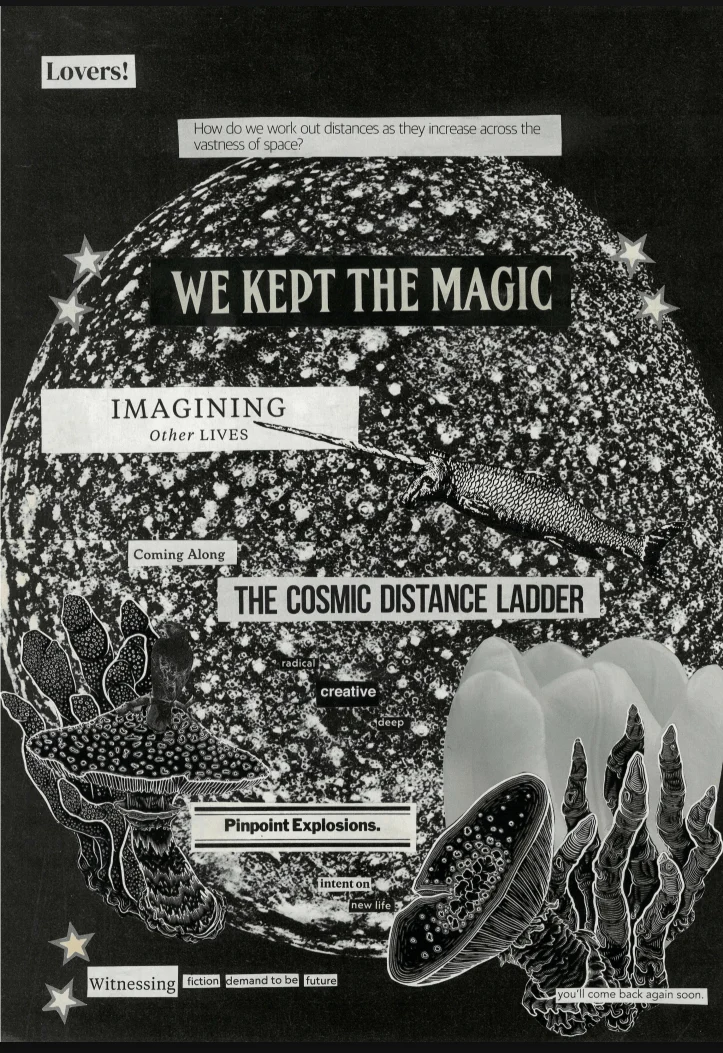
By juxtaposing the cold, cratered surface of Callisto—Jupiter’s second-largest moon—with a collage of organic imagery including mushrooms, white tulips, and a narwhal, Hanchey forces the reader to confront the "cosmic distance ladder." The work suggests that while science may quantify the vastness of space, it is the human capacity for imagination that bridges the gap.
The Intersection of Astrophysics and Intimacy
At its core, Hanchey’s poem asks a singular, haunting question: "How do we work out distances as they increase across the vastness of space?" It is a question that mirrors the modern scientific struggle to measure the expanding universe, yet Hanchey reframes it as a problem of the heart.
The poem utilizes a visual collage aesthetic, layering text over a mosaic of Callisto’s surface. This serves as a stark reminder of the harsh, alien environments we are currently exploring as a species. By punctuating this lunar landscape with terrestrial, biological markers—a crow, a white tulip, and even the fantastical figure of a narwhal—Hanchey argues for the necessity of retaining "magic" amidst the clinical precision of orbital mechanics.
"We kept the magic," the poem declares, positioning imagination as a necessary tool for survival in the deep-space future. It suggests that if we are to traverse the stars, we must carry our earthly intimacies with us, transforming "fiction" into the "future."
Chronology of the Work and Its Genesis
The publication of this piece is not an isolated event but rather the latest milestone in a prolific period for Hanchey. To understand the gravity of this work, one must look at the timeline of its development and the support structures that enabled its existence:
- June 2026: Hanchey completes the visual composition of the poem, finalizing the synthesis of the Callisto mosaic and the accompanying illustrative elements.
- Late June 2026: The poem undergoes the final editorial review process at Strange Horizons, a leading venue for speculative poetry and fiction.
- June 30, 2026: The digital assets and text-only formatting are prepared for publication, coinciding with the project’s sponsorship through the Strange Horizons annual fundraiser.
- July 2026: The poem is officially released to the public, drawing immediate attention for its unique hybrid format—part digital art installation, part lyrical verse.
The project was made possible, in part, by a generous contribution from reader and patron Zac Wood. This collaborative model of patronage highlights the evolving relationship between independent digital literary magazines and their audiences, ensuring that experimental art forms find a home despite the pressures of commercial media.
Supporting Data: The Science Behind the Poetry
Hanchey’s work references the "cosmic distance ladder," a term in astrophysics referring to the succession of methods by which astronomers determine the distances to celestial objects. From the parallax of nearby stars to the redshift of distant galaxies, this ladder is the fundamental framework of our understanding of the universe’s scale.
However, Hanchey’s application of this data is metaphorical. She juxtaposes the "pinpoint explosions" of stars—the supernovae that help astronomers calculate distance—with the "new life" of human imagination.
By grounding the poem in Callisto—a moon often cited by astrobiologists as a potential, albeit challenging, site for future human exploration due to its subsurface ocean—Hanchey taps into the current zeitgeist of space expansionism. Data from the Galileo and Juno missions have provided the high-resolution imagery seen in the poem’s background, grounding the emotional narrative in the reality of our solar system’s physical topography.

Official Context: The Voice of the Creator
Jenna Hanchey is no stranger to the intersection of speculative art and sociopolitical critique. As a land-based mermaid—a moniker she adopts to signify her connection to both the earth and the fluid, liminal spaces of the imagination—Hanchey’s work often explores themes of grief, liberation, and hope.
In an official statement regarding her recent work, Hanchey emphasized the importance of centering "intimacies" in science fiction. Her upcoming book, Decolonial Dreamwork: Africanfuturism and Imagination Beyond Development, scheduled for release by Ohio State University Press in February 2027, promises to further explore these themes.
"My work seeks to listen to what the birds carry on the wind," Hanchey noted in a recent interview. "In a time where technology often threatens to dehumanize our experiences, we must look to the intersection of poetry and scientific data to remember why we reach for the stars in the first place."
Implications for the Future of Speculative Literature
The reception of Hanchey’s poem highlights a growing trend in contemporary literature: the move away from pure prose toward multi-modal storytelling. By integrating visual collage with verse, Hanchey challenges the boundaries of what constitutes a "text."
1. The Digitization of Poetics
The use of digital formatting, including high-resolution imagery and accessibility-focused text-only versions, reflects a shift in how literary magazines are adapting to the internet age. The poem is not meant to be read on a printed page; it is meant to be experienced as a screen-based artifact, mirroring the digital nature of the space exploration it references.
2. A Call for "Hope-Based" Futurism
At a time when much of science fiction leans into dystopian narratives, Hanchey’s poem is a deliberate pivot toward "hope." By framing the vastness of space as an opportunity for "other lives" and "creative" expansion, she joins a cohort of writers who are redefining the genre to focus on restorative futures rather than apocalyptic endings.
3. The Role of Independent Patronage
The note regarding the fundraiser contribution by Zac Wood underscores the fragility and necessity of independent literary platforms. Without such contributions, experimental works that blend art, poetry, and astrophysics might be sidelined in favor of more traditional, easily monetized content. This model suggests that the future of niche, high-concept literature lies in direct community support.
Conclusion: A Witness to Fiction
Jenna Hanchey’s latest work serves as a reminder that science and poetry are not disparate fields. As we continue to launch probes into the dark, cold corners of the solar system, we must ensure that our cultural output keeps pace with our technological reach.
"Witnessing fiction demand to be future," as Hanchey writes, is the quintessential act of the modern dreamer. Whether we are staring at the craters of Callisto through a telescope or reading a poem on a screen, the goal remains the same: to find the "other lives" that might be waiting for us, and to recognize that the vastness of space is not a void, but a canvas for our deepest human longings.
As we look toward the 2027 publication of her forthcoming book, it is clear that Hanchey will continue to be a leading voice in the movement to humanize the cosmos, one verse—and one star—at a time.