

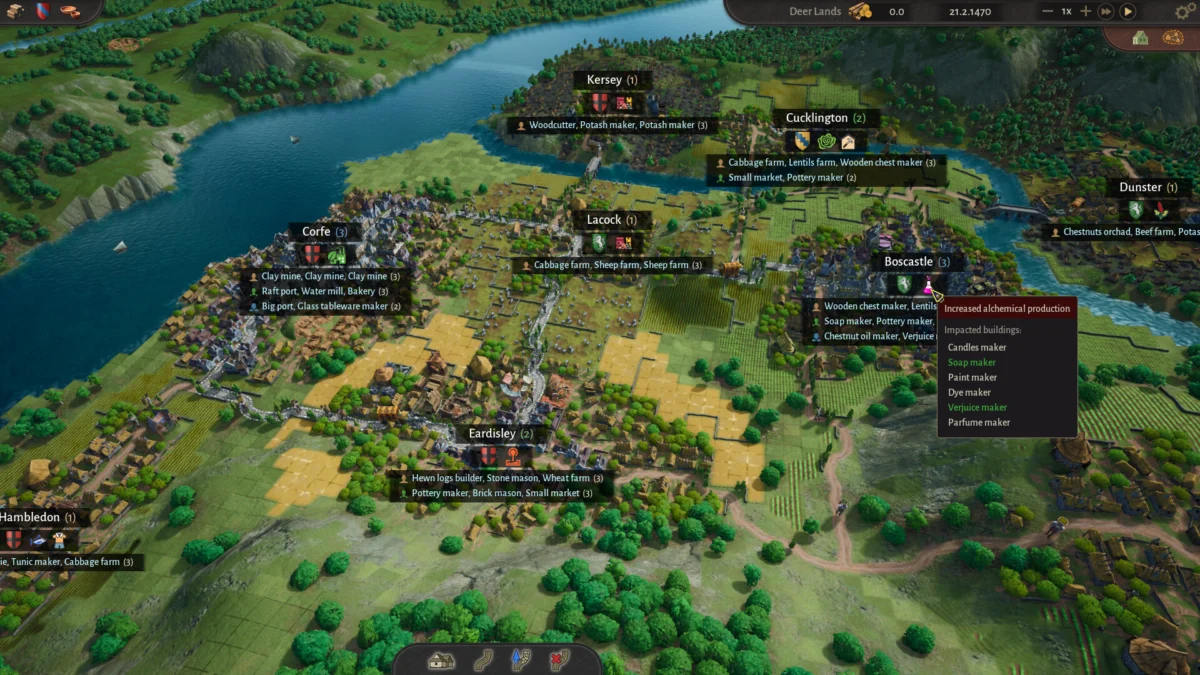
The landscape of medieval city-builders is about to undergo a significant shift. Nepos Games, the creative force behind the critically acclaimed Nebuchadnezzar, has officially pulled back the curtain on their most ambitious project to date: County of Fortune. Moving beyond the constraints of a single city-center simulation, this upcoming title promises to offer a macro-level approach to regional management, tasking players with the creation, connection, and cultivation of an entire medieval county.
The announcement, which confirms that Aquila Interactive will serve as the game’s publisher, has already generated significant buzz among strategy enthusiasts. Slated for a Windows PC release via Steam later this year, County of Fortune represents a fundamental evolution in how we conceive of medieval simulation games.
The Vision: Moving Beyond the Single Settlement
Most city-builders suffer from the "gilded cage" syndrome—the player is confined to a singular map, focusing on the minute placement of houses and wells. County of Fortune seeks to shatter these walls. According to the development team at Nepos Games, the player is cast in the role of a "lokator"—a historical term for a medieval colonizer and noble steward. Your task is not to manage a single village, but to oversee a vast, blank stretch of untamed wilderness and transform it into a thriving, interconnected region.
"You are not zooming into a single town; you are zooming out to see a whole county come to life," the developers stated in their official manifesto. This shift in perspective is the core philosophy of the game. By placing multiple settlements across a vast grid, players must contend with the macro-geography of the land. Rivers, mountain passes, and fertile plains dictate the success of your project, turning the map itself into the primary strategist.
Chronology of Development and Announcement
The path to County of Fortune began in the wake of the success of Nebuchadnezzar, a game that proved Nepos Games’ ability to handle complex economic systems and historical aesthetics.
- Initial Concept Phase: Following the post-launch support for Nebuchadnezzar, the team at Nepos Games sought to tackle the limitations of traditional city-building. The conceptual focus shifted toward "regionalism" and the interaction between independent settlements.
- The Partnership: In early 2026, Nepos Games finalized a publishing agreement with Aquila Interactive. This partnership was deemed crucial for the marketing and distribution of the title, allowing the developers to focus exclusively on the complex mechanics of their ambitious vision.
- The Reveal: In May 2026, the first official trailer and store page for County of Fortune were launched, providing the public with their first look at the gameplay loop—a blend of macro-management and intimate settlement design.
- Projected Launch: While a specific date has yet to be finalized, the developer has confirmed a release window for later in 2026, with the title currently available for wishlisting on Steam.
Supporting Data: The Mechanics of Regional Prosperity
The "heart" of County of Fortune lies in its layered approach to simulation. Unlike games where every building is micromanaged by the player, this title introduces a delegation system that mirrors the feudal structures of the medieval era.
The Geography of Success
In County of Fortune, location is paramount. The game engine treats the map as a living organism where resources are finite and positioning determines growth. For instance, placing a salt-works near a mountain pass will naturally attract trade and wealth, whereas building an urban center far from a water source will result in stagnation and hardship. The game forces the player to consider the "flow" of goods across the entire region, turning the map into a strategic puzzle.
A Layered Economic Model
The economy in County of Fortune is wide and deliberate. Players do not obsess over individual market stalls; instead, they act as regional architects, tuning trade routes, setting resource allocations, and watching the economy "breathe." This high-level management allows for a "patchwork" style of development, where one village might focus on agriculture, another on mining, and a third on trade, all feeding into a central hub.
The Human Element: Mayors, Houses, and Cultures
A county is more than just ledgers and roads. Nepos Games has introduced three layers of social dynamics that promise to keep the gameplay fresh across multiple playthroughs:

- Named Mayors: Every settlement is governed by an AI-driven mayor with unique traits and goals.
- Noble Houses: Rival houses compete for influence, adding a political layer to the expansion process. Your choices—which families you empower and which you alienate—will directly impact the stability of your county.
- Migrating Cultures: The game features dynamic cultural shifts. Migrating groups may bring prosperity to some villages while simultaneously complicating the social fabric of others, requiring the player to act as a diplomat and steward.
Official Responses and Developer Philosophy
Nepos Games has been clear that this game is a "builder for players who came for the city-building." In a market saturated with "survival" or "combat-heavy" strategy games, County of Fortune is doubling down on the satisfaction of creation.
"We wanted to build something that feels like an achievement," says the lead developer. "When you look at your county after ten hours of play, you shouldn’t see a single city you’ve perfected. You should see a region that you’ve nurtured into existence. The satisfaction comes from the connectivity—the road that connects the farm to the mill, the bridge that connects the village to the trade route."
Aquila Interactive, the publisher, has expressed strong confidence in the project. Their involvement signals a push to ensure the game reaches a broad audience of simulation enthusiasts, with a focus on deep, replayable mechanics that reward experimentation.
Implications for the Strategy Genre
The announcement of County of Fortune marks a significant trend in the strategy genre: the move toward "macro-simulation." As players grow tired of repetitive, micro-heavy city-builders, titles that offer a "god-like" view of regional development are seeing increased demand.
The "Regionalist" Evolution
By emphasizing the interdependence of towns, County of Fortune creates a higher stakes environment. If one town fails, it creates a ripple effect that touches the entire county. This creates a narrative of success and failure that feels more organic and less like a "game over" screen in a traditional simulation.
The Replayability Factor
Because of the interplay between the three layers of power—Mayors, Houses, and Cultures—no two counties will look the same. One player might focus on building a unified, prosperous heartland under a single, dominant noble house. Another might foster a chaotic, competitive patchwork of rival villages that trade with each other only out of necessity. This degree of emergent gameplay is likely to foster a strong community of players sharing their unique regional designs.
Future Outlook
As we look toward the latter half of 2026, the industry will be watching to see how Nepos Games balances these complex systems. The challenge will be ensuring that the game remains accessible while providing the depth that strategy veterans crave. If successful, County of Fortune could well become the new benchmark for regional management games, proving that the scale of a project is limited only by the player’s ambition and the developer’s vision.
For those eager to take up the mantle of a "lokator," the journey begins with the map. As the developers remind us: "You are a noble steward… given a blank stretch of kingdom to turn into a living county." It is a call to create, to connect, and to thrive in a world where every road you pave and every mayor you appoint tells a story of your own making.












No comments yet. Be the first to join the conversation!