

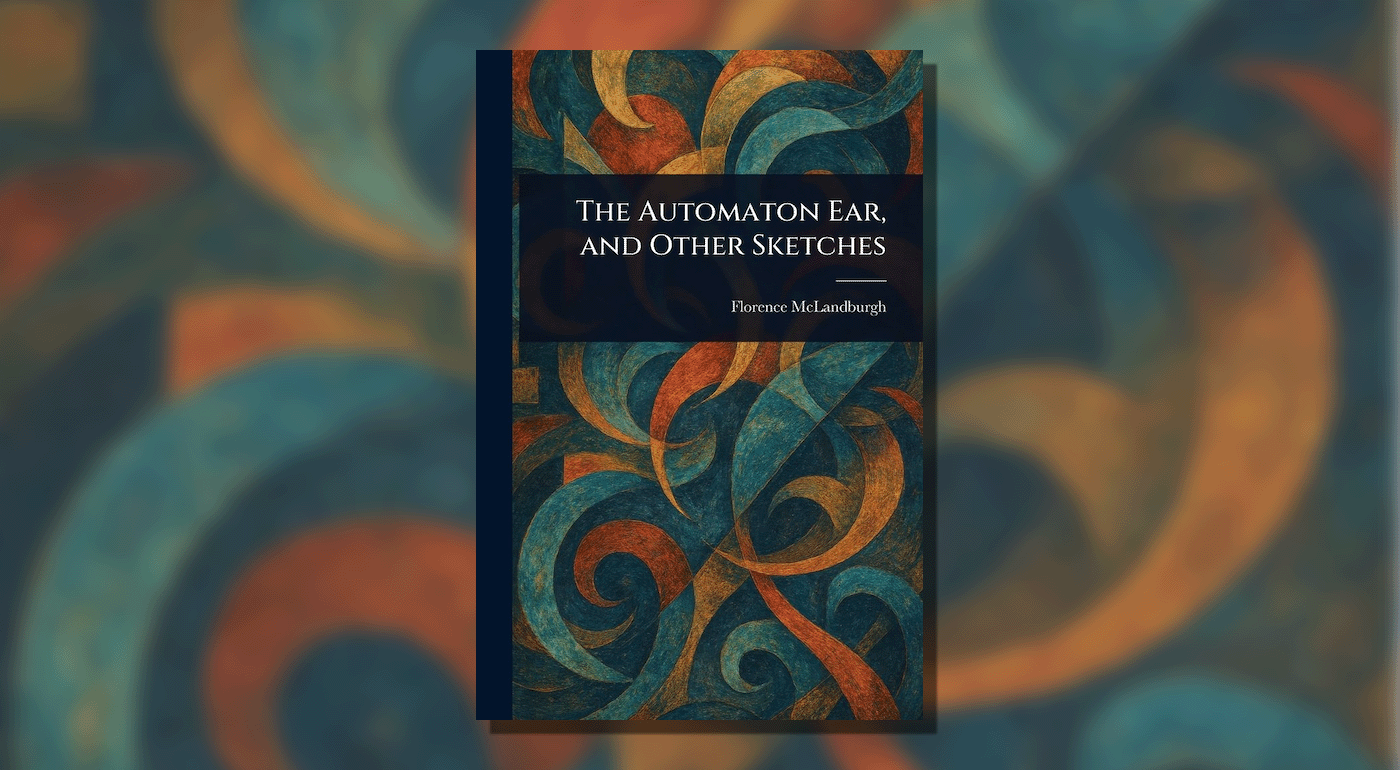
In the annals of 19th-century speculative fiction, few works capture the intersection of Victorian scientific obsession and existential dread as sharply as Florence McLandburgh’s 1873 short story, The Automaton Ear. First published in Scribner’s Monthly, the narrative serves as a seminal exploration of "Acoustic Time Travel"—a concept that predates modern concerns about digital permanence and the intrusive nature of historical surveillance. As we revisit this classic of cosmic horror, we find that its themes of monomania, the burden of history, and the fragility of the human psyche remain as relevant today as they were during the height of the Industrial Revolution.
The Genesis of an Obsession: Main Facts
The story follows an unnamed professor—colloquially referred to as "ProfX"—a scholar at a college near London who undergoes a rapid psychological decline after encountering a specific philosophical premise: that sound, once created, is never truly lost. It merely dissipates into the atmosphere, waiting to be reclaimed by a sufficiently sensitive instrument.
Inspired by a passage that posits, “A strain of music or a simple tone will vibrate in the air forever and ever,” the professor retreats from his academic duties. He locks himself within an abandoned church tower, converting the space into a laboratory for the construction of an "Automaton Ear." His objective is to build a device capable of magnifying these "ancient" vibrations. As he succeeds, he transitions from a man of science to a prisoner of history, gaining the ability to overhear everything from the flight of the Israelites to the private, mundane conversations of long-dead individuals. The narrative chronicles his subsequent descent into paranoia, social alienation, and, ultimately, a violent, hallucinated confrontation with a deaf-and-mute woman named Mother Flinse.
A Chronology of Scientific Descent
The trajectory of ProfX’s obsession is marked by distinct phases of psychological erosion:
- The Catalyst: While reading in a woodland, the professor encounters the theory of permanent sound. He perceives a connection between his own sensory sensitivity and the untapped "library" of the atmosphere.
- The Incubation: During a summer break, he begins his research. He experiments with an ear-trumpet, initially finding that his modifications actually dampen sound rather than amplify it.
- The Breakthrough: In the seclusion of an abandoned church, he achieves a configuration that allows him to tune into specific temporal frequencies. He effectively begins "listening" to the past.
- The Pathological Phase: The professor abandons his social life, becoming a recluse. His health deteriorates as he prioritizes the "Ear" over sustenance and sleep. Paranoia sets in; he fears that others will steal his discovery or that his own mind is failing.
- The Climax: In a desperate attempt to validate the reality of his invention, he lures Mother Flinse to his laboratory. He perceives her reaction to the sound as a miracle, but when she refuses to relinquish the device, he murders her in a fit of rage.
- The Resolution: The professor believes he is being haunted by the shrieks of his victim, only to discover they were the sounds of a trapped beetle. Following this, he experiences a sudden "awakening," where his delusions vanish, and he finds the church tower in a state of long-term abandonment, suggesting the "Ear" and the murder were entirely internal constructs.
Supporting Data: The Science of Eternal Echoes
The scientific foundation of McLandburgh’s story is rooted in the intellectual climate of the 19th century. The "fateful paragraph" that triggers the professor’s madness is a direct allusion to Charles Babbage’s The Ninth Bridgewater Treatise (1837). Babbage, a mathematician and computer pioneer, famously argued that the air acts as a "vast library," recording every word ever spoken.
This concept, while scientifically disproven by modern thermodynamics—which dictates that organized acoustic energy inevitably degrades into random thermal motion—held significant weight in Victorian intellectual circles. Hermann von Helmholtz, whose 1862 work On the Sensations of Tone is likely among the texts in the professor’s laboratory, provided the framework for understanding human auditory limitations. McLandburgh expertly weaves these real-world academic interests into the fabric of a horror narrative, grounding the professor’s "madness" in the very real, albeit misguided, scientific fervor of the era.
Furthermore, the story echoes the apocryphal legend surrounding Guglielmo Marconi. It is said that in his later years, the father of radio technology became obsessed with the idea that sound waves could be retrieved from the ether, dreaming of building a device to capture the Sermon on the Mount. This cross-pollination between fiction and the historical reality of scientific figures highlights a universal human anxiety: the desire to outlast the "dust-to-dust" cycle of mortality.
Official Responses and Literary Analysis
Literary critics and historians of the "Weird" have long debated the ending of The Automaton Ear. The abrupt reveal that the professor’s experience was a manifestation of bipolar disorder with systematized delusions serves as a double-edged sword. While some readers find the "it was all a dream" trope reductive, others argue that it serves as a scathing critique of the detached intellectual.
Anne, a contributor to the Reading the Weird project, notes that the story is a precursor to modern "algorithmic horror." By controlling the feed of information—in this case, the infinite history of human sound—the professor loses the ability to engage with the present. The "Ear" acts as a metaphor for the way we currently curate our digital realities, often at the expense of our physical environment and personal health.
Ruthanna, in her subsequent commentary, emphasizes the ableist nature of the professor’s "experiment" with Mother Flinse. The professor views the woman not as a person, but as a test subject for his ego. Her delight at the device is portrayed as genuine, which adds a layer of tragedy to the professor’s later claim that he never truly built the machine. If the machine didn’t exist, how can we explain the professor’s detailed description of her reaction? This lingering ambiguity suggests that McLandburgh may have intended for the reader to question the narrator’s reliability until the final, haunting sentence.
Implications: The Horror of Inaccessibility
The story’s true horror lies in the professor’s transformation from an academic to a monopolist of human history. The desire to own the past—to be the sole listener of the songs of the dead—reflects a dark side of the human condition. When one has access to the "best" of human history, the present becomes unbearable.
As modern readers, we live in an era where we can access a 40-part choral performance of Spem In Alium with a single tap of a screen. We have essentially built the "Automaton Ear" that the professor dreamed of, yet we are not necessarily happier or more enlightened. The implications of McLandburgh’s work extend into our digital age:
- Attention Depletion: Much like the professor, we are often so distracted by the vast, historical, and global streams of information available to us that we ignore the immediate reality of our surroundings.
- The Illusion of Control: The professor’s belief that he could "manage" the infinite echoes of the past mirrors the modern struggle to manage our digital footprints and the overwhelming influx of information.
- The Loss of Shared Reality: The professor’s isolation was born from his inability to share his "discovery." As we retreat into personalized digital echo chambers, we risk a similar, albeit less violent, form of social alienation.
Conclusion: A Lingering Resonance
Florence McLandburgh’s The Automaton Ear remains a foundational text for a reason. It captures the exact moment when human ambition reaches for the divine, only to collapse under the weight of its own isolation. Whether we view the professor as a man who truly touched the infinite or simply as a victim of his own mind, the story forces us to confront our own relationship with the past.
As the professor concludes his narrative with a prayer of gratitude, comparing his silent praise to the "song of Miriam by the sea," we are left to wonder: did he truly pass through the black waves of insanity, or is he still listening, tucked away in the forgotten corners of a tower that, in his mind, still echoes with the voices of a thousand years? In a world saturated with sound and digital artifacts, perhaps we are all, in our own way, pressing an ear against the cold metal of our devices, listening for something that was never meant to be heard again.












No comments yet. Be the first to join the conversation!