Nana Muazin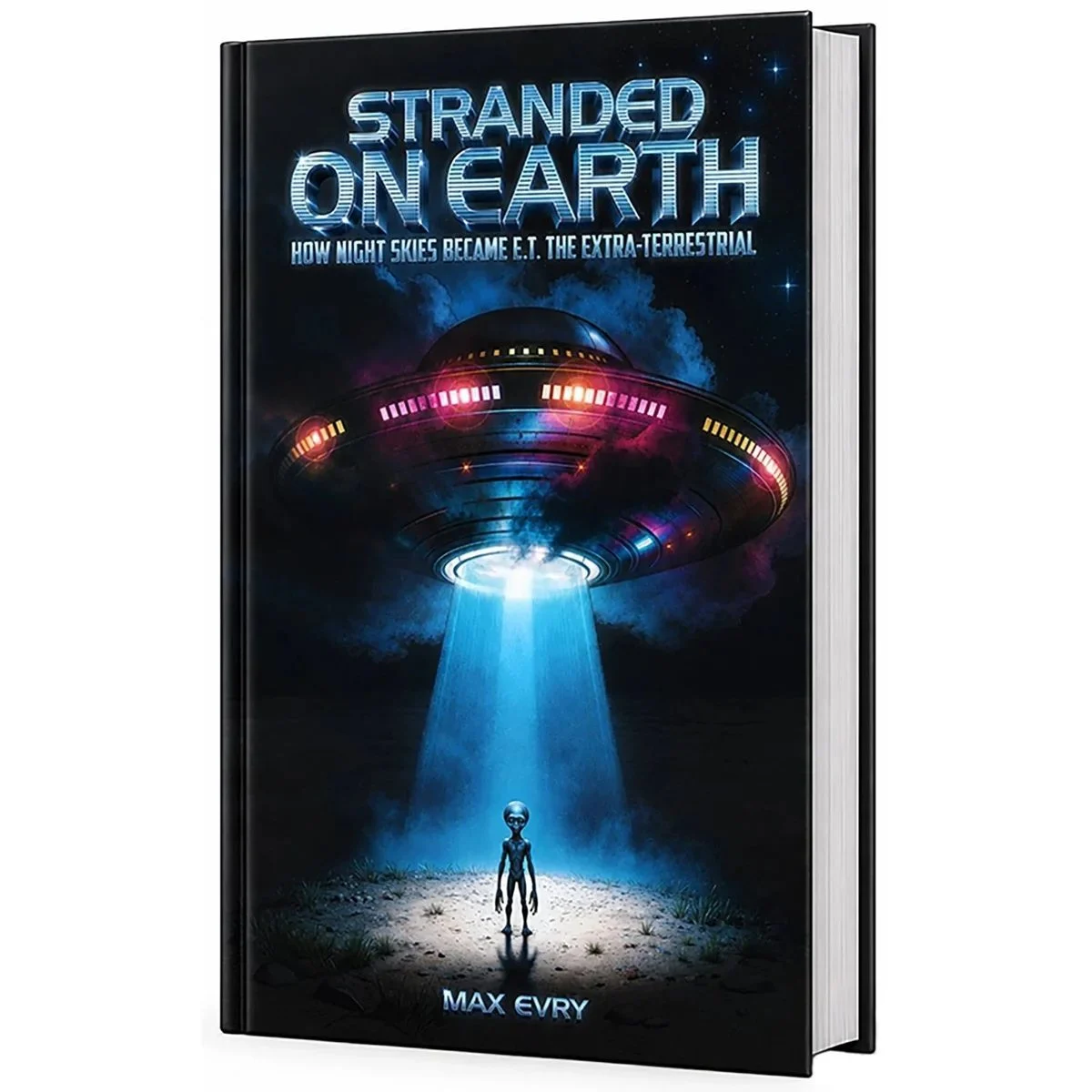
Steven Spielberg has long been the architect of our collective imagination regarding the stars. From the symphonic, awe-inspiring arrival of the mothership in Close Encounters of the Third Kind to the upcoming multimedia project Disclosure Day, Spielberg’s career is a persistent dialogue with the unknown. However, the path to his most iconic masterpiece, E.T.: The Extra-Terrestrial, was not a straight line of inspiration. It was a chaotic, often terrifying journey that began in the dark corners of a project that was never meant to be heartwarming: Night Skies.
In his new investigative chronicle, Stranded on Earth: How Night Skies Became E.T. the Extra-Terrestrial, author Max Evry pulls back the curtain on this transformative era of cinema. Evry, who previously dissected the fractured production of David Lynch’s Dune, offers a deep dive into the creative alchemy that turned a visceral, sci-fi horror nightmare into a story that defined childhood for generations.
The Main Facts: A Pivot of Epic Proportions
The central thesis of Stranded on Earth is that the cinematic landscape of the 1980s would look fundamentally different if not for the "creative chaos" surrounding Night Skies. Initially conceived as a follow-up to the success of Close Encounters of the Third Kind, Night Skies was intended to be a gritty, horror-leaning exploration of alien abduction. It was to feature malevolent entities, a darker tone, and a focus on the fear inherent in an extraterrestrial encounter.
The production was plagued by shifting studio politics, abandoned concepts, and radical rewrites. Yet, through the fog of these complications, a seed of empathy emerged. Spielberg, perhaps seeking to reconcile the terror of the unknown with a desire for connection, began to strip away the malice, eventually arriving at the story of a stranded botanist from another world. This book serves as both a historical record and a forensic examination of that pivot, utilizing new interviews with Spielberg’s original collaborators to chart how the horrific became the heroic.
A Chronology of Contact: From Firelight to E.T.
To understand the magnitude of this transition, one must look at the timeline of Spielberg’s obsession.

The Early Days: Firelight (1964)
Long before Hollywood took notice, a teenage Spielberg was already obsessed with the cosmos. His amateur feature, Firelight, laid the groundwork for his future career, establishing the visual vocabulary he would later perfect. This early interest was not merely a hobby; it was the genesis of a lifelong fascination with UFOs and the psychological impact of being visited by the "other."
The Close Encounters Era (1977)
The monumental success of Close Encounters of the Third Kind turned Spielberg into a cultural titan. It shifted the global perception of UFOs from the fringe of tabloid journalism to the center of high-concept science fiction. It was during this period of professional invincibility that the concept for Night Skies began to take root.
The Night Skies Crucible (1979–1981)
As production meetings began, Night Skies was slated to be a dark, suspense-filled thriller. The script focused on a family terrorized by extraterrestrials, featuring creature designs that leaned toward the grotesque rather than the sympathetic. However, as Spielberg wrestled with the narrative, the script began to bleed into other projects.
The Birth of the Extra-Terrestrial (1982)
The pivot occurred when the thematic weight of the project shifted. The horror elements were excised, the "scary" alien was replaced by a gentle, glowing visitor, and the focus shifted from abduction to friendship. In 1982, E.T. was released, shattering box office records and securing its place in the pantheon of classic cinema.
Supporting Data: The Interconnected Universe of Spielberg
One of the most fascinating aspects of Evry’s research is how the discarded elements of Night Skies did not disappear; they migrated. The book details how the DNA of this unmade horror film can be found in two other seminal projects of the era: Poltergeist and Gremlins.
Poltergeist and the Neighborhood of Nightmares
Released in the same year as E.T., Poltergeist captured the suburban dread that was originally intended for Night Skies. Both films were shot in similar environments, utilizing the American suburban landscape as a canvas for the supernatural. Evry’s research highlights the proximity of these productions, suggesting that the "horror" side of the Night Skies coin found a home in the Tobe Hooper-directed, Spielberg-produced Poltergeist.
Gremlins and the Dual Nature of the Visitor
Similarly, the concept of a creature—or creatures—entering a domestic space was central to Gremlins. While E.T. gave us the benevolent, single visitor, Gremlins allowed Spielberg to explore the chaotic, malicious side of the "unearthly" entity that was originally baked into the Night Skies pitch. These films represent the two halves of a fractured creative vision, demonstrating how one ambitious project split into several distinct cinematic voices.
Official Responses and Insights
In the official synopsis of Stranded on Earth, Max Evry notes: "For years, Night Skies has been an asterisk in the shadow of that era’s most popular movie. The story of this unmade project is just as fascinating as how E.T. itself came to be."
Evry’s approach is not to merely list facts but to reconstruct the tension of the writer’s room and the pressure of the studio boardroom. Through the "creative chaos" he describes, we get a glimpse of a filmmaker working at the peak of his power. The interviews included in the book provide a rare, unfiltered look at the collaborative process. By speaking with the artisans, writers, and producers who stood in the room when the decisions were made, Evry provides a level of depth that elevates the book beyond a standard "making-of" memoir.
Implications: The Legacy of the Unmade
The story of Night Skies offers profound implications for our understanding of the creative process. It serves as a reminder that "failure" or "abandonment" in Hollywood is rarely the end of an idea; it is often the fermentation process required for a better idea to bloom.

If Night Skies had been produced as originally intended, the 1980s might have been defined by a darker, more cynical brand of science fiction. Instead, the evolution into E.T. helped define a decade of optimism, heart, and the belief that even the most terrifying "other" could, with the right perspective, become a friend.
Furthermore, the book highlights the fragility of art. A few executive decisions, a change in a director’s mood, or a shift in the cultural zeitgeist could have easily erased the magic that millions of people feel when they see the iconic finger-touch of E.T. The fact that we have the final version of that film is a testament to the turbulent, unpredictable, and ultimately brilliant way that Steven Spielberg processes his ideas.
Conclusion
For those who view film history as a series of deliberate, masterfully planned steps, Stranded on Earth provides a necessary and exhilarating corrective. It shows us the messy, unpolished reality of artistic creation. It is a story of how a master of suspense found the courage to embrace sincerity, and how the shadows of an abandoned horror movie eventually gave birth to the brightest star in the cinematic firmament.
As we look forward to new projects like Disclosure Day, it is essential to remember where the journey began. Stranded on Earth is not just a book about an unmade movie; it is an essential guide to the mind of the man who taught us to look at the night sky and wonder what, or who, might be looking back.
Stranded on Earth: How Night Skies Became E.T. the Extra-Terrestrial is published by 1984 Publishing and will be available in bookstores and online retailers this October. For any student of film, history, or the intersection of fear and wonder, it is an indispensable addition to the library.

 Siti Muinah
 Azzam Bilal Chamdy