

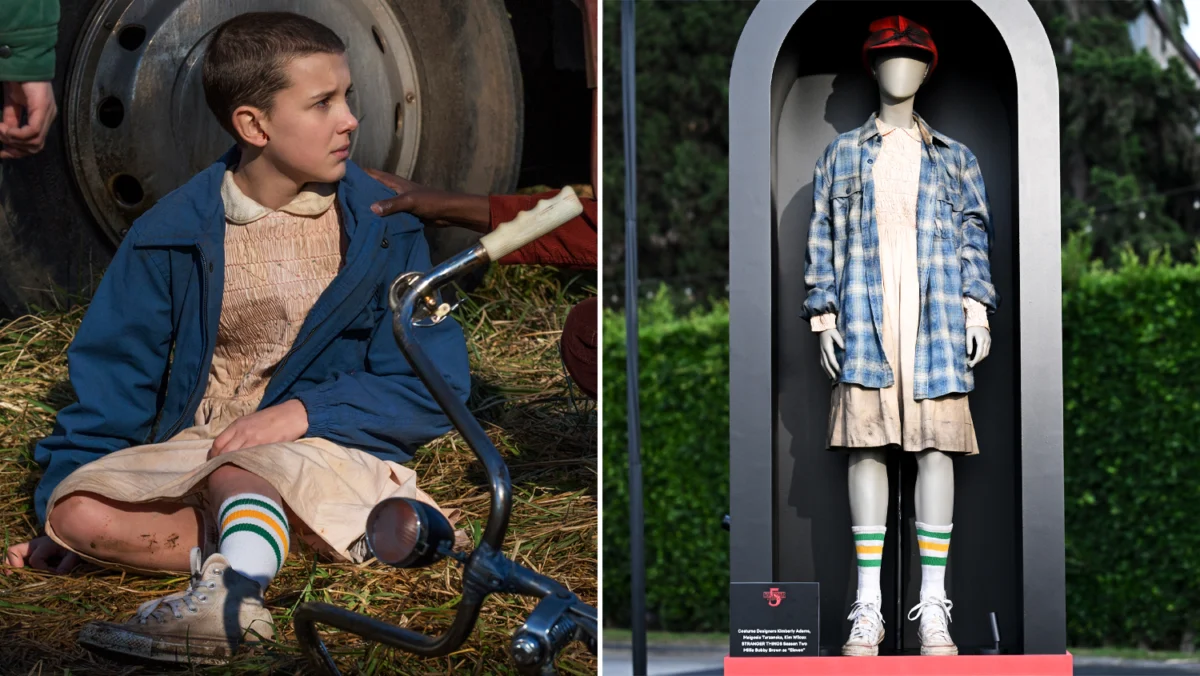
The cultural trajectory of Netflix’s Stranger Things has been nothing short of meteoric. Since its debut in 2016, the series has shattered industry records, redefined the streaming landscape, and galvanized a global fanbase. Now, in a historic move that cements its legacy within the annals of American entertainment, the series has achieved a milestone previously unthinkable for a digital-native production: an official place in the Smithsonian Institution’s National Museum of American History.
At a star-studded Netflix FYC (For Your Consideration) event held at the iconic Hollywood Forever Cemetery on May 21, 2026, it was announced that the costume worn by Millie Bobby Brown’s character, Eleven—specifically the signature pink dress from the show’s inaugural season—has been donated to the Smithsonian’s permanent collection.
A Legacy Etched in Fabric: The Donation
The donation was officially formalized as creators Matt and Ross Duffer and executive producer Shawn Levy signed the deed of gift on stage. The atmosphere was one of profound appreciation, marking the culmination of a five-season run that concluded on New Year’s Eve.
Ryan Lintelman, the entertainment curator at the Smithsonian’s National Museum of American History, oversaw the acquisition. For the museum, the piece is not merely a costume; it is a tangible artifact of a shift in how audiences consume, interact with, and identify with media in the 21st century.
"This costume so brilliantly illustrates Eleven’s journey to discover herself and claim her power," Lintelman noted during the ceremony. He elaborated on the narrative significance of the garment, explaining that for much of the first season, Eleven was confined to clinical hospital gowns or hand-me-downs, symbols of her lack of agency and identity. "When she first puts on the dress and a blonde wig, Eleven remarks that she looks ‘pretty.’ That moment is a major step in her journey toward self-awareness and empowerment."
Chronology of a Cultural Phenomenon
To understand why the Smithsonian has chosen to preserve this specific piece of pop culture, one must look back at the timeline of Stranger Things.
- July 2016: The series premieres, becoming an overnight global sensation. The "Eleven dress" becomes an instant cultural touchstone, dominating the Halloween costume market that same year.
- 2017–2022: As the series progresses through its middle seasons, Netflix pivots from simple content distribution to an aggressive brand expansion strategy. The show becomes the streamer’s first true "licensing bonanza," spawning everything from LEGO sets and tabletop games to immersive live experiences and apparel collaborations.
- 2023–2025: The show cements its status as a foundational pillar of modern television, with the Duffer Brothers and Shawn Levy overseeing a massive production scope that rivals blockbuster cinema.
- December 31, 2025: The five-season saga officially draws to a close, ending the narrative arc of the Hawkins crew and solidifying the show’s place in the pantheon of television history.
- May 2026: The Smithsonian announces the acquisition of the Eleven costume, formally recognizing the show’s impact on American cultural history.
Supporting Data: Why ‘Stranger Things’ Matters
The significance of Stranger Things extends far beyond its viewership numbers, which consistently placed it at the top of the Nielsen streaming charts. It represented the first time a streaming-exclusive series achieved the kind of "omnipresent" cultural footprint previously reserved for network juggernauts like Friends or Seinfeld.
The series served as the primary proof-of-concept for Netflix’s ability to turn a proprietary intellectual property into a massive, multi-faceted retail ecosystem. Before Stranger Things, the "streaming-to-merchandise" pipeline was largely theoretical. Following the show’s success, Netflix established dedicated divisions to manage consumer products, turning characters like Eleven and Dustin into household brands.
According to industry analysts, the show’s success in merchandising proved that streaming audiences were not just passive viewers, but active participants in the brand’s ecosystem. The Smithsonian’s decision to house the costume highlights the museum’s commitment to documenting contemporary history, acknowledging that the way we engage with media today is as much a part of the "American experience" as the traditional artifacts of the 20th century.
Official Responses and Reflections
The event at the Hollywood Forever Cemetery served as a poignant farewell for the cast and crew. For creators Matt and Ross Duffer, the transition from writing scripts in a room to seeing their work enshrined in Washington D.C. was overwhelming.

"This is amazing, thank you so much," Matt Duffer said as he signed the gift deed. His brother Ross and longtime collaborator Shawn Levy stood alongside him, visibly moved by the gesture.
Levy, who shares a personal history with the museum—having directed the 2009 blockbuster Night at the Museum: Battle of the Smithsonian—spoke to the weight of the moment. "To have the work that we poured our hearts into for years recognized by such an esteemed institution is a career highlight," Levy remarked.
Ryan Lintelman’s speech provided an intellectual framework for the show’s endurance, arguing that the series touches on deeply American anxieties. "The show tells a compelling and complex story with themes that resonate now and will stand the test of time: the deeply American skepticism of authority and established wisdom—especially the federal government and unethical activities in the pursuit of science and security," Lintelman said.
He followed this with a self-aware, lighthearted ad-lib, acknowledging his own status as a representative of the federal government, which drew a hearty laugh from the gathered crowd of actors, writers, and industry executives.
The Broader Implications: Redefining the Museum
The acquisition of the Eleven costume raises important questions about how cultural institutions will treat digital-era artifacts in the future. As television moves away from traditional broadcasting, the "museum-worthiness" of a show is no longer dictated by its ratings on a Nielsen box, but by its ability to influence the cultural zeitgeist.
By including Stranger Things in its collection, the Smithsonian is validating the idea that the "supernatural coming-of-age" genre is a significant contribution to 21st-century folklore. The show’s themes—the power of friendship, the courage of the marginalized, and the inherent truth-seeking nature of youth—are, as Lintelman suggested, archetypal.
Furthermore, the donation marks a shift in how museums view corporate-owned intellectual property. For decades, the Smithsonian has been the home of everything from the Hope Diamond to the Star-Spangled Banner. Adding a pink dress from a Netflix show might have seemed unconventional a decade ago, but in an era where digital content shapes our global consciousness, it is a logical evolution.
Conclusion: A Lasting Impression
As the dust settles on the final season of Stranger Things, the donation of Eleven’s costume ensures that the show will continue to tell its story long after the digital streams have been turned off. For fans, it provides a physical pilgrimage site in Washington D.C. For historians, it offers a window into the values, fears, and aesthetics of the mid-2020s.
The Duffer Brothers, Shawn Levy, and the entire cast have managed to create a piece of art that bridges the gap between entertainment and cultural history. As the costume is prepared for display, it stands as a testament to the idea that a group of individuals, much like the kids in Hawkins, can indeed change the world—or at least, the way we remember it.











No comments yet. Be the first to join the conversation!