In the high-stakes world of professional cosplay, few names carry as much weight as Kamui Cosplay. Known for her meticulous craftsmanship and technical prowess, the German-based creator recently took on one of her most daunting challenges to date: bringing the enigmatic Yelan from Genshin Impact to life for Gamescom 2023. Following a successful collaboration on the character Beidou, Hoyoverse once again tapped Kamui to embody the mysterious Liyue operative.
What appeared to be a sleek, straightforward character design at first glance quickly spiraled into a complex, five-week odyssey of engineering, textile manipulation, and 3D fabrication. This project not only showcases the dedication required for top-tier cosplay but also highlights the growing synergy between game developers and the fan communities that elevate their intellectual properties to new heights.

The Foundation: Digital Precision in a Physical Space
The journey began not with fabric, but with data. To achieve the level of accuracy expected by Hoyoverse and the Genshin Impact community, Kamui turned to the official 3D character models provided by the developers via Aplaybox.com.
“Hoyoverse uploads all 3D models of all characters,” Kamui explains. For creators, this is a game-changer. Accessing the original assets allows for precise measurement of proportions and intricate design elements that might be missed in standard 2D illustrations. This practice, increasingly common in high-end costume design, bridges the gap between digital asset creation and tangible craftsmanship. Whether it is characters from Genshin Impact, Honkai: Star Rail, or the newer Zenless Zone Zero, these digital blueprints serve as the backbone for modern, screen-accurate cosplay.

Chronology of Construction: A Five-Week Sprint
The project was structured into distinct phases, each presenting unique engineering hurdles that required immediate, iterative solutions.
The Dress: Mastering Asymmetry
The primary challenge for the dress was its silhouette—a complex, open-backed garment that required both aesthetic elegance and structural integrity. Kamui utilized the "duct tape method" to create a bespoke pattern. By wrapping her torso in tape and drafting the lines directly onto her body, she ensured a perfect fit before transferring the design to heavy royal blue satin.

Working with satin is notoriously difficult due to its tendency to fray and slip. The open-back design posed a significant structural dilemma: how to keep the garment secure without sacrificing the character’s silhouette. The solution involved a complex internal bracing system, utilizing faux leather for structural support and a modified bra strap integration to ensure the dress remained anchored during the high-activity environment of a major trade show like Gamescom.
The Jacket: A Study in Texture
Yelan’s white jacket, which appears to float effortlessly on the character’s back in-game, required a masterclass in weight distribution. Kamui moved away from the plain white aesthetic, opting for a white brocade with subtle floral ornaments to add depth and "believability" when viewed in person.

To achieve the "floating" effect, she employed a system of hidden press-on buttons and internal supports. The jacket was further detailed with laser-cut pleather and 3D-printed resin components, creating a high-contrast look that mimicked the game’s intricate textures. By incorporating a grey lining and faux fur collars, the piece moved from a simple garment to a high-fashion ensemble.
The Leggings and Accessories: Individualized Engineering
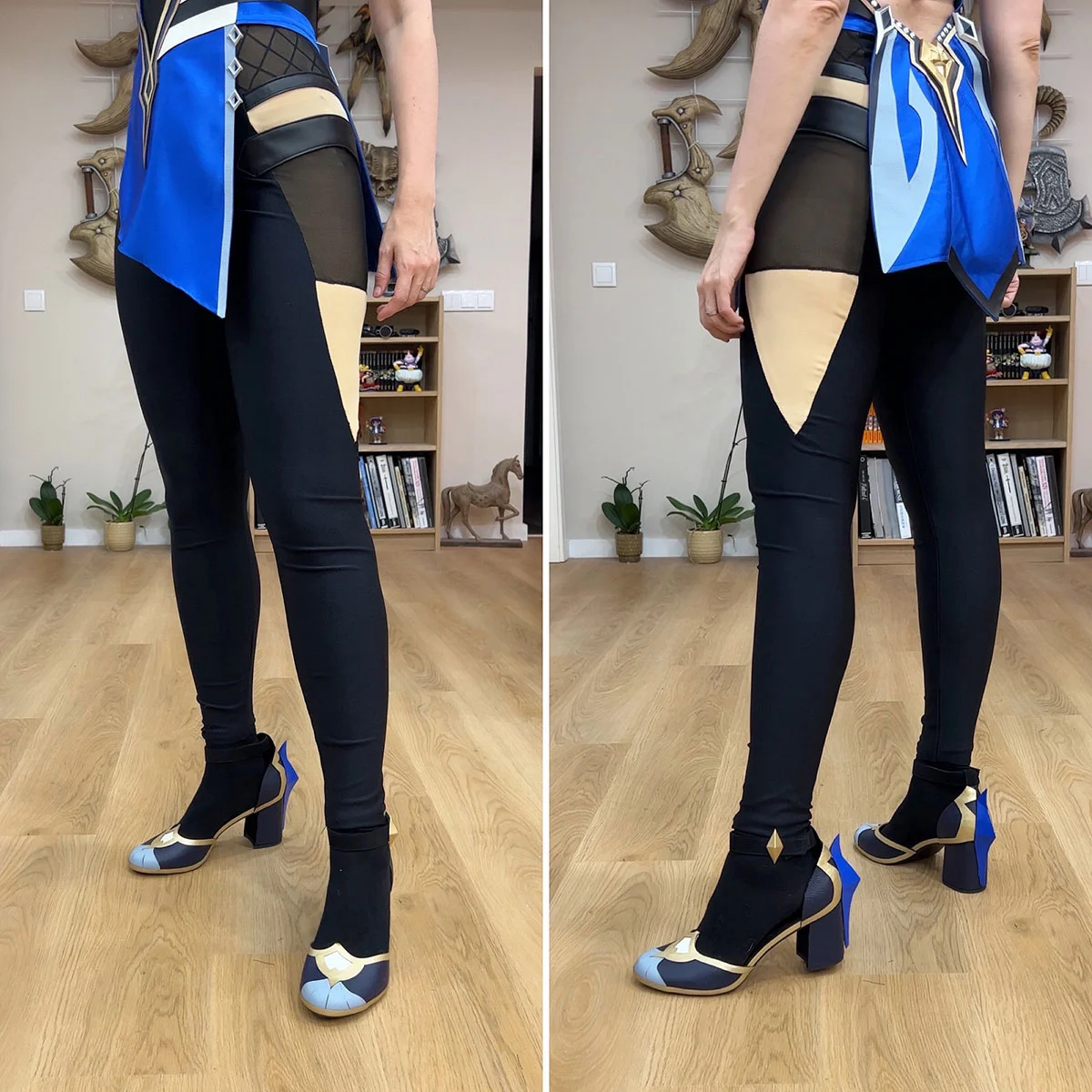
Perhaps the most complex aspect of the build was the leggings. Each leg features a unique design, preventing the use of a "mirror" pattern. Kamui had to treat each leg—and each glove—as a completely separate, bespoke project. Utilizing over 20 different materials, ranging from delicate netting to industrial faux leather, the build required an exhaustive attention to detail. Every tiny golden ornament was either laser-cut or 3D-printed using an Anycubic resin printer, demonstrating the diverse technological stack now required for professional-grade cosplay.

The Weapon: Building the Aqua Simulacra
No Genshin Impact character is complete without their signature weapon. The Aqua Simulacra, Yelan’s signature bow, was a collaborative effort involving Kamui’s partner, Benni, and his brother, Jakob.
The process began in Blender, where Jakob spent over a week sculpting the 3D model. Once finalized, the parts were printed on an ABS 3D printer. To ensure the prop was convention-safe and durable, the internal structure was reinforced with PVC piping. The painting process was equally rigorous, utilizing an airbrush system to achieve the signature blue-to-gold gradients that define the bow’s aesthetic. The final result was a lightweight, detachable, and highly detailed prop that stood as a testament to the team’s collective skill.

Implications for the Cosplay Community
Kamui’s Yelan build serves as a case study for the evolution of the hobby. It highlights three major shifts:
- Technological Integration: The reliance on 3D printing and laser cutting has moved from "optional" to "essential" for those aiming for professional-level accuracy.
- Collaborative Ecosystems: The involvement of specialized artists (like Krystl Cosplay for wig styling) and technical support (Benni and Jakob) underscores that modern, top-tier cosplay is rarely a solo endeavor.
- Community-Developer Synergy: Hoyoverse’s active support—providing assets and collaborating on official appearances—marks a positive shift in how developers view fan-made content. By treating cosplayers as ambassadors rather than just fans, the company cultivates a deeper emotional connection with its player base.
Reflections on the "Cost of Creation"
Beyond the technical achievements, the article touches on the emotional and physical toll of such projects. Kamui emphasizes the importance of a "step-by-step" mentality to avoid being overwhelmed by the sheer scale of the work. This disciplined approach is essential for any creator looking to maintain their mental well-being while pushing the boundaries of their craft.

The finished Yelan costume, photographed at the scenic Monte Palace Garden in Madeira, became a focal point of Gamescom 2023. It wasn’t just a costume; it was a physical manifestation of thousands of hours of research, trial-and-error, and technical refinement.
"Kudos to all cosplayers who decide to make their costumes on their own," Kamui writes, acknowledging the temptation of "ready-to-wear" alternatives. Yet, the choice to build from scratch is what preserves the art form. The Yelan project stands as a reminder that while digital games exist in a virtual space, the passion they inspire can be rendered in the real world with staggering, tangible detail.

For those looking to replicate these techniques, the extensive documentation—including tutorials on 3D model retrieval, sewing techniques, and prop painting—is available through Kamui’s social channels and YouTube, providing a roadmap for the next generation of creators to follow. As the lines between virtual and physical continue to blur, projects like this suggest that the future of cosplay is limited only by the creator’s access to technology and their willingness to master the details.