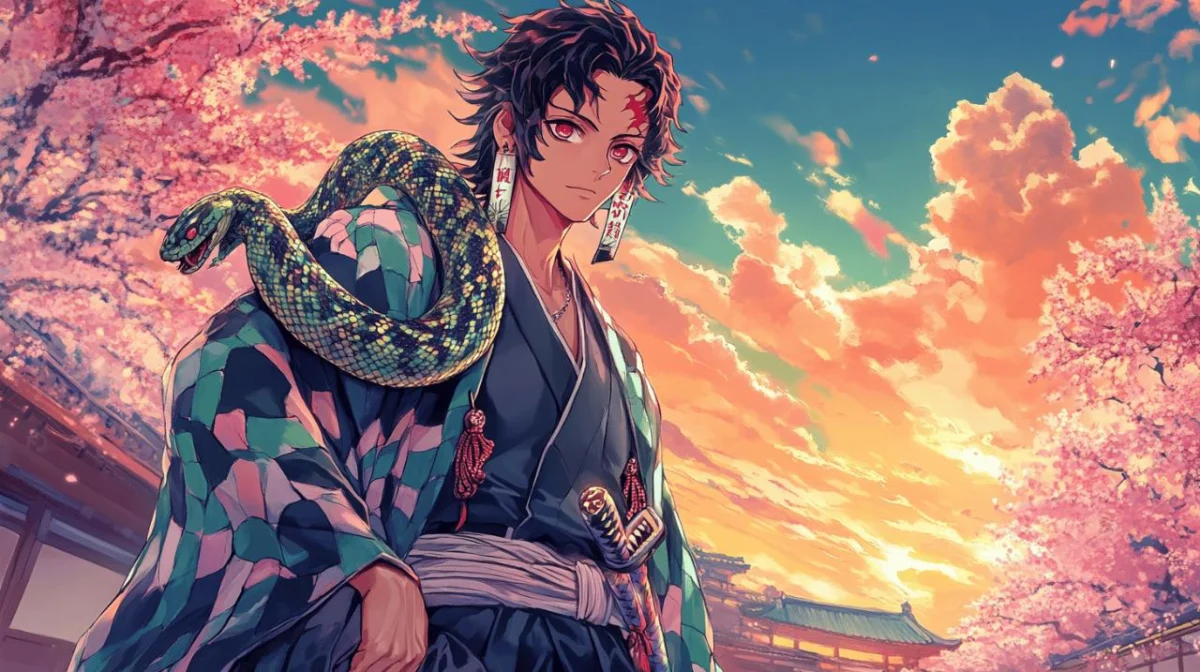
Obanai Iguro, the Serpent Hashira of the Demon Slayer Corps, stands as one of the most enigmatic and psychologically complex figures in Koyoharu Gotouge’s Demon Slayer: Kimetsu no Yaiba. Often characterized by his biting tongue, bandaged face, and the ever-present white serpent coiled around his shoulders, Iguro represents the tragic synthesis of hereditary trauma and unwavering resolve. As a member of the elite Hashira, his journey is not merely one of martial prowess, but a poignant narrative of redemption and the search for human connection amidst a world consumed by darkness.
Main Facts: The Anatomy of a Hashira
At the core of the Demon Slayer Corps’ defense lies the Hashira, the nine most powerful swordsmen. Within this hierarchy, Obanai Iguro occupies a unique space. Standing at 162 cm and weighing 53 kg, his physical stature is deceptively slight, yet he possesses a level of agility and swordsmanship that rivals the strongest of his peers.
The Source of the Serpent Breath
Iguro’s combat style, the "Breath of the Serpent," is a derivative of the Breath of Water, characterized by serpentine, fluid, and unpredictable strikes. Unlike the more linear styles of other Hashira, Obanai’s technique mimics the striking patterns of a viper. By utilizing his uniquely curved Nichirin blade, which ripples like a serpent’s body, he is able to strike from blind angles that are nearly impossible for demons to parry.
Kaburamaru: The Silent Partner
Perhaps the most distinctive aspect of Iguro’s combat identity is his bond with Kaburamaru, his white pet snake. Kaburamaru is more than a companion; the serpent acts as a sensory extension for Iguro. Given that Iguro’s right eye is partially blind, Kaburamaru provides vital spatial awareness, warning him of incoming attacks and allowing for a level of coordination that borders on the symbiotic.
Chronology: A Life Forged in Shadows
To understand the man, one must understand the trauma that defined his formative years. Iguro’s history is a dark stain on the lore of the Demon Slayer Corps, rooted in a clan of thieves that operated in the shadows of the Edo period.
The Curse of the Serpent
Born into a family that worshipped a serpentine demon, Iguro was the first male child born into the clan in 370 years. His birth was met not with celebration, but with exploitation. The demon demanded the blood of the clan’s children, and Iguro was kept imprisoned in a cage, his mouth mutilated by his own relatives to mirror the slit-mouthed appearance of the demon they worshipped. This ritualistic scarring served as the foundation of his lifelong self-loathing.
Escape and Ascension
Iguro’s eventual escape from his family’s clutches was a moment of desperate liberation, though it left him with a deep-seated distrust of others. He was rescued by the former Flame Hashira, Shinjuro Rengoku, and eventually sought refuge in the Demon Slayer Corps. His rise through the ranks was fueled by a burning hatred for the demons that had turned his life into a nightmare, leading him to adopt the "Serpent" title as a reclamation of the very image that had haunted his youth.
Supporting Data: Martial Capabilities and Tactical Mastery
While often labeled as having "moderate" physical strength compared to powerhouses like Gyomei Himejima, Iguro’s efficiency in battle is statistically unmatched in terms of precision and tactical IQ.
The Transparent World and Crimson Blades
During the final battle at the Infinity Castle, Iguro achieved two major milestones that cemented his legendary status:
- The Demon Slayer Mark: Manifesting during the high-stakes confrontation with Muzan Kibutsuji, the mark drastically increased his stamina, speed, and sensory perception.
- The Transparent World: By accessing this state of heightened perception, Iguro was able to perceive the flow of blood and the movement of muscles within his opponents, allowing him to strike at vital points before a demon could even react.
- Crimson Nichirin Blade: By applying immense pressure to his sword during combat, Iguro turned his blade a scorching crimson, a trait that directly inhibits the regenerative capabilities of demons—a crucial factor in the final assault against the Progenitor of Demons, Muzan.
Training Protocols
His training regimen is legendary within the Corps. He famously forced his subordinates to train by navigating through a maze of human obstacles, a drill designed to sharpen reaction times and movement fluidity. This harsh training style, while controversial among lower-ranking slayers, was the crucible that forged the high-speed reflexes necessary for a Hashira to survive against Upper Rank demons.
Official Responses and Internal Dynamics
Within the Hashira, Obanai’s personality was initially perceived as abrasive and cold. He was notorious for his harsh critiques of Tanjiro Kamado and his general cynicism toward those he deemed "weak." However, this exterior was a protective shell.
The Mitsuri Kanroji Connection
The most significant aspect of Iguro’s character development is his burgeoning romance with Mitsuri Kanroji, the Love Hashira. Initially meeting as colleagues, their relationship evolved through shared battles and a mutual understanding of the "outsider" status. For Iguro, Mitsuri represented the warmth and acceptance he had been denied since childhood. His dedication to her went beyond mere camaraderie; he saw in her the possibility of a life after the war.
The Final Sacrifice
During the "Sunrise Countdown Arc," Iguro’s loyalty to the Corps and his love for his fellow Hashira culminated in an act of total selflessness. Despite being mortally wounded, he continued to fight Muzan with everything he had, shielding Tanjiro and ensuring the defeat of the demon king. His final moments, spent in the arms of Mitsuri, provided a tragic but beautiful resolution to his character arc: the boy who was once a prisoner of a demon finally found peace as a savior of humanity.
Implications: The Legacy of the Serpent
The death of Obanai Iguro left a profound vacuum in the Demon Slayer Corps, but his legacy remains one of the most potent in the organization’s history.
A Paradigm Shift in Slayer Tactics
Iguro’s mastery of the Breath of the Serpent and his innovative use of external sensory aids (Kaburamaru) paved the way for future generations of slayers to look beyond raw power. He proved that even a body scarred by trauma and burdened by "moderate" strength could reach the absolute zenith of martial art if paired with intellect and determination.
Symbolic Significance
In the broader context of the series, Iguro acts as a mirror to the demonization of the weak. His family treated him like a monster, and for a long time, he felt like one. By transforming his trauma into a weapon for the protection of others, he defied the destiny his family had carved for him. His life serves as a narrative rebuttal to the nihilism promoted by the demons—a testament to the idea that no matter how dark one’s origins, the capacity for compassion and justice remains the ultimate human strength.
Cultural Impact
Iguro has become a fan favorite, frequently cited in community polls as one of the most compelling characters in the Demon Slayer franchise. His design—the mismatched eyes, the snake, the striped haori—has become iconic, representing the duality of his nature: the deadly, cold precision of a snake, and the hidden, vulnerable heart of a man who only ever wanted to be free.
In conclusion, Obanai Iguro’s story is not just a side chapter in the history of the Hashira; it is a vital pillar of the series’ thematic depth. He remains a reminder that heroes are not born, but forged in the fires of their own darkest memories, and that even the coldest heart can be thawed by the warmth of a genuine connection.