

Since its explosive debut, Meta’s Threads has transitioned from a viral experiment into a cornerstone of the modern digital landscape. For marketing teams and digital strategists, the platform is no longer an optional "side project"; it is a vital arena for brand identity, community building, and real-time engagement. As we move through 2026, the data confirms that Threads has successfully secured its place as a permanent fixture in the social media ecosystem.
Understanding the trajectory of Threads requires moving beyond initial hype to analyze the metrics that matter. By examining its growth, user demographics, and shifting competitive dynamics, brands can transition from passive observers to proactive participants in the text-based social revolution.
The Evolution: A Chronology of Rapid Adoption
The story of Threads is one of the most remarkable chapters in tech history. Its trajectory serves as a masterclass in leveraging existing infrastructure—specifically the massive Instagram user base—to achieve unprecedented market penetration.
The Record-Breaking Launch (July 2023)
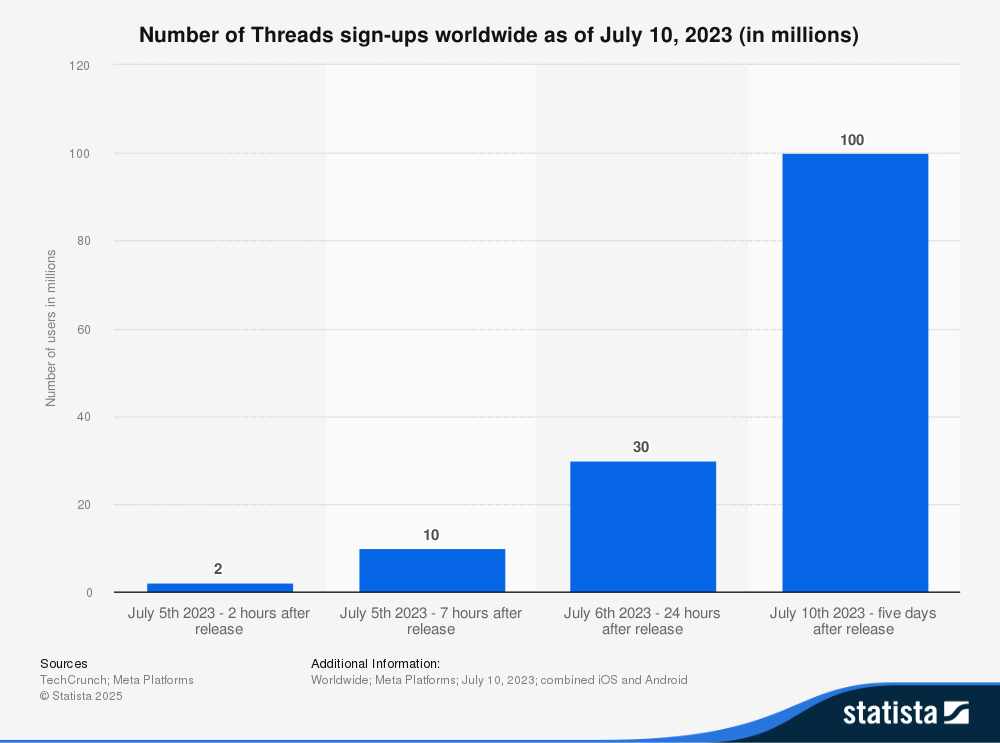
Threads arrived at a moment of significant industry turbulence, capitalizing on a widespread desire for a frictionless, text-first experience. The platform executed the most successful software launch in history, securing 30 million sign-ups in its first 24 hours. By the end of its fifth day, it had shattered all records by crossing the 100-million-user threshold.
Strategic Integration and Global Expansion (2024)
The following year was defined by the removal of friction. Meta’s strategic decision to roll out the app in the European Union in late 2023 unlocked a massive new market, leading to a surge of 34 million downloads in that region alone. During this phase, Meta pivoted from simple acquisition to retention, focusing on feature rollouts that turned the app into a daily habit.
Maturity and Monetization (2025–2026)
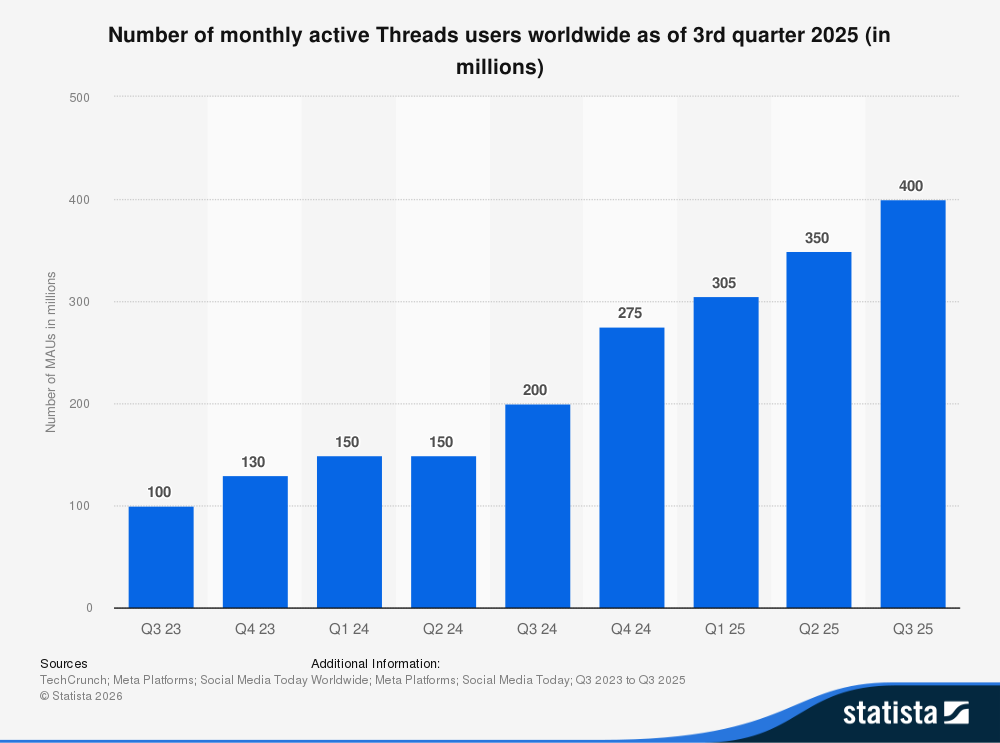
By the end of 2025, Threads had achieved 400 million monthly active users (MAUs). The platform moved into 2026 with a clear focus on monetization, opening its ad inventory to global advertisers via Meta Ads Manager. This transition from an experimental, ad-free environment to a robust commercial ecosystem marked the final stage of its evolution from a "novelty" to a "necessity."
Supporting Data: The Metrics of Momentum
For brands looking to optimize their strategies, the following data points underscore the platform’s current standing.
1. The Scaling of Active Users
As of late 2025, Threads reached 400 million MAUs. Perhaps more importantly, the platform’s daily active user (DAU) count surpassed 150 million in October 2025. With a stickiness ratio of roughly 37.5%, Threads sits comfortably within the "healthy" industry benchmark of 20% to 50%, proving that users are not just downloading the app—they are opening it daily.
2. Demographic Dominance
The platform’s audience is distinctly young and tech-forward. Gen Z and Millennials represent the core of the user base, each holding a 17% market penetration rate. This demographic distribution makes Threads an ideal environment for brands looking to build long-term loyalty with digital natives.
3. Global Geographic Footprint
Threads has become a truly global force. India currently leads the charge, accounting for 32% of total global downloads, followed by Brazil at 22% and the United States at 16%. This geographic diversity allows for multinational brands to craft inclusive, broad-reaching campaigns.
4. The Mobile vs. Desktop Divergence
A critical insight for strategists is the platform’s preference for mobile. Threads saw a 127.8% year-over-year growth in mobile daily active users. While X (formerly Twitter) continues to dominate the desktop traffic segment, Threads has effectively "won" the battle for the pocket-sized, on-the-go attention span.
Official Responses and Strategic Shifts
Meta’s leadership has been notably measured in their approach to Threads. Rather than forcing aggressive monetization early on, Adam Mosseri and the team at Meta prioritized "community health."
In official statements, Meta has emphasized that the goal for 2026 is to build a "positive, productive space for conversation." The recent introduction of ad formats—including sponsored posts and promoted accounts—has been handled with careful consideration for the user experience. By integrating these ads into the existing Meta Ads Manager, the company has provided a seamless transition for agencies already familiar with the Meta ecosystem, reducing the barrier to entry for professional marketers.
Implications for Brand Strategy in 2026
The data suggests a paradigm shift in how brands must interact with their audiences. We are no longer in an era where a single "master post" can be copy-pasted across all platforms.
The Rise of Conversational Commerce
Threads is a "reply-first" environment. Unlike platforms that reward passive consumption of video, Threads rewards brands that engage in the comments. The most successful brands on the platform—such as Netflix and ClickUp—utilize a "quick-witted" voice that feels human rather than corporate.
The Repurposing Dilemma
Data indicates that 52% of marketers currently repurpose content from other platforms. While this is an efficient starting point, it is not a long-term strategy. To capture the remaining 48% of the audience’s attention, brands should look to create platform-native content, such as short-form text reflections or text-based storytelling, which are currently seeing higher engagement rates than generic video re-uploads.
Content Preferences
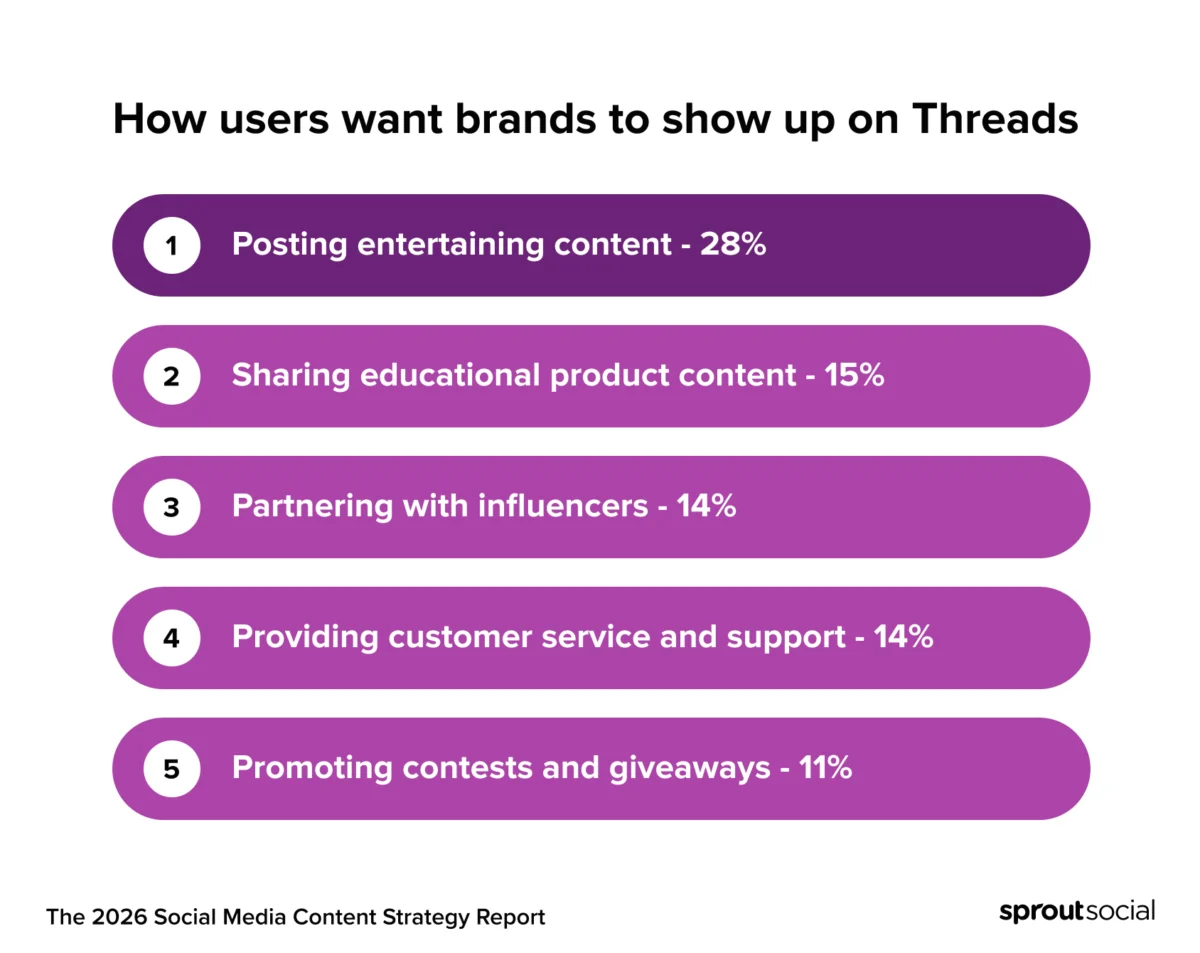
According to the 2026 Social Media Content Strategy Report, users are explicitly asking for:
- Entertainment (28%): Lighthearted, relatable content that breaks the "business-only" tone.
- Education (15%): Value-driven threads that solve a specific problem.
- Community Engagement (14%): Utilizing the platform for direct customer service and real-time interaction.
The Threads vs. X Rivalry: A Competitive Analysis
The rivalry between Threads and X is the most significant competitive story in social media. While X remains a larger entity by total user count, its 15.2% decline in year-over-year mobile engagement contrasts sharply with Threads’ explosive 127.8% growth.
| Metric | Threads | X (Formerly Twitter) |
|---|---|---|
| Monthly Active Users | 400 Million | 557 Million |
| Mobile DAUs | 141.5 Million | 125 Million |
| Growth Trend | Rising | Declining |
The implication is clear: X remains the "town square" for legacy breaking news and desktop power users, but Threads is rapidly becoming the "social lounge" where daily, habitual mobile interaction occurs. Smart brands will maintain a presence on both, but their investment and tone will necessarily differ.
Conclusion: The Path Forward
The transition of Threads from a "viral phenomenon" to a "permanent fixture" is complete. With an active user base of 400 million and a sophisticated advertising infrastructure now in place, the platform has moved past the "wait and see" phase.
For marketing teams, the mandate for 2026 is integration. Using advanced analytics tools like Sprout Social, brands can now move away from anecdotal evidence and toward data-backed strategies. By monitoring engagement rates, tracking cross-channel performance, and listening to the specific conversations happening within the Threads ecosystem, marketers can ensure they are not just present on the platform, but leading the conversation.
As we look toward the remainder of 2026, the question is no longer whether your brand should be on Threads, but how you will use the platform’s unique conversational dynamics to deepen your connection with your audience. The window for early-mover advantage is closing, but the opportunity for sustained, meaningful community building has never been greater.
Frequently Asked Questions
Does Threads have ads yet?
Yes. Following a successful testing phase, Meta officially rolled out ad inventory to global advertisers in early 2026. The platform now supports promoted posts and sponsored accounts via Meta Ads Manager.
Is Threads bigger than X?
In terms of mobile daily active users, yes. Threads has surpassed X. However, X still maintains a lead in total monthly active users and desktop-specific traffic.
How should brands measure their Threads success?
Success on Threads should be measured by engagement depth—specifically replies and shares—rather than just passive likes. Utilizing comprehensive analytics platforms allows for a unified view of how your Threads performance contributes to your broader social media ROI.












No comments yet. Be the first to join the conversation!