

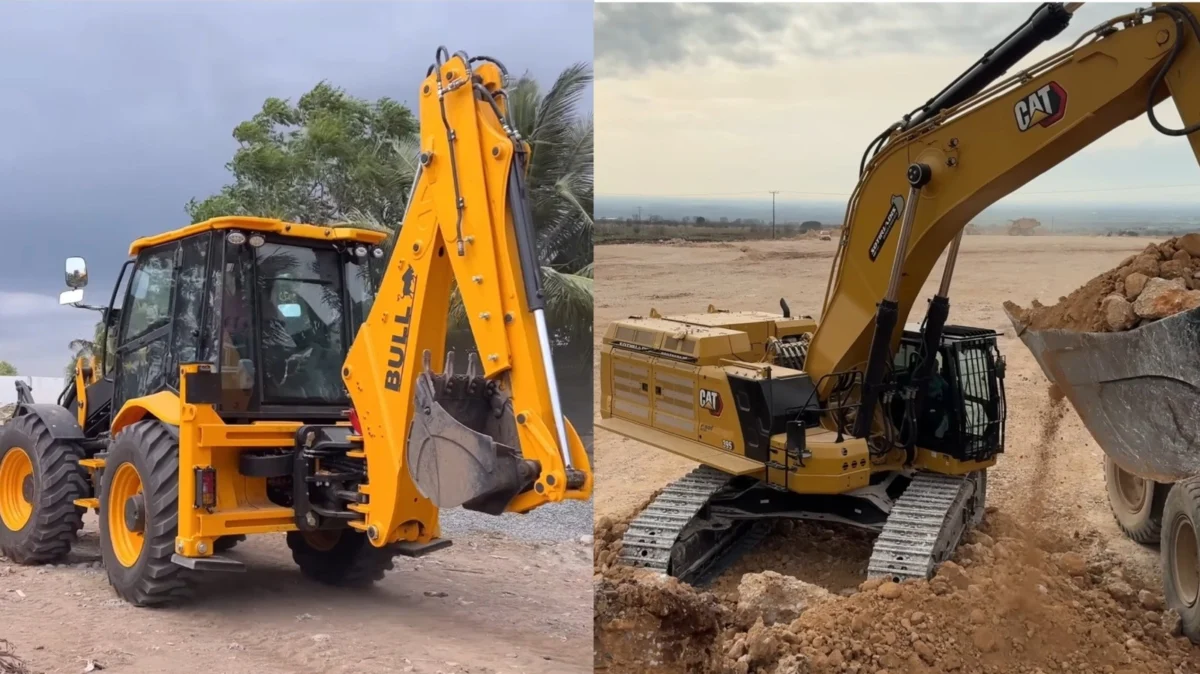
In the landscape of modern civil engineering, infrastructure development, and residential construction, two silhouettes dominate the horizon: the backhoe and the excavator. While often conflated by the casual observer, these machines represent distinct evolutionary paths in heavy equipment design. Choosing the right tool for a project is not merely a matter of preference; it is an economic and operational decision that dictates the efficiency, safety, and ultimate success of a construction site.
The Foundations: Distinguishing the Heavyweights
At their core, both backhoes and excavators are members of the excavation family, engineered to move earth and manipulate materials. However, their architecture and intended applications diverge significantly.
A backhoe is fundamentally a modified tractor. Its design features a front-mounted loader bucket and a rear-mounted digging arm (the "backhoe"). This dual-ended configuration makes it the quintessential "Swiss Army knife" of the construction world. Because it is built on a tractor chassis, it offers high road mobility, with many models capable of traveling safely on public thoroughfares between job sites.
Conversely, an excavator is a dedicated digging machine. It typically consists of a long bucket arm attached to a pivoting cab that sits atop a rotating platform, which can be mounted on either tracks or wheels. Unlike the backhoe, which is limited to roughly 200 degrees of rotation, the excavator offers a full 360-degree range, allowing for unparalleled versatility in confined or complex work environments.
Chronology: The Evolution of Earthmoving
The history of these machines reflects the growing needs of an industrializing world. The early 20th century saw the transition from manual labor to steam-powered shovels, but the true revolution began in the mid-1950s.
- 1953: Joseph Cyril Bamford (JCB) pioneered the concept of the tractor-loader-backhoe, integrating a hydraulic digging arm onto a farm tractor. This innovation allowed contractors to consolidate two machines—a loader and a backhoe—into one.
- The 1960s and 70s: As suburban sprawl accelerated, the need for machines that could dig utility trenches and load debris in tight residential spaces fueled the popularity of the backhoe.
- The 1980s to Present: With the rise of massive civil infrastructure projects, the excavator became the industry standard for high-volume, deep-trenching operations. Today, the technology has bifurcated into specialized niches, ranging from micro-excavators available at rental outlets like Home Depot to the gargantuan Bagger 293—a bucket-wheel excavator that weighs over 15,600 tons and stands as a testament to human engineering.
Supporting Data: Operational Capabilities
When comparing the two, the data consistently points toward the excavator for heavy-duty digging. Excavators provide greater reach and digging depth, with a center of gravity optimized for stability while lifting massive loads.
Performance Metrics at a Glance:
- Backhoes: Generally limited to depths of 12–16 feet (though premium models like the JCB 4CX-15 push this to 20 feet). Their strength lies in versatility and transportability.
- Excavators: Capable of digging depths exceeding 30–40 feet in mid-to-large configurations. Their full-swing capability allows them to dump soil into trucks parked in any position, a significant logistical advantage.
The maneuverability of modern backhoes has seen technological leaps. The JCB 4CX-15, for instance, utilizes four-wheel steering and a "crab mode," allowing it to navigate uneven terrain with a level of agility that previously required specialized, dedicated equipment.
Specialized Attachments: Beyond the Bucket
The true power of these machines is unlocked through their hydraulic quick-couplers, which allow for the seamless integration of specialized attachments.
Backhoe Versatility
Backhoes are frequently fitted with patch planers for road maintenance. A rotating drum equipped with asphalt picks allows the machine to grind down damaged road surfaces, preparing them for a smooth overlay. This ability to travel to a site, perform precision milling, and then load the debris into a truck makes the backhoe an indispensable asset for municipal road crews.
Excavator Forestry Applications
In the forestry sector, the excavator transcends its role as a digger. By swapping the bucket for a forestry mulcher, the machine becomes a land-clearing powerhouse, capable of grinding trees up to 10 inches in diameter. Further attachments like hydraulic grapples allow for log sorting, while stump splitters turn a once-difficult cleanup process into a rapid mechanical task.
The Innovation of the Walking Excavator
Perhaps the most striking development in the excavator family is the "walking excavator." Moving away from traditional tracks, these machines utilize four independent, articulated hydraulic legs. These legs allow the operator to anchor the machine on slopes that would topple conventional equipment. By sinking stabilizing claws into the earth, these machines can operate on steep, mountainous terrain, performing precision felling and clearing work in areas previously inaccessible to heavy machinery.
Official Industry Perspectives
Industry analysts and project managers emphasize that the choice between these machines is driven by the "project scope."
"If a contractor is doing a multi-utility installation—say, digging a trench, loading pipe, and backfilling—a backhoe is the most cost-effective choice because it does everything in one package," explains a representative from a major equipment rental firm. "However, once you move into deep excavation, foundation work for high-rises, or quarry operations, the excavator is not just better; it is the only safe and viable option. You cannot expect a backhoe to perform the high-cycle, deep-digging tasks required for a large-scale project."
Manufacturers have responded to these needs by creating "mini" versions of both machines. These compact units serve the residential market, where space is at a premium and noise ordinances or ground-pressure limits prevent the use of full-sized industrial equipment.
Implications for Future Construction
As the construction industry moves toward automation and electrification, the divide between backhoes and excavators is becoming increasingly blurred by software. Modern machines now feature "grade control," a system where the computer helps the operator maintain a perfect slope or depth, reducing the margin for error.
The implications for smaller operators are significant. With the accessibility of high-quality equipment rentals, the barrier to entry for small-scale site preparation has lowered. Whether it is a landscaping project requiring a mini-excavator or a small-town road repair necessitating a backhoe, the ability to select the right tool has never been easier.
Ultimately, while the backhoe remains the champion of the "jack-of-all-trades" environment, the excavator stands as the undisputed king of heavy, sustained excavation. Understanding the nuanced differences in their reach, rotation, and specialized attachment capabilities allows for smarter hiring, better site planning, and ultimately, a more efficient construction industry. As technology continues to push these machines into new terrain—literally and figuratively—the line between "digger" and "tool carrier" will continue to evolve, offering new ways to shape the world around us.











