In the vibrant, high-stakes world of cosplay, few projects capture the imagination quite like the weapons wielded by the Archons of Genshin Impact. Recently, the renowned cosplay artisan Kamui Cosplay embarked on an ambitious journey to recreate "A Thousand Blazing Suns," the colossal claymore belonging to Mavuika, the Pyro Archon of Natlan. This endeavor, born from a unique intersection of personal passion and an official collaboration with developer HoYoverse, represents a masterclass in modern prop-making, blending traditional EVA foam techniques with advanced digital fabrication and complex LED programming.
The Genesis of a Masterpiece: A Collaborative Coincidence
The project originated from a serendipitous alignment of interests. As an avid player of Genshin Impact and an expert in EVA foam construction, Kamui—known for previous iconic builds like Yelan and Beidou—found herself drawn to the striking aesthetic of the Pyro Archon. The design of her sword, characterized by its aggressive, rocket-engine-inspired silhouette and brilliant yellow-orange luminescence, offered a perfect challenge for a creator who prides herself on integrating electronics into wearable art.

Simultaneously, HoYoverse, recognizing the cultural impact of professional cosplayers on the Genshin community, reached out to propose an official content partnership. The brief was simple yet creatively demanding: produce content showcasing the release of the new Archon. For Kamui, Mavuika’s sword served as the ideal centerpiece for this promotion, allowing for a deep dive into the craft while highlighting the game’s latest expansion.
Chronology of Construction: From Digital Blueprints to Physical Reality
The creation of a prop of this magnitude follows a rigorous, multi-stage engineering process.

Phase I: The Blueprint and Digital Modeling
The foundation of the build rested on precision. While in-game screenshots provided the visual reference, the team utilized 3D models sourced from aplaybox.com. This platform is a vital resource for the Genshin community, offering access to original character and weapon assets. Navigating the site requires patience and the assistance of translation tools, but the result—a high-fidelity 3D file—is invaluable for scaling.
A critical decision in this phase was the physical scale of the sword. While the in-game model is massive, adhering strictly to the digital proportions would have resulted in a prop that was physically unwieldy. The team opted for a two-meter length, a choice that prioritized the "natural" feel of the prop during movement and display over strict adherence to the potentially impossible proportions of a digital asset.

Phase II: Foam Fabrication and Structural Integrity
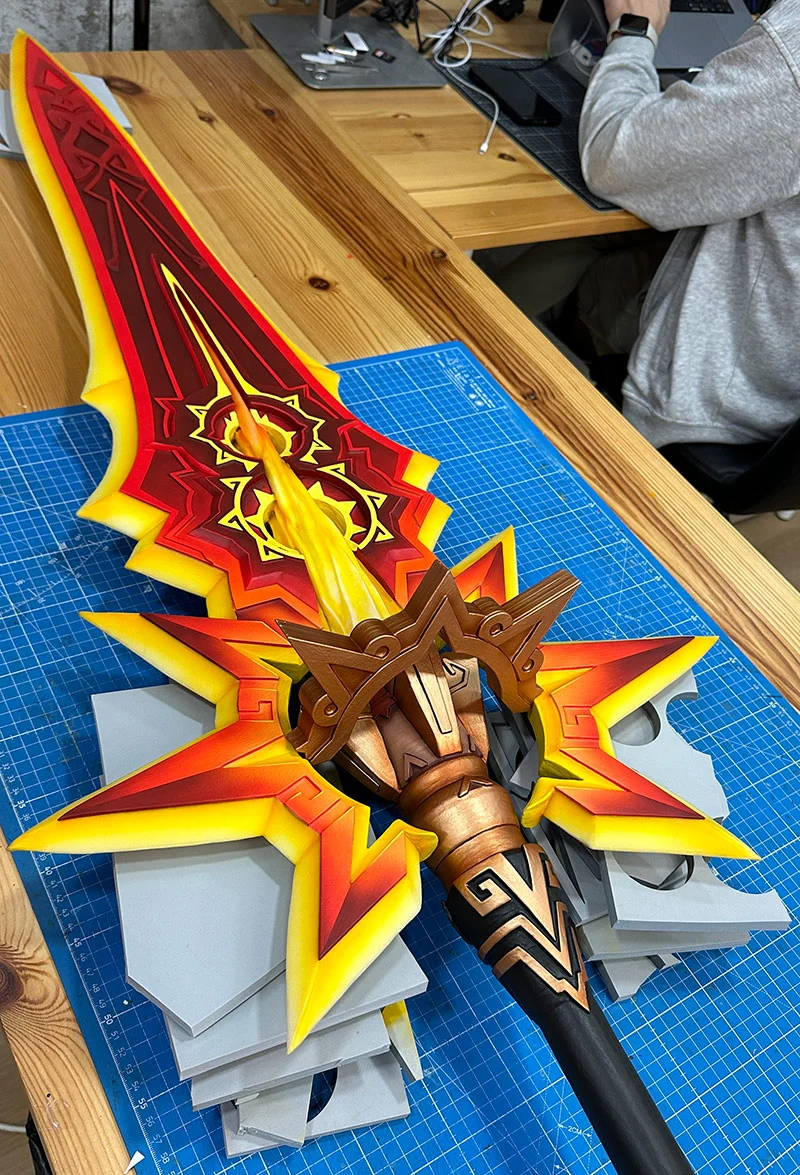
Once the blueprints were finalized, the focus shifted to structural integrity. The "rocket-engine" core of the sword demanded significant internal stability, provided by a sturdy PVC pipe running the length of the weapon. Around this core, the team layered 10 mm EVA foam to build the body.
To optimize the workflow, the team integrated a CO2 laser cutter into the production line. By converting their blueprints into vector files, they were able to achieve a level of precision and speed unattainable through manual cutting. However, as the creators noted, the laser cutter is not a shortcut; it requires extensive preparation of files, proving that technology serves as a tool for refinement rather than a substitute for skill.

Phase III: The Electronic Nervous System
The sword’s signature feature is its lighting. To bring the "burning" effect to life, the team employed an Adafruit Feather M4 Express paired with a Prop-Maker FeatherWing. This setup, a hallmark of the creator’s technical style, powered 300 individual digital RGB LED pixels.
The programming allowed for a reactive experience: the sword would pulse with a fire-like animation that changed when the prop was struck against the ground—a physical trigger that simulated the weapon’s power. The complexity of hiding 300 LEDs, battery packs, and wiring within the grip without sacrificing aesthetics is a testament to the sophistication of modern prop engineering.

Phase IV: The Marathon of Finishing
The final stage, painting, proved to be the most grueling. Using Vallejo airbrush colors, the team faced the logistical nightmare of masking. Because the sword required multiple layers of color and translucency—essential for the LEDs to glow effectively—they had to rely heavily on painter’s tape to protect finished sections.
The process turned into a three-day, sleep-deprived marathon. Each side of the two-meter blade had to be masked, painted, and unmasked with extreme caution to prevent the adhesive from peeling the underlying paint. The final detailing was completed by hand using high-pigmentation acrylics, resulting in a vibrant, professional finish that blurred the line between digital asset and physical object.

Supporting Data and Professional Insights
The success of the project relies on specific tools and methodologies that have become standard in the professional cosplay industry.
- Materials: The use of high-density EVA foam and specialized LED-diffusing foam (Plastazote LD45) is essential for props that require both structural rigidity and light transmission.
- Electronics: The Adafruit ecosystem remains the industry gold standard for cosplay animatronics. The "Book of Light and Sound Effects" by the creator serves as a foundational text for those looking to replicate these reactive, trigger-based light systems.
- Fabrication: The transition from manual box-cutting to CO2 laser engraving represents a shift toward "industrial-grade" home crafting. This allows for complex geometric shapes that would be prone to error if cut by hand.
Official Responses and Community Engagement
The collaboration between Kamui Cosplay and HoYoverse highlights a broader industry trend: the professionalization of fan-created content. HoYoverse’s willingness to sponsor independent creators to build high-end props demonstrates a sophisticated understanding of the "community loop." By facilitating the creation of authentic, high-quality replicas, the developer deepens the emotional connection between the player base and the game’s lore.

For the community, the project provides more than just a "making-of" video; it offers a roadmap. By releasing the blueprints and providing detailed documentation of the electronics, the creators are lowering the barrier to entry for fans who wish to pursue high-level crafting. The social media engagement—marked by high views on platforms like TikTok—serves as a marketing engine for Genshin Impact, keeping the character of Mavuika at the forefront of the cultural conversation long after the initial patch release.
Implications for the Future of Cosplay
The creation of "A Thousand Blazing Suns" signals a maturation in the craft of cosplay. It is no longer merely about recreating a costume for a convention; it is about engineering a prop that functions as a piece of interactive technology.

- Technological Integration: As micro-controllers become more accessible, we can expect the next generation of props to feature more advanced interactivity, such as app-controlled lighting or complex motion-sensitive soundscapes.
- Digital-to-Physical Workflow: The use of game files as the basis for physical construction is becoming standard. This symbiotic relationship between game developers and creators will likely lead to even more accurate, lore-friendly gear as access to 3D assets becomes more streamlined.
- The "Pro-Am" Standard: The line between professional prop makers and high-end hobbyists is increasingly thin. Projects like this set a new standard for what is expected at major conventions, pushing the entire community toward higher levels of technical proficiency.
Ultimately, the Mavuika sword project is a triumph of artistic will. It highlights the dedication required to transform a two-dimensional concept into a living, glowing, physical reality. For the team involved, the reward was not just the completion of a challenging project, but the satisfaction of holding an artifact that, for all intents and purposes, was pulled directly from the screen and into the real world.