

Introduction: The Digital Evolution of the Escape Room Phenomenon
The traditional escape room—a physical adventure game in which players solve a series of puzzles and riddles using clues, hints, and strategy to complete objectives—has undergone a massive digital transformation over the last decade. While physical locations thrive in metropolitan hubs, the genre has found a second, perhaps more expansive life, within the world of Roblox. Among the most popular iterations of this genre is Project Escape Room, a title that has recently garnered significant attention with its latest "Prison" map update.
Project Escape Room: Prison challenges the cognitive faculties of its players, placing them in a high-security virtual environment where the only way out is through meticulous observation and logical deduction. This article provides a comprehensive journalistic deep dive into the mechanics of the game, a step-by-step walkthrough of its most challenging map, and an analysis of why such digital simulations continue to dominate the global gaming landscape.
Main Facts: Deciphering the Appeal of Project Escape Room
Project Escape Room is not merely a game of speed; it is a game of intellect. Developed within the Roblox ecosystem—a platform that boasts over 70 million daily active users—the "Prison" map represents a pinnacle of environmental storytelling and puzzle design.
The Core Objectives
In the Prison map, players are cast as inmates wrongly or rightly accused, tasked with navigating a labyrinthine correctional facility. The challenge is multi-faceted:
- Environmental Interaction: Every object, from a discarded dumbbell to a flickering light, may hold a clue.
- Logic Puzzles: Players must decode numerical sequences and color-coded systems.
- Temporal Pressure: While some modes allow for casual play, the core experience is built around escaping before "security" catches up or time expires.
Technical Specifications
The game utilizes Roblox’s proprietary Luau scripting language to create complex interactions. Unlike simpler "Obby" (obstacle course) games, Project Escape Room relies on a sophisticated "Inventory System" where players must collect and combine items to progress, bridging the gap between casual platforming and hardcore point-and-click adventure games.
Chronology: A Definitive Walkthrough of the Prison Escape
Escaping the high-security confines of the Prison map requires a systematic approach. Based on expert playthroughs and community data, the following six steps represent the critical path to freedom.
Step 1: The Initial Breach – Escaping the Cell
The journey begins in a cramped, two-man cell. The primary objective here is to locate the "Cell Key" or trigger the electronic release.
- The Search: Players must investigate the undersides of the bunks and the area behind the porcelain toilet. Often, a small "Hand-Shank" or a "Lockpick" is hidden within the mattress texture.
- The Mechanism: In the latest update, the cell door is controlled by a hidden lever located behind a loose brick in the wall. Identifying the brick requires looking for slight discoloration in the gray masonry. Once pulled, the magnetic lock disengages, granting access to the main cell block.
Step 2: Cryptography – Counting the Tally Marks
Once in the hallway, players encounter a reinforced gate requiring a four-digit PIN. The solution is etched into the very history of the prison: the tally marks.
- The Observation: Scattered throughout the first three cells are sets of tally marks scratched into the walls by "former inmates."
- The Calculation: Players must count the total number of marks in each specific quadrant. For example, if Cell A has 5 marks, Cell B has 3, and Cell C has 8, the code is often a variation of these numbers (e.g., 5380). This step teaches players that in Project Escape Room, the environment is the manual.
Step 3: Engineering – The Circuitry Challenge
After bypassing the gate, players enter the maintenance corridor. A malfunctioning power box blocks the path to the showers.
- The Puzzle: Players are presented with a series of colored wires (Red, Blue, Green, Yellow).
- The Logic: A nearby "Maintenance Log" (a readable in-game note) provides a cryptic clue: "The sky comes before the blood, but the grass grows last." Translating this, the player must cut or connect the wires in the order of Blue (sky), Red (blood), and Green (grass). Failure to do so resets the puzzle and triggers an alarm.
Step 4: The Steam Enigma – Solving the Shower Pattern
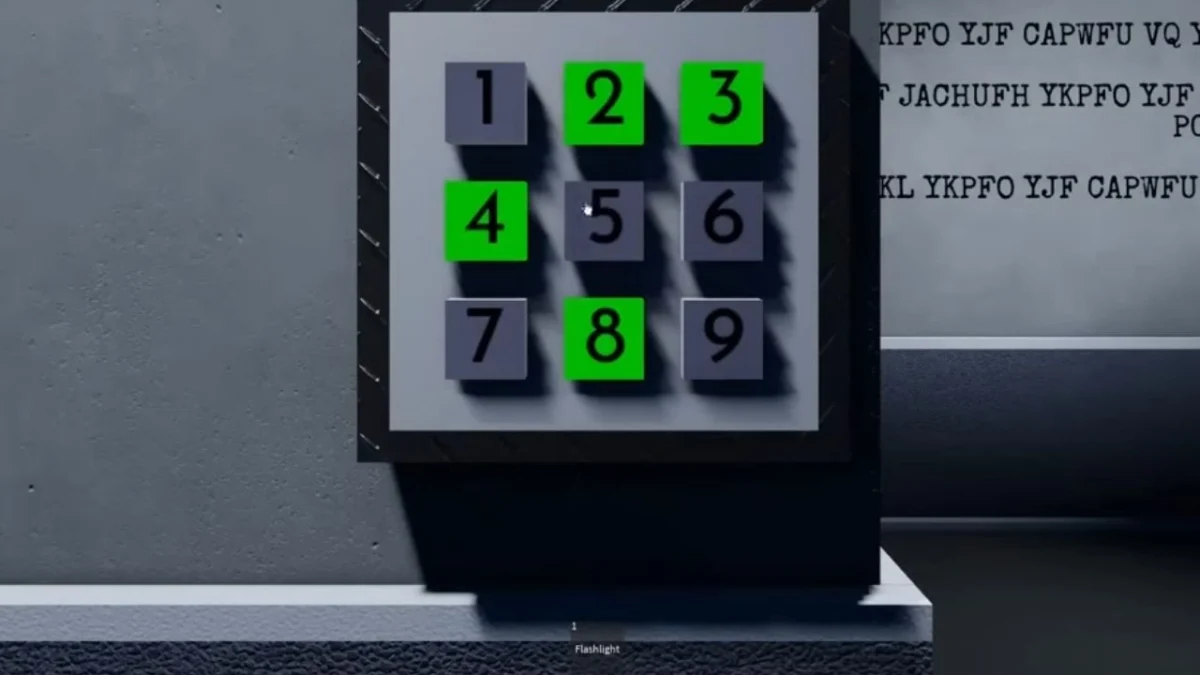
The shower room is often the point where most players become stuck. The room is filled with steam, obscuring the exit.
- The Pattern: On the floor of the shower, there are nine tiles arranged in a 3×3 grid. Some tiles are slightly warmer (indicated by a subtle red glow or steam particles).
- The Solution: Players must step on the tiles in a specific sequence that mirrors the "Shower Schedule" found on a bulletin board in the previous room. This requires a high degree of memory and spatial awareness.
Step 5: Physicality and Weight – Examining the Dumbbells
The prison gym serves as the penultimate challenge. Here, the puzzle shifts from visual to numerical weight.
- The Clue: A locked locker in the corner requires a weight-based code.
- The Investigation: Players must interact with the dumbbells scattered across the floor. Each dumbbell has a number (e.g., 5 lbs, 10 lbs, 25 lbs).
- The Execution: The code is derived from the sum of the missing weights from the racks. If the 25 lb and 10 lb weights are missing, the code involves "35." This subtle use of "environmental absence" is a hallmark of high-level escape room design.
Step 6: The Final Dash – Finding the ‘Gate Padlock’ Key
The final exit is a massive iron gate leading to the yard. It is secured by a "Gate Padlock."
- The Location: The key is not in a box or under a rug; it is held by the "Warden’s Shadow." Players must navigate a dark ventilation shaft to peer into the Warden’s office.
- The Acquisition: Using a "Magnet Tool" found in Step 3, players must fish the key through a vent grate. Once the key is obtained, a sprint to the final gate ensues. Unlocking the padlock triggers the "Freedom" cinematic, concluding the map.
Supporting Data: The Metrics of Digital Escape
The success of Project Escape Room: Prison is backed by staggering engagement metrics within the Roblox platform.
| Metric | Value (Estimated) |
|---|---|
| Active Players (Peak) | 15,000 – 25,000 concurrently |
| Completion Rate | 18% (Initial attempt) |
| Average Time to Escape | 22 Minutes |
| Total Visits | Over 100 Million (Series total) |
Data suggests that the "Prison" theme is the most popular sub-genre within Roblox escape rooms, likely due to the high stakes and the cultural ubiquity of prison-break narratives in media (e.g., Prison Break, The Shawshank Redemption). Furthermore, psychological studies on "Game-Based Learning" suggest that puzzles like those in Step 3 and Step 5 improve deductive reasoning and pattern recognition in younger demographics, which make up a significant portion of the Roblox user base.
Official Responses: Insights from the Development Community
While the developers of Project Escape Room often remain anonymous or operate under group pseudonyms like "Project Games," their interactions on dev-forums provide insight into the game’s philosophy.
In a recent community Q&A, a lead designer noted:
"Our goal with the Prison map was to move away from ‘jump scares’ and focus on ‘logical dread.’ We wanted the player to feel that the answer was always right in front of them, hidden in plain sight. The tally marks puzzle, for instance, was designed to reward players who actually stop to look at the textures we spent hours painting."
Roblox Corporation itself has praised such "Experience" creators for pushing the boundaries of what the engine can do. By moving beyond simple physics-based games into complex, logic-driven narratives, developers are transforming Roblox from a "toy box" into a legitimate game development engine.
Implications: The Future of Virtual Problem Solving
The popularity of Project Escape Room: Prison carries broader implications for the future of digital entertainment and education.
1. The Democratization of Game Design
Roblox allows independent creators to reach millions without the need for a traditional publisher. This means that niche genres, like the hyper-specific "Prison Escape Room," can find a massive audience and generate significant revenue for the creators through "Developer Exchange" (Robux to USD).
2. Cognitive Development
As digital escape rooms become more complex, they serve as informal educational tools. They require literacy, basic arithmetic, logical sequencing, and collaborative problem-solving (when played in multiplayer mode).
3. The Shift to Virtual Reality (VR)
With Roblox’s expanding support for VR headsets like the Meta Quest, games like Project Escape Room are poised to become even more immersive. The "Prison" map, when experienced in 360-degree VR, moves from a screen-based puzzle to a visceral, claustrophobic simulation, further blurring the lines between gaming and reality.
Conclusion
Project Escape Room: Prison is more than just a diversion on a popular gaming platform; it is a testament to the enduring human desire to solve puzzles and overcome confinement. Whether you are a seasoned "escape specialist" or a newcomer to the world of Roblox, the Prison map offers a masterclass in digital level design. By following the steps outlined in this guide—from the initial cell breach to the final padlock—players can sharpen their minds and experience the thrill of the virtual great escape.
As Roblox continues to evolve, we can only expect these challenges to become more intricate, further cementing the platform’s status as the premier destination for the next generation of digital adventurers.
About Roblox:
Roblox is a global platform where millions of people gather together every day to imagine, create, and share experiences with each other in immersive, user-generated 3D worlds. Developed by Roblox Corporation, the platform is available on Microsoft Windows, Xbox One, Xbox Series X/S, Android, iOS, Fire OS, and Mac.











No comments yet. Be the first to join the conversation!