

In the high-stakes, high-heat world of contemporary ceramics, the introduction of organic, fibrous material—specifically paper—is often viewed as a fool’s errand. The combustion temperatures of a kiln are designed to transform clay into stone, a process that typically reduces paper to ash in a matter of seconds. Yet, for Seoul-based artist Jongjin Park, the tension between the ephemeral nature of paper and the permanence of ceramic is not a barrier; it is the very foundation of his aesthetic language.
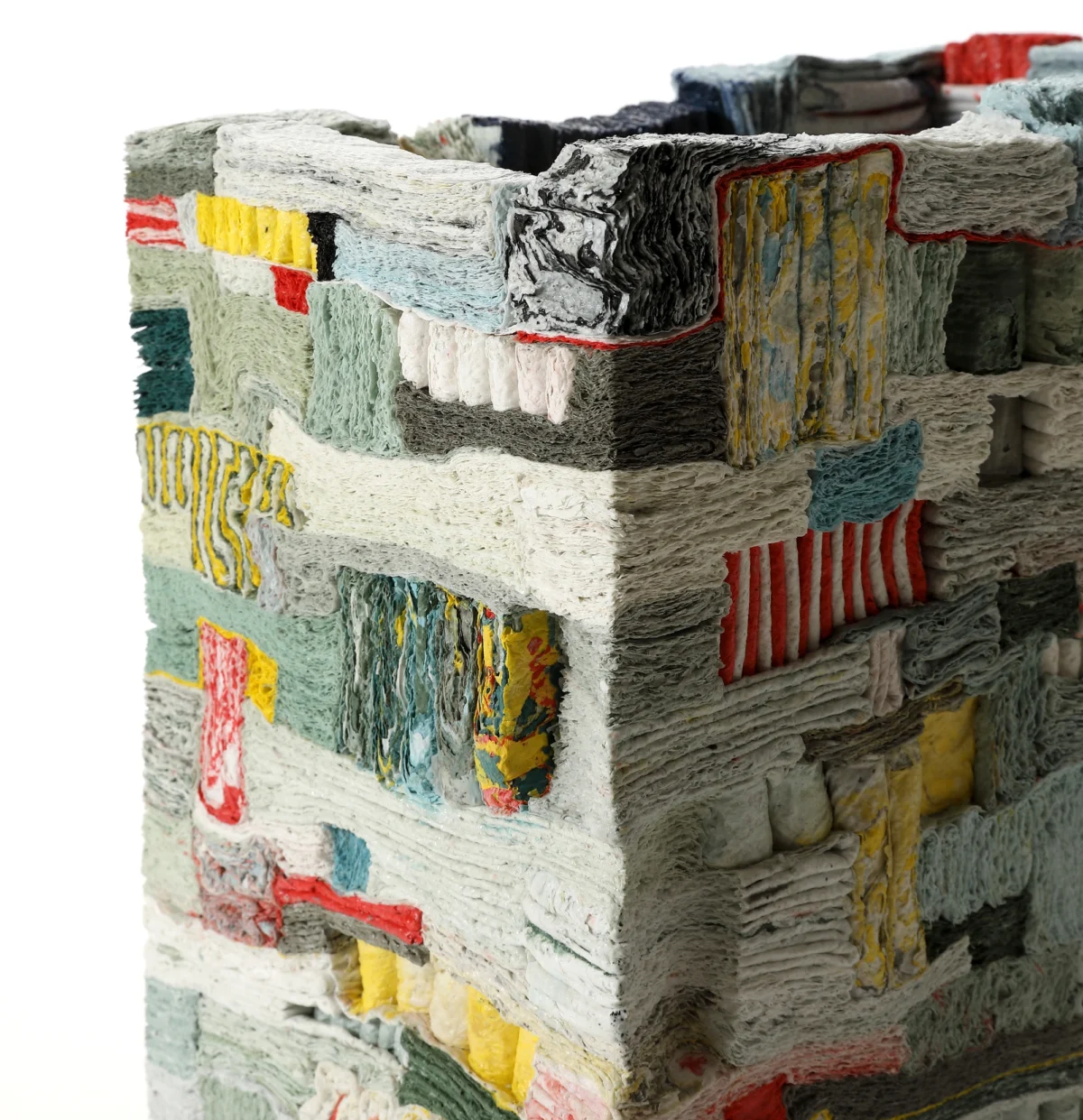
Park’s recent triumph as the winner of the 2026 Loewe Craft Prize serves as a watershed moment for the medium. His award-winning sculpture, Strata of Illusion, is a masterwork of structural subversion—a rectangular form that defies gravity with its open-top, slouching silhouette, built entirely from thousands of layered paper towels saturated in watered-down ceramic slip.

The Core Innovation: Merging Fiber and Fire
The fundamental challenge of Park’s practice lies in the alchemical transformation of his materials. By dipping standard, mass-produced paper towels into a liquid clay slip, Park creates a composite material that functions as a structural hybrid. Once the paper is folded, stacked, and manipulated, it is fired in a kiln.
The brilliance of his technique lies in how he manages the "disappearance" of the internal paper structure. As the kiln temperatures rise, the paper fibers undergo a controlled carbonization, leaving behind a fragile, fossil-like ceramic skeleton that retains the precise texture and geometry of the original fold. This process produces an object that possesses the density of stone but the visual lightness of a stack of parchment.

Chronology of a Breakthrough: From Experimentation to Recognition
The evolution of Park’s work did not happen overnight. It was the culmination of years of iterative material research, driven by a desire to challenge the rigid, historical stereotypes associated with ceramic art.
- Early Explorations: Park began his journey by questioning why ceramics were tethered to the traditional "clay-only" paradigm. His early experiments focused on identifying materials that could act as a scaffold for liquid slip without compromising the structural integrity of the final piece.
- The Paper Towel Pivot: Recognizing the uniform texture and high absorbency of paper towels, Park began to treat them as a sculptural medium rather than a utility. He discovered that by layering them while wet, he could dictate the "slouch" and "flow" of the final, fired sculpture.
- Refining the Technical Infrastructure: Recognizing the hazards of burning paper in large quantities—both to the kiln and the environment—Park invested in specialized kiln technology. By integrating high-chimney exhaust systems, he ensured the safe expulsion of carbonized gases, turning a fire hazard into a precise industrial process.
- The 2026 Loewe Craft Prize: With his technique perfected, Park submitted Strata of Illusion to the Loewe Foundation. The jury, comprised of international luminaries in craft, architecture, and design, recognized the work as a paradigm shift in how we perceive the longevity of materials.
Technical Data and Ethical Considerations
Park’s practice is as much about environmental consciousness as it is about artistic innovation. A central pillar of his studio philosophy is the use of recycled paper derived specifically from repurposed milk cartons. This material choice is intentional; the fibers in recycled carton paper are often more resilient, providing the necessary strength to support the weight of the ceramic slip during the drying phase.

The "Flexible State" Concept
Park challenges the standard perception of the "unfired" state. In traditional pottery, the pre-fired, wet-clay stage is often categorized as "fragile." Park, however, rebrands this as a "flexible state."
"In my practice, this pre-fired state is not viewed as ‘fragile’—the way traditional unfired ceramics are commonly perceived—but rather redefined as a ‘flexible’ state where patterns, forms, and colors can be actively manipulated," Park explains. By embracing the slippery, malleable nature of his composite material, he allows the sculpture to dictate its own gravity, resulting in the organic, "slouching" forms that define his signature style.

Implications for the Future of Ceramics
The implications of Jongjin Park’s work extend far beyond the gallery walls. His success signals a broader movement within the craft world toward "hybridity"—a methodology where traditional techniques are fused with unconventional, often discarded, materials.
Disrupting the Ceramic Canon
For centuries, ceramics have been associated with durability, utility, and the earth. By incorporating paper, Park introduces a concept of "monumental ephemera." He forces the viewer to consider the history of the object: Was it once a simple, disposable household item? Does it now represent a geological formation? This conceptual friction—the tension between the thinness of paper and the density of ceramic—is the hallmark of his contribution to the field.

Academic Influence
Beyond his studio practice, Park serves as a professor in Craft & Collectible Design at Seoul Women’s University. His pedagogy is deeply influenced by his experimental approach. By teaching the next generation of makers to "look beyond the clay," he is fostering an environment where technical hurdles are seen as invitations to innovate rather than limitations.
Official Responses and Juror Commentary
The Loewe Craft Prize jury cited Park’s work for its "unprecedented marriage of industrial material and artisanal technique." While the foundation does not release individual juror transcripts, the consensus among the 2026 committee was that Park had successfully "redefined the vocabulary of the vessel."

"The work does not merely hold space; it interrogates it," noted one representative during the awards ceremony. "Park has turned a humble, everyday item—a paper towel—into something that possesses the gravity and historical weight of a stone monument. It is a masterclass in material subversion."
A Philosophical Conclusion: Harmony in Tension
Ultimately, Jongjin Park’s work is an exploration of duality. He finds beauty in the contradictions of the material world: thinness vs. density, flexibility vs. rigidity, and the transient vs. the permanent.

As he continues his work in Seoul, the art world is watching closely. Park’s journey from a curious experimenter to an internationally acclaimed master of craft suggests that the boundaries of ceramics are far more elastic than previously imagined. By folding time and texture into his layers, he has created a new stratum of artistic expression—one where the paper disappears, but the illusion of its presence remains forever frozen in fire.
For those interested in witnessing the alchemy firsthand, Park’s ongoing documentation of his process via his digital channels offers a rare glimpse into the intense labor required to master such a volatile medium. His work serves as a reminder that the most profound artistic breakthroughs often occur at the intersection of the unexpected, the ethical, and the technically daring.









No comments yet. Be the first to join the conversation!