

The race to redefine heavy-lift orbital access has hit a series of complex, high-stakes maneuvers as Blue Origin, the aerospace venture founded by Jeff Bezos, works to recover from a recent ground-test anomaly. With the debut of the New Glenn rocket representing a cornerstone of future lunar exploration and commercial space infrastructure, the industry is watching closely. While confidence in Blue Origin’s engineering resilience remains high, the margin for error in the broader Artemis timeline has necessitated a dual-track strategy: full-speed recovery for the New Glenn program and the pragmatic development of contingency launch plans by NASA and its partners.
The Current State of Play: Resilience and Recovery
In a recent briefing, Jared Isaacman—a key figure in the private space sector and a close observer of the industry’s heavy-lift landscape—offered a cautiously optimistic assessment of Blue Origin’s trajectory. “They’re making great progress,” Isaacman stated, referencing the company’s efforts to rectify the anomalies that hampered its recent ground-test campaign.
For Blue Origin, the "Plan A" remains unchanged: to successfully launch the Mk. 1 iteration of the New Glenn vehicle on its maiden voyage before the end of the calendar year. This goal is more than a mere milestone; it is a critical gate-check for the company’s broader ambitions, including the deployment of the Blue Moon lander, which is slated to play a pivotal role in the Artemis program.
“They are very committed to getting back in the business of launching New Glenn before the end of the year,” Isaacman noted. “Plan A is looking a lot better today than it was weeks ago, just based on the progress that the Blue Origin team is making.”
Chronology of the Anomaly and Technical Response
The road to this recovery has been defined by rapid, transparent engineering pivots. Following an unexpected event during a recent ground test—which resulted in the loss of the launch site’s lightning tower and the massive transporter-erector mechanism—Blue Origin’s leadership has moved to expedite their return-to-flight timeline.
Dave Limp, CEO of Blue Origin, has been at the forefront of the investigative process. In a recent statement, Limp confirmed that the investigation into the root cause is nearing completion. “The vehicle is highly instrumented with extensive data from multiple camera angles and sensors, giving us confidence in our ability to identify and correct the root cause,” Limp noted. “Early analysis points to the aft section of the first stage.”
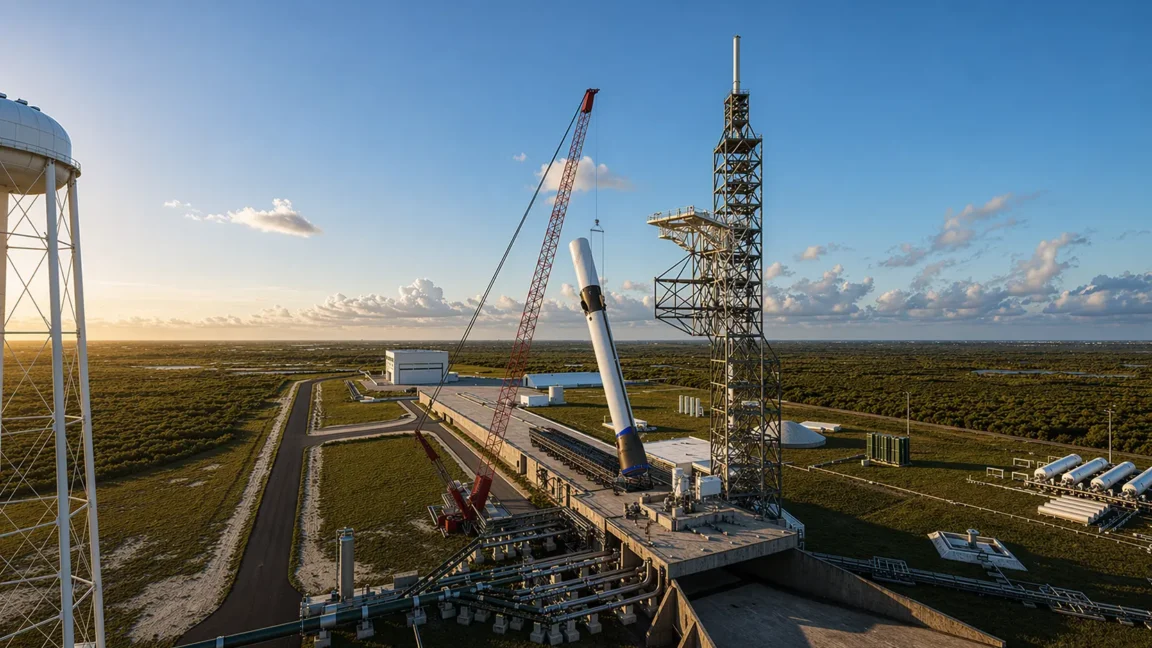
To circumvent the time-intensive process of rebuilding the transporter-erector—a gargantuan piece of infrastructure that typically ferries the rocket from the integration hangar to the launch pad—Blue Origin is opting for a more agile, albeit unconventional, solution. The company has released technical visualizations demonstrating the use of heavy-lift cranes to position the integrated first and second stages directly onto the launch mount. Under this revised workflow, the vehicle would be hoisted into place, subjected to rigorous pre-flight testing, and then topped with its payload fairing.
This pivot represents a significant departure from the traditional transporter-erector workflow, prioritizing speed and modularity over the conventional "roll-out" methods used by legacy launch providers.
NASA’s Prudence: The Contingency Calculus
While Blue Origin maintains its momentum, NASA is balancing its enthusiasm for the New Glenn program with the cold, hard realities of the Artemis III mission schedule. The agency’s commitment to the lunar program is absolute, but that commitment demands a risk-mitigation strategy that accounts for potential delays in any single component of the launch architecture.
Isaacman emphasized that prudence dictates NASA should maintain visibility into alternative launch vehicles. Should the New Glenn schedule experience further slippage, the agency is evaluating the capacity of the SpaceX Falcon Heavy and the United Launch Alliance (ULA) Vulcan rocket to serve as potential substitutes for the Endurance mission and other associated logistics.
“We’ve got time into 2027 before we’re getting nervous,” Isaacman said, providing a clear window for the industry to digest. “If we start tracking towards mid-2027, that has implications for the Artemis III mission, and for uncrewed landers, and that would be more concerning.”
This timeline reflects the immense pressure on the Artemis schedule. Every month of delay in heavy-lift validation ripples outward, affecting supply chains, crew training, and orbital alignment windows for lunar surface operations. NASA’s current posture is one of “active monitoring”—receiving daily updates from the Blue Origin team to ensure that any potential downstream impacts are identified before they become systemic failures.
Supporting Data and Industry Implications
The importance of New Glenn to the global space ecosystem cannot be overstated. As a reusable, heavy-lift vehicle, it is designed to fill a specific market gap: the transition between the medium-lift capabilities of current rockets and the ultra-heavy-lift requirements of deep-space exploration.
Key Technical Indicators:
- Infrastructure Adaptability: By moving to a crane-based assembly, Blue Origin is essentially "de-risking" its launch pad infrastructure, reducing the number of moving parts that could fail during critical pre-launch operations.
- Instrumentation Density: The high level of sensor data mentioned by Limp indicates a modern, data-driven approach to root-cause analysis, which generally leads to faster iteration cycles compared to the "tear-down and inspect" methods of the mid-20th century.
- Market Reliability: The interest from NASA in "Plan B" options (Falcon Heavy/Vulcan) highlights a shift in aerospace procurement. The government is no longer reliant on a single provider for heavy-lift capabilities, a trend that encourages competition and drives down costs.
Transparency as a Strategic Asset
Isaacman lauded Blue Origin for its newfound transparency during this recovery phase. In the competitive, often secretive world of private aerospace, Blue Origin’s willingness to share details regarding the anomaly and its subsequent mitigation strategy is seen as a sign of maturity.
“The broad interest within the space community in this topic is understandable,” Isaacman observed. “When you are talking about the primary architecture for a human return to the moon, the entire industry is effectively a stakeholder in your success.”
This transparency serves a dual purpose. First, it reassures the public and commercial partners that the company is managing its challenges with engineering discipline rather than marketing spin. Second, it helps maintain the confidence of the federal government, which remains the primary customer for the lunar lander missions.
The Path Ahead: Looking Toward 2027
As 2024 draws to a close, the focus shifts to the final weeks of the year. The success of the New Glenn’s first flight will be the ultimate validator of the engineering changes currently being implemented. Should the crane-assisted launch strategy prove successful, it will likely influence how Blue Origin approaches future launch pad designs, potentially leading to a more modular and robust infrastructure model.
However, the "mid-2027" threshold remains the true north for mission planners. While Isaacman and his counterparts remain supportive, the window for tolerance is narrowing. The next six months will be decisive. If Blue Origin hits its internal milestones, the New Glenn will solidify its position as a pillar of the lunar economy. If the anomaly resolution stretches beyond the projected window, the contingency plans currently being drafted by NASA will move from theoretical discussions to actionable procurement orders.
Ultimately, the situation underscores the inherent volatility of the New Space era. The transition from legacy launch paradigms to the high-cadence, high-stakes model of the 21st century is rarely linear. As Blue Origin works to hoist its rocket onto the launch mount with the help of cranes and a refreshed sense of urgency, the entire aerospace sector is reminded that in the pursuit of the moon, progress is rarely measured in perfectly smooth flights, but rather in the resilience of the team that refuses to be grounded by failure.
With the eyes of the global space community fixed on the Cape, the coming months will determine whether the New Glenn becomes the transformative vehicle its designers envision, or whether the burden of the Artemis schedule will necessitate a broader, more diversified reliance on the existing heavy-lift fleet. One thing is certain: in the high-stakes game of orbital logistics, the only thing more important than the rocket itself is the plan to keep the mission moving forward, regardless of the challenges on the ground.











