

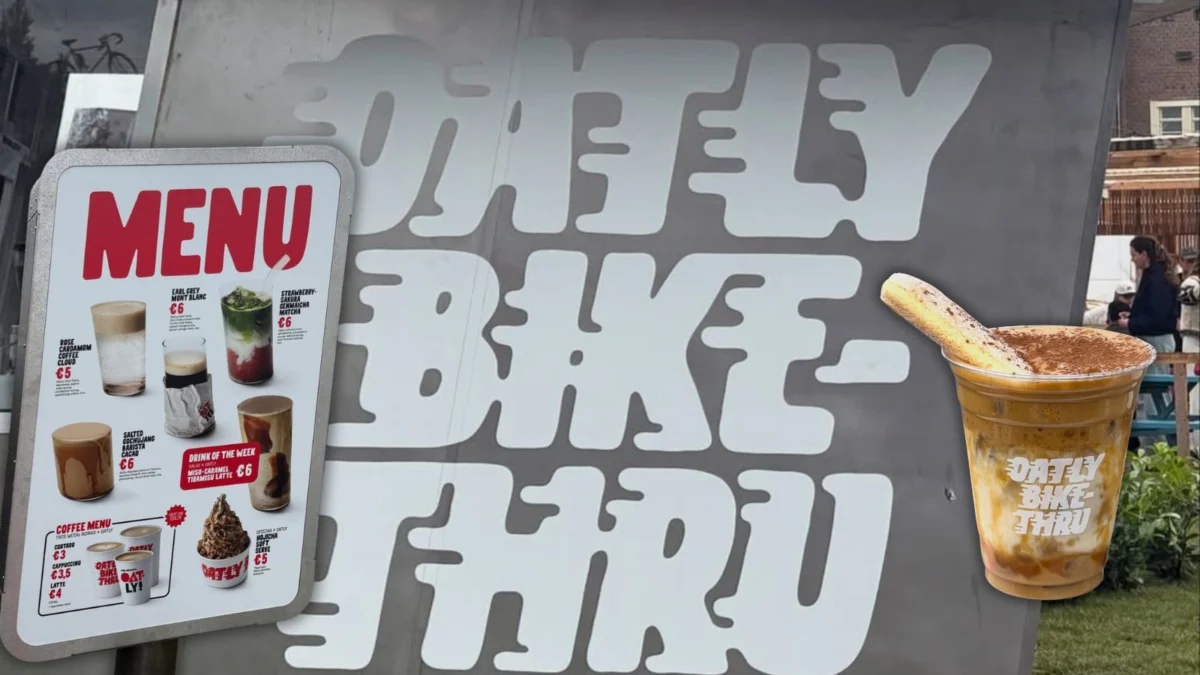
In a bold reimagining of the modern urban landscape, oat milk titan Oatly has unveiled an installation that challenges the car-centric convenience culture: the world’s first "bike-thru." Located at Papaverhoek 24 in Amsterdam, this temporary pop-up serves as both a functional coffee stop and a powerful statement on sustainable urban mobility. By allowing cyclists to order, pay, and collect specialty coffee without ever dismounting, the brand is positioning itself at the intersection of environmental activism and high-end café culture.
The activation, which opened its doors in mid-May 2026, is scheduled to run through June 7, 2026. It serves as a laboratory for the future of "fast" service, trading the carbon-heavy exhaust of traditional drive-thrus for the quiet hum of bicycle chains.
The Genesis of the Concept: Why Amsterdam?
Amsterdam was not chosen for the "bike-thru" by accident. With a cycling infrastructure that is the envy of the world and a cultural predisposition toward two-wheeled transit, the city serves as the perfect testing ground for Oatly’s vision. The installation features a dedicated, marked cycle lane that funnels riders directly to an ordering window, ensuring that the process is as seamless as a commute.
The initiative is part of a broader shift in how brands engage with the "green" consumer. Rather than simply promoting a product, Oatly is attempting to integrate itself into the daily rhythms of the city’s most sustainable commuters.
A Chronology of the Pop-Up
- May 15, 2026: Official opening of the bike-thru, featuring the inaugural residency of Barcelona-based roaster Nomad.
- May 23, 2026: Copenhagen’s April Coffee takes over, introducing Scandinavian brewing aesthetics to the Amsterdam cycling community.
- May 30, 2026: Wide Awake, an ethical roaster based in Brussels, begins their residency, focusing on sustainable sourcing.
- June 5–7, 2026: A grand finale weekend featuring a collaboration with local Amsterdam roaster, Dak.
- June 7, 2026: Final day of operation for the Papaverhoek 24 site.
Curating the Experience: A Global Coffee Journey
While the architecture of the bike-thru is novel, the product inside is equally experimental. Oatly has opted against a static menu, instead treating the pop-up as a rotating gallery for some of Europe’s most acclaimed independent roasters.
The menu highlights the versatility of oat milk in elevated, unconventional beverages. During the first week, customers were treated to a Miso Caramel Tiramisu Latte, a drink that pushed the boundaries of traditional coffee flavor profiles. The subsequent weeks have featured a shakerato-style beverage topped with woodruff cold foam, followed by the highly anticipated mystery drink curated by Wide Awake.
Beyond the rotating roasters, the brand has maintained a constant: the Oatly x Oficina Hojicha soft serve. This dairy-free treat has become a staple of the site, drawing in customers who may not even be in the market for a caffeine boost but are curious about the innovation behind the counter.
Official Responses and Corporate Philosophy
The logic behind the project is rooted in the belief that sustainable choices should be the path of least resistance. Christiaan van Doornik, General Manager for Oatly Benelux, encapsulated this sentiment in a statement provided to FONK Magazine:
"Moving sustainably should feel logical, not forced. Amsterdam had already chosen the bicycle. We only cycled towards the city."
This statement reflects a significant shift in corporate environmentalism. Rather than lecturing consumers on their carbon footprint, Oatly is attempting to optimize the "sustainable life" by making it more convenient than the status quo. By removing the need to park a bike, lock it, walk into a shop, and wait, the brand is providing a competitive advantage to the cyclist—a "speed" incentive for a greener lifestyle.
Integrating Digital Convenience: The ClassPass Partnership
Recognizing that modern convenience is as much about digital efficiency as it is about physical infrastructure, Oatly has partnered with ClassPass. Users of the app can book five-minute collection windows, effectively "reserving" their coffee in advance. This move not only prevents the build-up of bike traffic in the dedicated lane but also offers a 35% discount to app members, incentivizing the use of the platform and ensuring a steady flow of traffic.
This integration of digital logistics into a physical pop-up demonstrates how brands are moving toward a hybrid "phygital" model. By digitizing the queue, Oatly has ensured that their bike-thru functions with the precision of a high-end logistics hub, rather than a cluttered street stall.
Broader Implications: The Death of the Car-Centric Drive-Thru?
The Oatly bike-thru arrives at a time when the traditional drive-thru is facing increased scrutiny. As cities attempt to lower emissions and reclaim space from automobiles, the concept of a "drive-thru" is increasingly seen as a relic of the mid-20th century.
However, the "drive-thru" model—the ability to procure goods without leaving one’s vehicle—remains popular due to its inherent convenience. Oatly’s experiment effectively "hacks" this model. By replacing the 2,000-pound gas-powered vehicle with a bicycle, the brand maintains the speed and accessibility of the drive-thru while eliminating the environmental and spatial costs.
The "Viral" Contrast
The industry has taken note of such shifts, particularly when compared to the chaotic nature of traditional drive-thru culture. Earlier this year, a Chick-fil-A in Florida went viral when a customer attempted to traverse a drive-thru on horseback. The resulting confusion—where staff had no protocol for handling a non-motorized, biological "vehicle"—underscored the rigidity of current drive-thru infrastructure. Oatly’s design, by contrast, is a deliberate, proactive response to the evolution of urban transit.
Challenges and Future Outlook
While the bike-thru has been met with enthusiasm, it is not without its challenges. The primary issue for such installations is scalability. A bike-thru requires specific urban density, a culture of cycling, and the physical space to accommodate a lane that doesn’t obstruct existing traffic.
Furthermore, the rotating nature of the roasters, while excellent for engagement, makes it difficult for the brand to establish a standard operating procedure. Every week, the staff must adapt to new beans, new recipes, and new branding requirements from the visiting roasters.
Despite these logistical hurdles, the project serves as a powerful proof-of-concept. If Oatly can successfully demonstrate that consumers will prioritize a "bike-thru" over a traditional drive-thru when the experience is superior, we may see a wider adoption of this model by other chains.
Conclusion
The Oatly bike-thru in Amsterdam is more than just a marketing stunt; it is an urban design intervention. By validating the bicycle as a legitimate "vehicle" worthy of its own service infrastructure, Oatly is nudging the public toward a more sustainable future.
As the pop-up concludes on June 7, the data collected regarding traffic flow, customer wait times, and the popularity of the specialty menu will likely inform future activations. For now, the site stands as a testament to the idea that the most effective way to change consumer behavior is not to demand change, but to build a better, faster, and more enjoyable way to live.
As cities across the globe look to decrease their reliance on cars, the "bike-thru" may well transition from a novelty pop-up to a permanent fixture in the modern, eco-conscious metropolis. For the residents of Amsterdam, it is currently the gold standard for a morning commute: fast, caffeinated, and entirely carbon-neutral.











No comments yet. Be the first to join the conversation!