

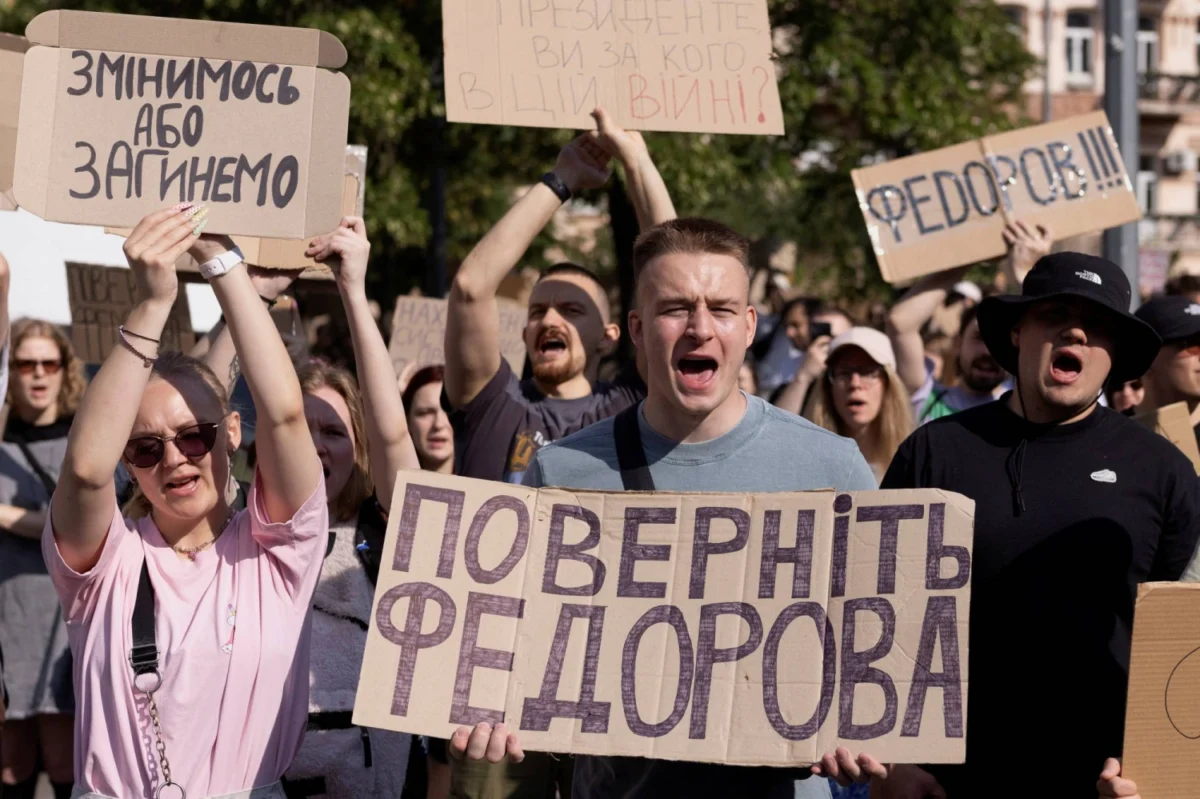
KYIV — The stability of Ukraine’s wartime leadership faced an unprecedented test this week as rare public demonstrations erupted across the capital and several regional hubs. The catalyst for the unrest: President Volodymyr Zelenskyy’s abrupt decision to remove Mykhailo Fedorov, the 35-year-old Minister of Defense, marking the second major cabinet overhaul within a single year.
As the echoes of protest ring through the streets of Kyiv, the move has laid bare deep-seated fractures within the Ukrainian government, signaling a brewing power struggle between the civilian administration and the military establishment. The dismissal of Fedorov—a tech-forward reformer credited with modernizing the country’s defense infrastructure—has ignited a firestorm of controversy, prompting not only civil unrest but a high-level resignation within the Air Force command.
The Core Conflict: A Clash of Visions
The tension that precipitated this crisis has been simmering for months. At the heart of the dispute is a fundamental disagreement over military strategy and institutional reform. Mykhailo Fedorov, who rose to prominence through his work in digital transformation, had been tasked with a Herculean mission: converting an outmanned and often bureaucratic Ukrainian army into a lean, tech-driven, and highly efficient fighting force capable of sustaining a long-term war of attrition against Russian aggression.
Sources close to the administration suggest that Fedorov’s reformist agenda frequently collided with the traditionalist approach championed by Kyiv’s top military brass. While Fedorov pushed for rapid integration of autonomous drones, AI-driven logistics, and decentralized command structures, senior military figures reportedly viewed these changes as risky departures from established doctrine.
The “spilling over” of this dispute into the public sphere represents a dangerous inflection point. For a nation that has largely maintained a unified front since the onset of the full-scale invasion, the open dissent signifies that the pressure of the protracted conflict is beginning to strain the internal mechanics of the Ukrainian state.
Chronology of the Crisis
- Monday, July 13: Reports emerge suggesting a cooling of relations between the Ministry of Defense and the General Staff regarding the procurement of new-generation battlefield technology.
- Tuesday, July 14: Internal briefings indicate that President Zelenskyy held closed-door meetings with military leadership to address "coordination inefficiencies."
- Wednesday, July 15: The Office of the President issues a brief, terse statement announcing that Mykhailo Fedorov would be stepping down as Minister of Defense, citing the need for "new strategic direction."
- Thursday, July 16 (Morning): News of the dismissal spreads, triggering spontaneous gatherings of protestors in Independence Square.
- Thursday, July 16 (Afternoon): Hundreds of demonstrators, including volunteers, tech entrepreneurs, and civil society leaders, march to the presidential administration building.
- Thursday, July 16 (Evening): A senior commander of the Air Force announces his resignation in solidarity with the reformist wing, citing the removal of Fedorov as a "misguided step that jeopardizes our technological edge."
Public Outcry and the "Fedorov Factor"
The public response to Fedorov’s exit has been unusually vocal for a country currently under martial law. Protesters are not merely calling for his reinstatement; they are demanding transparency regarding the decision-making processes that guide the nation’s defense strategy.
"Fedorov was not just a politician; he was the bridge between our tech sector and the front lines," said Olena Petrovska, a volunteer who has worked with drone-procurement initiatives since 2022. "Removing him now, while we are fighting for our survival, feels like an attempt to revert to the old ways of doing things. We want a modern army, not a bureaucratic one."
The sentiment is shared by many in the private sector. Since his appointment, Fedorov had been instrumental in mobilizing the "IT Army," a loose coalition of coders and engineers who have provided Ukraine with a significant asymmetric advantage in cyber warfare and tactical intelligence. His removal has sparked fears that the momentum of these initiatives will be lost, potentially stalling the technological breakthroughs essential to countering Russia’s larger conventional force.
Supporting Data: The Strategic Necessity of Modernization
The stakes of this leadership change are underscored by the current state of the battlefield. Military analysts have long noted that Ukraine’s ability to survive has depended on its capacity to do more with less.

- Drone Integration: Under Fedorov’s leadership, the Ministry of Defense saw a 300% increase in the procurement and deployment of domestically produced FPV (First Person View) drones.
- Digital Logistics: The implementation of the "Delta" situational awareness system, championed by the Ministry, allowed for real-time battlefield data sharing, which proved critical in several key defensive operations in the east.
- Personnel Efficiency: Reformist efforts were aimed at digitizing recruitment and reducing the administrative burden on front-line units, an area where the military establishment has faced persistent criticism.
By sidelining the architect of these programs, the Zelenskyy administration risks alienating the very tech ecosystem that has provided the country with its most significant tactical advantages.
Official Responses: Navigating the Fallout
The President’s office has attempted to mitigate the backlash by framing the change as a routine, albeit necessary, administrative transition. In a televised address, a spokesperson for the administration stated, "The President is grateful for the service provided by Minister Fedorov. However, the nature of this war is evolving. We require leadership that can balance technological innovation with deep, traditional military expertise. This is about evolution, not abandonment."
However, this rhetoric has done little to satisfy critics. Opposition lawmakers have called for an emergency parliamentary session to review the decision. Even within the ruling "Servant of the People" party, some members have expressed private concerns that the move could be perceived as a consolidation of power rather than a strategic reshuffle.
The resignation of the Air Force commander—a figure respected for his role in maintaining the integrity of Ukraine’s skies—adds a layer of professional military disapproval that the President cannot easily dismiss as mere "civilian political noise."
Implications: The Road Ahead
The implications of this cabinet shakeup are profound. First, it signals that the "honeymoon period" of absolute unity within the Ukrainian leadership may be over. As the war enters a more grinding phase, the competition for resources, budget, and strategic influence between the civilian government and the military high command is likely to intensify.
Second, the unrest poses a significant diplomatic challenge. Ukraine’s Western allies, who provide the funding and equipment necessary for the war effort, have consistently emphasized the need for transparent and stable governance. Public protests and high-level resignations in the middle of a cabinet reshuffle could provide ammunition to critics in the U.S. and Europe who argue that Ukraine’s internal political stability is fragile.
Finally, there is the question of morale. The volunteers and the tech community represent a vital pillar of the Ukrainian war effort. By creating a rift with this demographic, the administration risks damaging the informal but highly effective networks that have served as a force multiplier for the regular army.
As Kyiv heads into the weekend, the government remains under immense pressure. Whether Zelenskyy can effectively pivot to a new defense strategy without losing the trust of the civil society that has supported him so fervently remains the defining question of his presidency. The protests in Kyiv are not just about a single man; they are about the soul of Ukraine’s resistance—a movement that has prided itself on agility, transparency, and a modern, forward-looking vision for the future of the nation.
If the administration fails to address these concerns, the current unrest may prove to be the precursor to a much larger movement for structural reform that could fundamentally change the political landscape of wartime Ukraine. For now, the city remains on edge, waiting to see if the President will provide the transparency the people demand, or if he will double down on a path that is increasingly being challenged by those he is meant to lead.











