


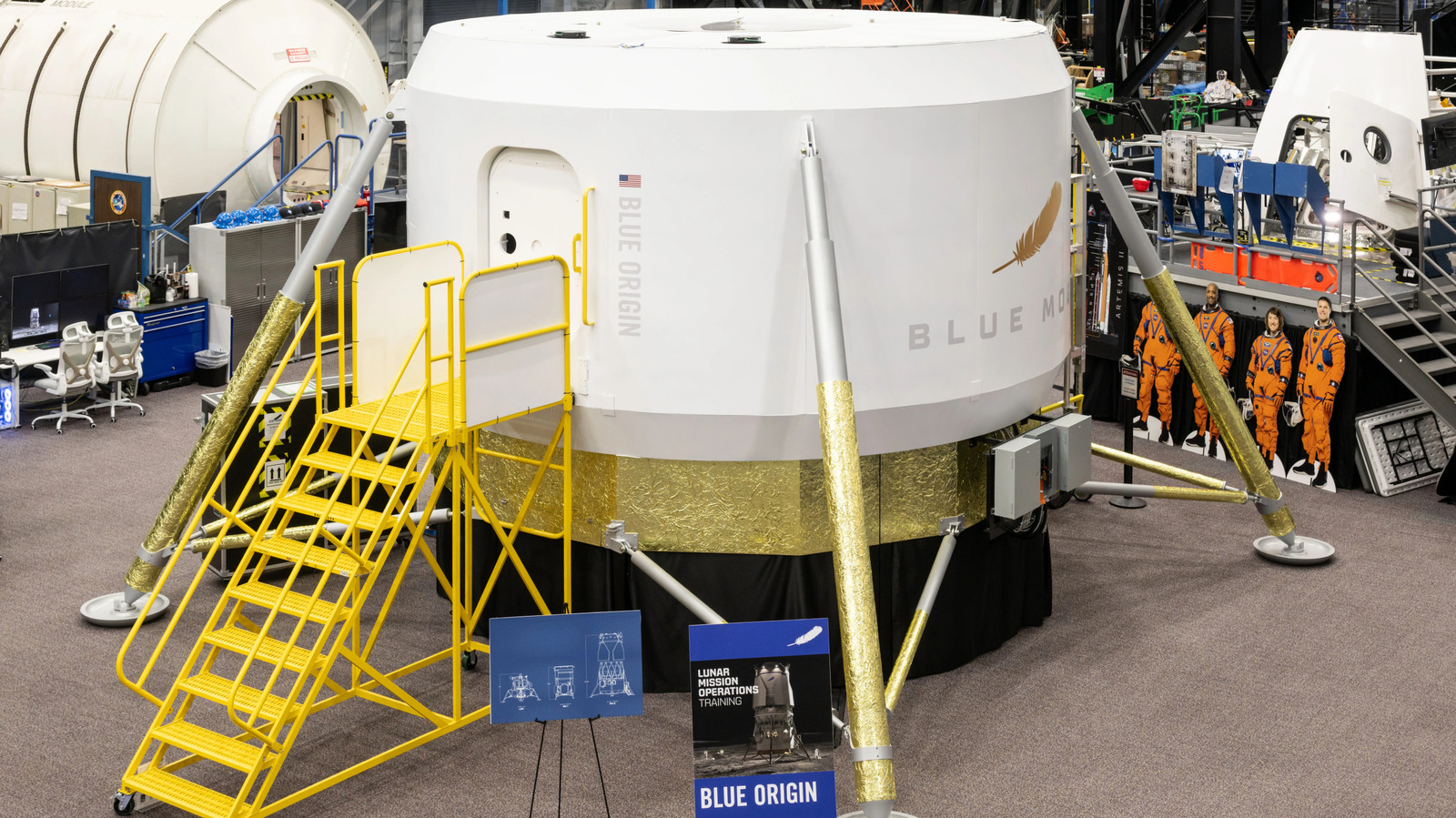
The United States’ ambition to re-establish a permanent human presence on the lunar surface has taken a tangible, steel-and-aluminum step forward. Following the successful completion of the Artemis II mission—a historic flight that saw a crewed Orion spacecraft loop around the Moon—NASA has officially shifted its operational focus toward the logistics of surface exploration. As part of this transition, the agency has received and installed a full-scale prototype of the crew cabin for Blue Origin’s "Blue Moon" Mark 2 lander at the Johnson Space Center in Houston, Texas.
This milestone represents more than a symbolic achievement; it is the beginning of the rigorous "human-in-the-loop" testing phase required to ensure that when astronauts eventually touch down, they are prepared for the unforgiving reality of the lunar environment.
The Anatomy of the Mission: Main Facts
The prototype currently sitting in Houston is a 15-foot-tall replica of the crew cabin that will eventually serve as the home and workspace for Artemis astronauts. While the final vehicle will tower over 52 feet when fully integrated with its propulsion and life-support systems, the cabin represents the "business end" of the mission.
The primary objective of this hardware is to facilitate high-fidelity simulations. NASA engineers and astronauts will use this mock-up to:
- Refine Mission Scenarios: Practicing the ingress and egress procedures under simulated lunar gravity and constraints.
- Communication Protocols: Testing the link between the lunar surface and mission control in Houston.
- Spacesuit Integration: Evaluating how bulky Extravehicular Activity (EVA) suits interact with the hatch, airlocks, and cabin interfaces.
- Simulated Moonwalks: Perfecting the transition from the cabin to the lunar regolith, ensuring that equipment deployment and geological sampling procedures are streamlined.
By integrating Blue Origin into the ground-based testing cycle, NASA is signaling its commitment to a multi-provider strategy. By leveraging both Blue Origin and SpaceX, the agency aims to build a redundant, robust lunar transportation infrastructure that reduces the risks associated with relying on a single launch vehicle or lander design.
A Chronology of the Artemis Era
The path to the moon has been characterized by iterative testing, historical milestones, and the occasional setback. To understand the significance of this current training phase, one must look at the timeline of the Artemis program:
- Artemis I (2022): The uncrewed test flight of the Space Launch System (SLS) and Orion capsule proved the viability of the heavy-lift architecture.
- Artemis II (2024-2025): The crewed mission successfully validated life-support systems and navigation during a 10-day circumlunar journey.
- Thermal Vacuum Testing (2024-2025): Blue Origin’s uncrewed "Endurance" (MK1) lander successfully underwent extreme thermal vacuum chamber testing at NASA facilities, proving the craft’s ability to withstand the radical temperature shifts of the lunar environment.
- Current Phase: The arrival of the Blue Moon Mark 2 prototype at Johnson Space Center marks the transition from purely structural testing to operational human readiness.
- Artemis III (Targeting 2027): This mission is set to test critical orbital docking capabilities, allowing the Orion spacecraft to link up with a lander in low Earth orbit or lunar orbit.
- Lunar Landing Goal (2028): NASA’s current target for the first crewed landing of the modern era, leveraging the finalized landers from industry partners.
Supporting Data: The Challenges of Lunar Landing
Landing on the Moon is statistically one of the most difficult feats in aerospace engineering. Recent history serves as a sobering reminder of the hazards involved. The "soft landing" remains elusive for many:
- The Peregrine Mission: The Astrobotic lander suffered a propulsion failure, leading to a controlled re-entry into Earth’s atmosphere.
- Intuitive Machines’ Odysseus: While ultimately successful in sending data, the lander tipped over upon touchdown due to landing gear complications, highlighting the extreme sensitivity of terrain-relative navigation.
- Hakuto-R: The Japanese iSpace mission crashed due to an altimeter error that mistook a crater rim for the lunar surface, underscoring the necessity for advanced sensor fusion.
These failures have informed the design of the Blue Moon lander. NASA is demanding high-redundancy systems and advanced hazard-avoidance algorithms to ensure that the Blue Moon can autonomously identify safe landing zones and navigate around boulders or craters that could compromise the mission.
Official Responses and Industry Collaboration
NASA’s decision to integrate private industry into the Artemis program is a strategic shift from the Apollo era, where the agency owned the design and manufacturing. Today, NASA acts as a customer and a partner.
In a recent briefing, NASA representatives emphasized the "Human Landing System" (HLS) program’s goal: "The integration of this mock-up is a vital step in our human-centric approach. We aren’t just building a vehicle; we are building an operational workflow that must be instinctive for the crew."
Blue Origin, for its part, has framed the Mark 2 development as an evolution of its orbital launch experience. By utilizing lessons learned from its New Shepard rocket and the development of the BE-7 engine, the company claims it is building a "sustainable" lander that can eventually serve as a permanent ferry between lunar orbit and the surface.
Implications: The Long-Term Vision
The training prototype is not merely a tool for a single mission; it is the foundation for a sustainable lunar economy. The implications of this development are threefold:
1. Risk Mitigation via Redundancy
By working with both SpaceX and Blue Origin, NASA ensures that if one provider faces a delay or a technical hurdle, the other can serve as a primary or secondary option. This competitive environment has spurred both companies to accelerate their R&D, moving from paper designs to physical prototypes at a pace rarely seen in government-only space programs.
2. The Move Toward Sustained Presence
The Artemis program is not about "planting a flag and leaving," as was the case in 1969. The goal is to build a base camp near the lunar south pole. The Blue Moon lander’s design, which emphasizes cargo capacity and potential long-term habitability, reflects this. The training currently being conducted at the Johnson Space Center includes simulations for moving scientific equipment, which will be essential for identifying lunar ice deposits and other resources.
3. Advancing Human Factors Engineering
The "human-in-the-loop" testing phase is arguably the most critical component for mission success. Even the most sophisticated autonomous system can be overridden or supplemented by human intuition. By training with the prototype, NASA is collecting terabytes of data on how astronauts move within a confined, low-gravity-capable environment. This data will inform everything from the placement of light switches to the ergonomic design of the cockpit consoles, ensuring that the crew remains focused on science and exploration rather than fighting their own hardware.
Conclusion
As the Artemis program gathers momentum, the sight of the Blue Moon prototype in Houston serves as a powerful reminder that the return to the Moon is no longer a distant aspiration—it is an active engineering project. The road to 2028 is paved with technical challenges, from the volatility of lunar dust to the complexities of orbital docking. However, by prioritizing human-centric training and fostering a competitive landscape between commercial partners, NASA is meticulously de-risking the journey.
The coming months will see astronauts begin the physical act of "practicing the moon," a vital ritual that ensures that when the first boot prints are made in the lunar regolith in the coming years, they will be the result of the most comprehensive preparation in the history of spaceflight.











No comments yet. Be the first to join the conversation!