Iffa Jayyana
By Editorial Staff
June 20, 2026
In an era where Western media giants often tread carefully around the political sensitivities of the White House, the international anime landscape has reminded audiences of the medium’s unique ability to serve as a mirror to power. This week, the hit series Baki-Dou: The Invincible Samurai caused a massive stir in the cultural zeitgeist with an episode that bypassed subtle allegory in favor of a visceral, unflinching, and highly controversial depiction of American political leadership.
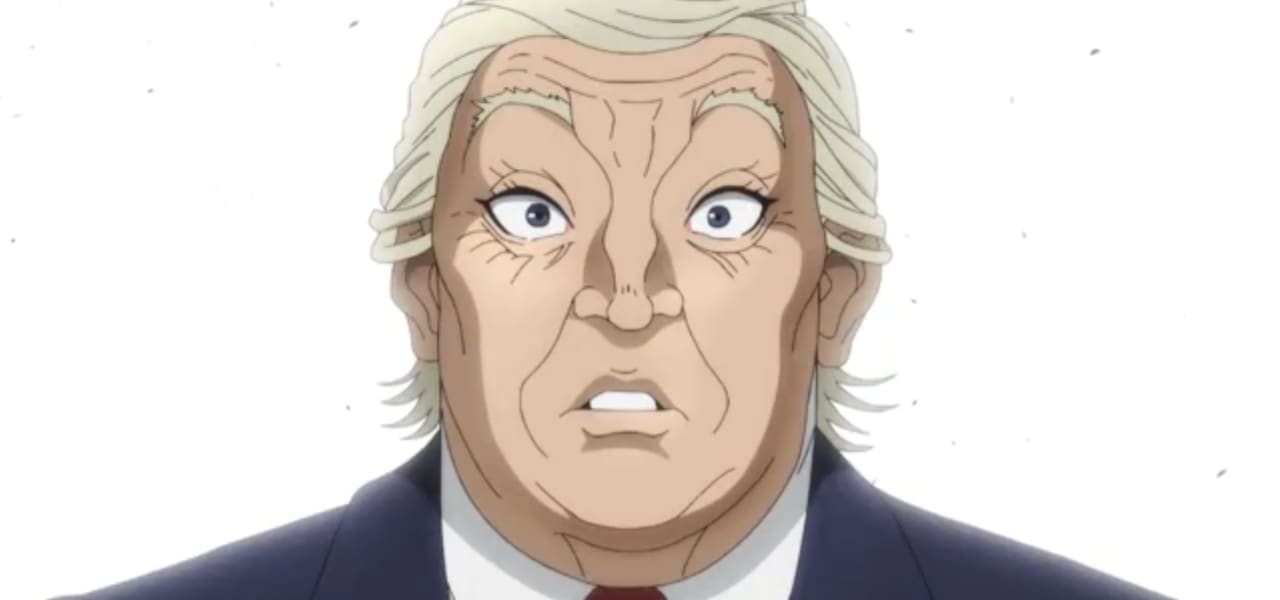
The latest season features a narrative arc involving a character named "President Tranp," whose arrival in the series has sparked intense debate regarding the boundaries of political satire in animation.
The Core Incident: A Moment of Unintended Humiliation
The controversy centers on a pivotal scene in the second part of the current season. As the plot unfolds, President Tranp is depicted arriving at his inauguration, tasked with the ceremonial requirement of pledging personal loyalty to Yujiro Hanma, the world’s most powerful superhuman fighter.
In the narrative of Baki-Dou, Hanma represents the absolute apex of human strength—a force of nature that dictates global policy through sheer physical dominance. Tranp, mirroring his real-world counterpart’s rhetoric, initially projects an air of defiance, railing against the emasculating nature of the mandatory oath. He vows to bypass the ritual entirely. However, the tension breaks the moment he locks eyes with Hanma. In a moment of stark, humiliating physical failure, the character is depicted losing total control of his bladder, leaving a puddle at his feet before frantically reciting the oath he claimed he would ignore.
The clip, which has since gone viral on platforms like X (formerly Twitter), has been viewed millions of times, drawing sharp lines between those who see it as a biting critique of political performativity and those who view it as an unnecessary escalation of media hostility.
Chronology: From Manga Page to Global Viral Sensation
The trajectory of this controversy began with the publication of Keisuke Itagaki’s original manga, where the depiction of international leaders has always been a staple of the Baki franchise’s high-octane, hyper-masculine world.
- Late 2025: Speculation began regarding the adaptation of the "Inauguration Arc" as production studios teased the inclusion of international political figures.
- Early June 2026: Leaks from the animation production team suggested that the "Tranp" character would be treated with even less reverence than previous leaders depicted in the franchise.
- June 19, 2026: The episode aired globally via streaming platforms. Within hours, social media platforms were flooded with screen-grabs and video clips.
- June 20, 2026: International media outlets began reporting on the viral nature of the scene, marking a rare moment where a niche anime series crossed over into mainstream political discourse.
Supporting Data: The Anime Industry’s "Autonomy"
The Baki franchise is part of a broader trend in Japanese animation where the "superhuman" genre frequently intersects with real-world geopolitical anxieties. Unlike domestic U.S. programming, which is often subject to the pressures of corporate consolidation and direct political lobbying, the anime industry—largely based in Tokyo—operates with a different set of cultural incentives.
Industry analysts note that while Japanese studios are generally risk-averse, they prioritize the "purity" of the creator’s vision. Keisuke Itagaki, the creator of Baki, has long utilized hyperbole as his primary storytelling device. In his world, the physical manifestations of fear are the ultimate truth-tellers. When characters face Yujiro Hanma, their bodies betray them, representing a loss of agency that transcends political affiliation.
Official Responses and Public Sentiment
As of the morning of June 20, there has been no official comment from the White House regarding the depiction of the "Tranp" character. However, representatives from the production committee behind Baki-Dou issued a brief statement:
"The Baki series has always been a reflection of strength, weakness, and the absurdity of power. We do not comment on specific character inspirations, but we stand by the creative vision of the production team to depict the internal psychology of our characters as they confront forces beyond their control."
Public sentiment remains polarized. On one side, fans of the series argue that the show is simply adhering to its established brand of extreme, transgressive satire. On the other, critics—including various political pundits—have argued that the depiction crosses a line into "coordinated digital propaganda," questioning whether such imagery is appropriate for global broadcasts.
Implications: The Changing Landscape of Political Satire
The Baki-Dou incident arrives at a critical juncture for the entertainment industry. In the United States, late-night television has faced a period of "softening" in its political commentary, with several high-profile hosts facing pressures to align with the current administration’s talking points. Simultaneously, the rise of government-backed "documentary" content on major streaming platforms has led to a perception that Western entertainment is becoming increasingly homogenized.
The fact that an anime series—a medium often dismissed as "niche"—has become the primary vehicle for this level of political critique suggests a shifting power dynamic in global media.
.png)
1. The Erosion of Domestic Satire
When domestic platforms are perceived as "clamped down," international media inevitably fills the vacuum. The success of the Baki clip suggests that audiences are actively seeking content that feels "unfiltered," regardless of whether they agree with the message.
2. The Global Stage
The incident also highlights how anime has transcended its cultural borders. A show produced in Japan for a domestic audience is now being consumed, debated, and analyzed by an American electorate, effectively turning a Japanese animation studio into an unlikely participant in the U.S. culture war.
3. The Future of Characterized Leadership
Will this set a precedent? Historically, shows like South Park and The Simpsons served as the vanguard of political satire in the U.S. However, as those properties have faced corporate pushback, the baton is being picked up by foreign creators who are not beholden to the same domestic regulatory or economic pressures.
Conclusion
Whether one views the depiction of President Tranp as a masterclass in satire or a gross breach of decorum, the impact of Baki-Dou cannot be understated. It serves as a stark reminder that in the age of global streaming, no political figure is safe from the creative, often brutal, gaze of international animators. As the season progresses, it is likely that the "Tranp" arc will remain a focal point of discussion, not just for anime fans, but for anyone tracking the intersection of pop culture and political discourse in the 21st century.
The "Invincible Samurai" may deal in fiction, but the conversation it has sparked is undeniably real.


 Basiran
 Ammar Sabilarrohman