

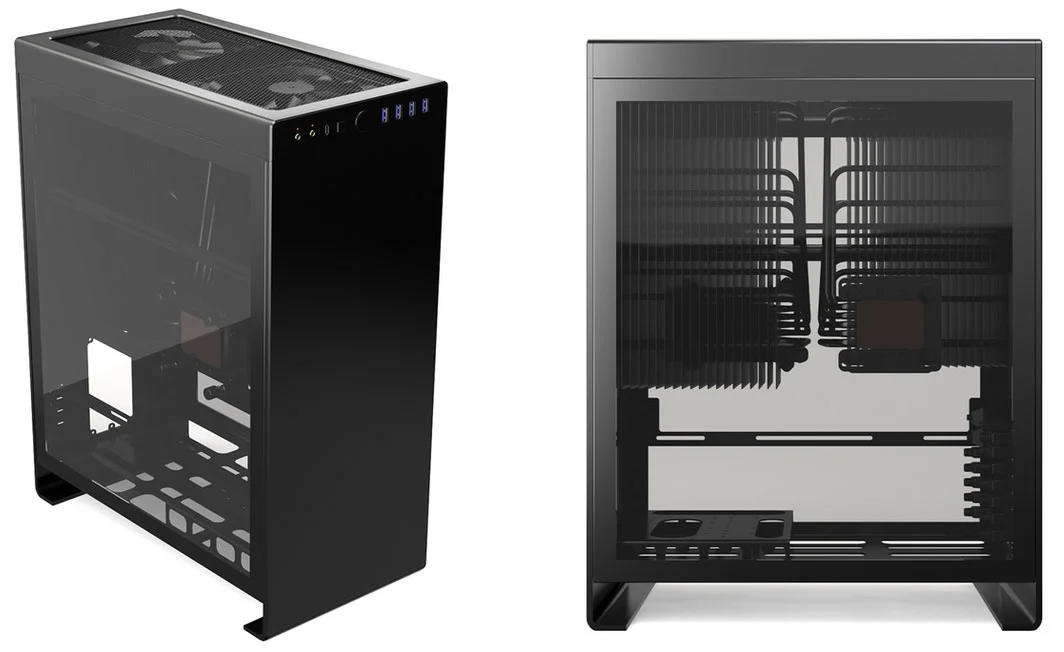
The pursuit of the "perfect" PC is a journey often defined by compromises. Enthusiasts must choose between raw, unbridled performance—often accompanied by the jet-engine roar of high-RPM fans—or a compact, whisper-quiet system that struggles to dissipate the heat generated by modern high-TDP processors and graphics cards. MonsterLabo, a boutique chassis manufacturer, has spent the better part of the last few years attempting to shatter this dichotomy. Their latest update to "The Beast," a monolithic, passively cooled PC chassis, marks a significant milestone in the evolution of silent computing.
Launched recently via Indiegogo, the updated design of The Beast aims to address the limitations of previous iterations while expanding customization options for those who demand both aesthetic individuality and absolute silence.
The Evolution of Passive Cooling: A Chronology of The Beast
The concept of a truly high-performance, fanless PC was once relegated to the realm of low-power NUCs and office workstations. MonsterLabo changed the conversation in March 2021, when they demonstrated a prototype of The Beast. During that public demo, the system was configured with an AMD Ryzen 3800X and an Nvidia GeForce RTX 3080—components that would typically require aggressive active cooling solutions.
Running the hardware-intensive Microsoft Flight Simulator 2020 at 1440p on an ultrawide monitor, the system achieved what many deemed impossible: stable thermal management without a single spinning fan. The CPU maintained a steady 75°C, while the GPU hovered at a comfortable 65°C. This proof-of-concept served as the catalyst for the current Indiegogo campaign, which introduces a refined, more versatile version of the chassis designed for a broader range of high-end hardware.
The Heart of the Machine: Engineering Thermal Equilibrium
At the core of The Beast’s thermal performance lies "The Heart," an ambitious cooling block that accounts for nearly half of the chassis’s internal volume. In the latest iteration, this has been upgraded to "The Heart²."
While the nomenclature implies a significant internal redesign, technical analysis suggests that the core cooling architecture remains consistent with its predecessor. The block is bifurcated into two distinct sections: one dedicated to the CPU and the other to the GPU. These massive aluminum structures act as a giant heat sink, drawing thermal energy away from the components and dissipating it through the chassis’s exterior fins.
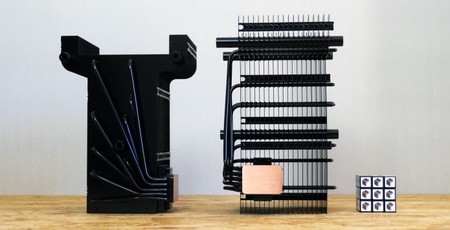
The most notable engineering improvement in this generation is the strategic collaboration with EKWB. MonsterLabo has integrated specialized heat spreaders—developed alongside the water-cooling experts at EKWB—for memory modules and for graphics cards with a Thermal Design Power (TDP) exceeding 220W. This partnership addresses a common failure point in passive builds: the accumulation of heat in secondary components like VRAM and VRMs (Voltage Regulator Modules), which often lack sufficient airflow in traditional silent builds.
Supporting Data: Real-World Performance and Stress Testing
To understand the capabilities of the new Beast, we look toward independent benchmarks, such as the recent deep-dive by Optimum Tech. The system was put to the test using an Intel i9-10900K—a notoriously hot-running processor—configured to run at 4.5GHz on all 10 cores at 1.13V.
Under these conditions, the CPU stabilized at 89°C. While this is certainly at the upper end of the thermal envelope, it is a testament to the chassis’s capability that a high-end 10-core chip could operate indefinitely without thermal throttling in a completely fanless environment.
The GPU, an RTX 3080, required a more delicate touch. By utilizing MSI Afterburner to apply an undervolt and a modest 150-200MHz base clock reduction, the GPU was kept at a stable, sub-80°C temperature under heavy load. To ensure the build remained "fully silent," the build utilized a SilverStone NightJar PSU, a high-quality fanless power supply unit. These results highlight a critical takeaway for potential buyers: building a fanless PC is as much about component selection as it is about the case itself. MonsterLabo and industry experts strongly advise choosing motherboards with "overspecced" VRM sections and robust, integrated heatsinks, as the lack of moving air makes the motherboard’s own thermal management capabilities vital to the system’s longevity.
Implications for the PC Enthusiast Market
The release of the updated Beast signifies a shift in the high-end PC market. For years, the "silent PC" crowd was limited to underpowered components. MonsterLabo is effectively proving that the "performance ceiling" for fanless systems is moving rapidly upward.
However, this luxury comes with significant implications:
- Complexity of Assembly: Unlike standard ATX cases, building in The Beast requires meticulous planning. Thermal management is entirely dependent on the physical contact between the components and the cooling blocks. Users must be comfortable with undervolting, power limiting, and specialized hardware installation.
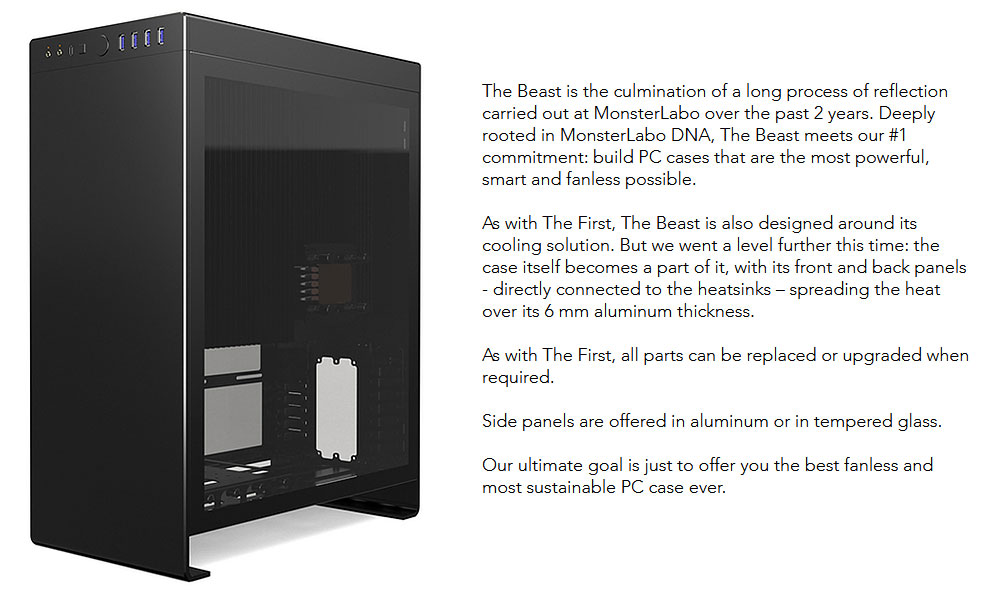
- Aesthetic Customization: Recognizing that enthusiasts often want their rigs to be unique, MonsterLabo has introduced custom color finishes and logo engraving services. This move directly addresses the "boutique" nature of their clientele, allowing owners to move away from the industrial, utilitarian look of raw aluminum.
- The "Pre-Built" Shift: By offering pre-built options starting at €2,850, MonsterLabo is lowering the barrier to entry for users who want the silence of a fanless PC without the potential pitfalls of a custom build. They have also begun offering an assembly service for customers who supply their own parts, including "fanless optimization" performed by their technicians. This service is a game-changer, ensuring that components are correctly thermal-gapped and optimized for the unique requirements of passive cooling.
Official Responses and Availability
MonsterLabo has been clear about their production roadmap. The Indiegogo campaign serves as both a funding mechanism and a way to manage the logistics of producing such a heavy, precision-engineered product.
For those looking to secure a unit, the timelines are staggered:
- The Christmas Batch: As of the latest report, the initial batch is nearing completion, with the final unit being allocated for immediate shipping.
- The Easter Batch: A secondary production run is slated for completion in April 2022. With roughly 197 units remaining, this represents the primary window for interested buyers.
- The Brass Edition: A limited-run "Brass Edition" of The Beast is also expected to ship by Easter 2022. This variant is aimed at high-end collectors, though it remains to be seen how the material will affect the chassis’s thermal mass and oxidation over time.
Conclusion: Is Silence Worth the Price?
The Beast by MonsterLabo is not a product for the casual gamer. It is an engineering statement—a bridge between the aesthetic of a sculpture and the raw power of a workstation. By embracing the limitations of passive cooling and turning them into a design philosophy, MonsterLabo has carved out a unique niche in the industry.
For the user who values a silent environment—whether for professional audio production, focused research, or simply the desire for a disturbance-free gaming experience—The Beast represents the pinnacle of modern cooling technology. It demands patience, a higher financial investment, and a willingness to engage with the finer points of hardware tuning. Yet, for those who successfully tame its requirements, the result is a machine that performs at the top of its class while remaining entirely, and profoundly, silent.
As the industry moves toward higher power densities and even hotter components, MonsterLabo’s approach may prove to be more than just a niche hobbyist trend. It may well be the blueprint for the next generation of high-performance, sustainable, and noise-free computing.












No comments yet. Be the first to join the conversation!