

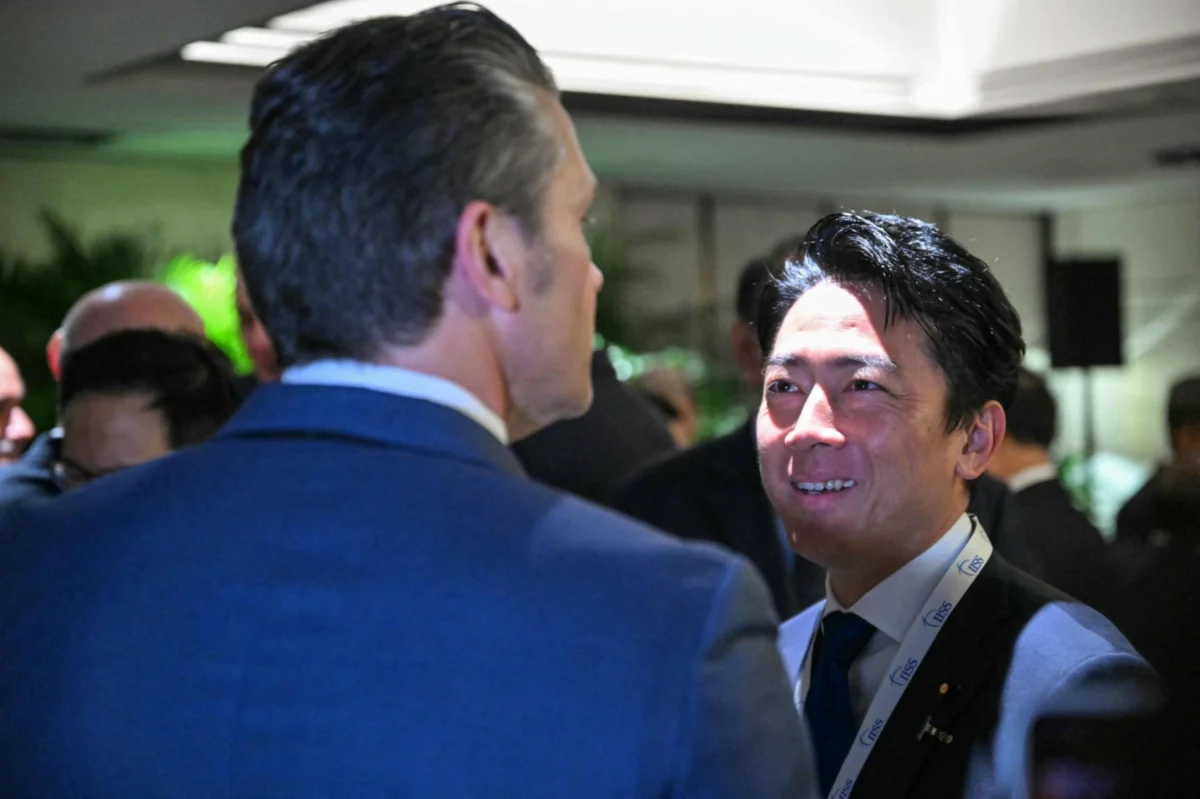
SINGAPORE — As the geopolitical temperature in the Indo-Pacific continues to rise, the Shangri-La Dialogue—Asia’s premier defense summit—served as the backdrop for a pivotal recalibration of the U.S.-Japan security alliance. On Saturday, U.S. Secretary of Defense Pete Hegseth and Japanese Defense Minister Shinjiro Koizumi held a high-stakes ministerial roundtable, signaling a shift from traditional military posturing toward a deep, structural integration of the two nations’ defense-industrial bases.
The meeting, held amidst the bustling security forum in Singapore, underscored a burgeoning consensus in Washington and Tokyo: that the current pace of military modernization is insufficient to counter the rapid expansion of Chinese naval and missile capabilities. By prioritizing joint production and supply chain resilience, the two defense chiefs are moving to ensure that the U.S.-Japan alliance remains the bedrock of regional stability.
The Strategic Imperative: Bridging the Gap
The meeting between Hegseth and Koizumi did not occur in a vacuum. Only hours before their formal bilateral discussions, Secretary Hegseth delivered a pointed address during a plenary session at the Shangri-La Dialogue, where he urged Japan to assume a more proactive role in its own defense.
Hegseth’s message was clear: the era of the United States acting as the sole "security guarantor" in the Pacific is evolving into a model of shared responsibility. For Japan, this shift necessitates a departure from long-standing constitutional constraints and historical hesitations regarding defense spending and arms production.
Minister Koizumi, representing a Japanese administration increasingly cognizant of the vulnerabilities in its own backyard, met this challenge with a focus on practical implementation. The dialogue between the two men centered on the "industrialization of security"—the idea that the next conflict in the Pacific will be won not just by the most advanced aircraft, but by the nation or alliance that can produce, maintain, and replace munitions faster than its adversary.
Chronology of the Summit Engagements
The events of the weekend in Singapore reflect the accelerated tempo of Indo-Pacific diplomacy:
- Friday Evening: Security delegations arrived in Singapore, with informal consultations taking place behind closed doors. Intelligence assessments regarding Chinese maneuvers in the South China Sea and around the Taiwan Strait were shared among key regional partners.
- Saturday Morning (Keynote): Secretary Hegseth addressed the Shangri-La Dialogue, emphasizing that "the defense of the Indo-Pacific requires an industrial base that is as agile as the threats it faces."
- Saturday Afternoon (Bilateral Meeting): Secretary Hegseth and Minister Koizumi convened for their ministerial roundtable. The discussion moved past abstract commitments and into the logistical weeds of defense-industrial cooperation.
- Saturday Evening (Press Readout): The Japanese Ministry of Defense released a summary indicating that both parties had reached an agreement to fast-track joint development programs, specifically regarding advanced missile systems and unmanned aerial platforms.
Supporting Data: The Case for Industrial Integration
The urgency driving the Hegseth-Koizumi talks is backed by sobering data regarding regional power balances. According to recent defense intelligence reports cited during the summit:
- Missile Disparity: The People’s Liberation Army (PLA) has deployed an arsenal of medium-range ballistic missiles that currently outnumber combined U.S. and Japanese inventories in the theater by a significant margin.
- Manufacturing Bottlenecks: Analysis from think tanks like the Center for Strategic and International Studies (CSIS) has highlighted that current U.S. production lines for precision-guided munitions would be exhausted within weeks of a high-intensity conflict in the Indo-Pacific.
- The "Japan Factor": Japan’s sophisticated manufacturing sector—particularly in robotics, metallurgy, and high-end electronics—offers the United States a critical lifeline to mitigate its domestic manufacturing shortfall.
During their talks, the two ministers explored the "streamlining of acquisition processes." This suggests a move toward legal and bureaucratic harmonization, allowing Japanese firms to legally integrate into the U.S. defense supply chain—a move that was nearly impossible just a decade ago due to Japan’s strict arms export controls.
Official Responses and Diplomatic Nuance
The tone of the official readouts from both the Pentagon and Japan’s Ministry of Defense was one of calculated optimism.
A spokesperson for the U.S. Department of Defense stated, "Secretary Hegseth and Minister Koizumi have reaffirmed that the security environment in the Indo-Pacific requires a new level of industrial partnership. We are moving from buying off-the-shelf to building together."

From Tokyo, Minister Koizumi’s office emphasized the "sovereignty-preserving" nature of the partnership. "Japan is committed to contributing to regional peace," the ministry stated. "By deepening our industrial ties with the United States, we are not merely purchasing equipment; we are building a resilient, shared ecosystem that deters aggression before it manifests."
However, the response from Beijing was immediate and critical. A spokesperson for the Chinese Foreign Ministry labeled the summit as "an attempt to create a regional military bloc," warning that such moves would only "exacerbate regional tensions and undermine the collective security architecture of Asia."
Implications: The Future of the Alliance
The outcomes of the Singapore meetings carry profound implications for the next decade of Pacific security:
1. Shift Toward "Co-Production"
The most significant takeaway is the shift toward co-production. This is not merely an agreement to sell weapons; it is an agreement to build them together. This implies that future missile systems, potentially including next-generation interceptors, will be designed with components sourced from both U.S. and Japanese factories. This creates a "dual-redundancy" in the supply chain—if a factory in the U.S. is incapacitated, the Japanese facility can surge production, and vice versa.
2. Legal and Regulatory Reform
To achieve these goals, both governments will need to navigate complex legal frameworks. In the United States, this may involve reforms to the International Traffic in Arms Regulations (ITAR) to allow for easier technology transfers to Japan. In Japan, it requires continued public and legislative support for the gradual loosening of the "Three Principles on Transfer of Defense Equipment and Technology."
3. Deterrence as a Technical Capability
The alliance is signaling to regional adversaries that the cost of conflict has risen significantly. By demonstrating that the U.S. and Japan can synchronize their industrial output, they are attempting to restore the credibility of deterrence. If Beijing knows that the alliance can sustain a protracted fight, the calculus for potential aggression changes.
4. Integration of Emerging Tech
Beyond missiles, the ministers discussed the integration of Artificial Intelligence (AI) and unmanned maritime systems. Japan’s expertise in maritime surveillance and autonomous undersea vehicles (AUVs) is seen as a force multiplier for the U.S. Navy’s distributed maritime operations concept.
Conclusion: A New Security Paradigm
The meeting between Secretary Hegseth and Minister Koizumi in Singapore serves as a microcosm of a larger, global shift. The traditional post-WWII model of "hub-and-spoke" security—where the U.S. manages individual bilateral relationships—is being replaced by a more web-like, interconnected structure.
As the Shangri-La Dialogue concludes, the takeaway is clear: the U.S.-Japan alliance is no longer just a defensive treaty on paper. It is transforming into a sophisticated, industrial-military machine designed to ensure that the Indo-Pacific remains open and free. Whether this move effectively deters regional assertiveness or triggers a new arms race remains the central question for the coming years.
For now, the message from Singapore is one of ironclad resolve: the United States and Japan are no longer just partners in defense; they are partners in the production of power itself.











No comments yet. Be the first to join the conversation!