

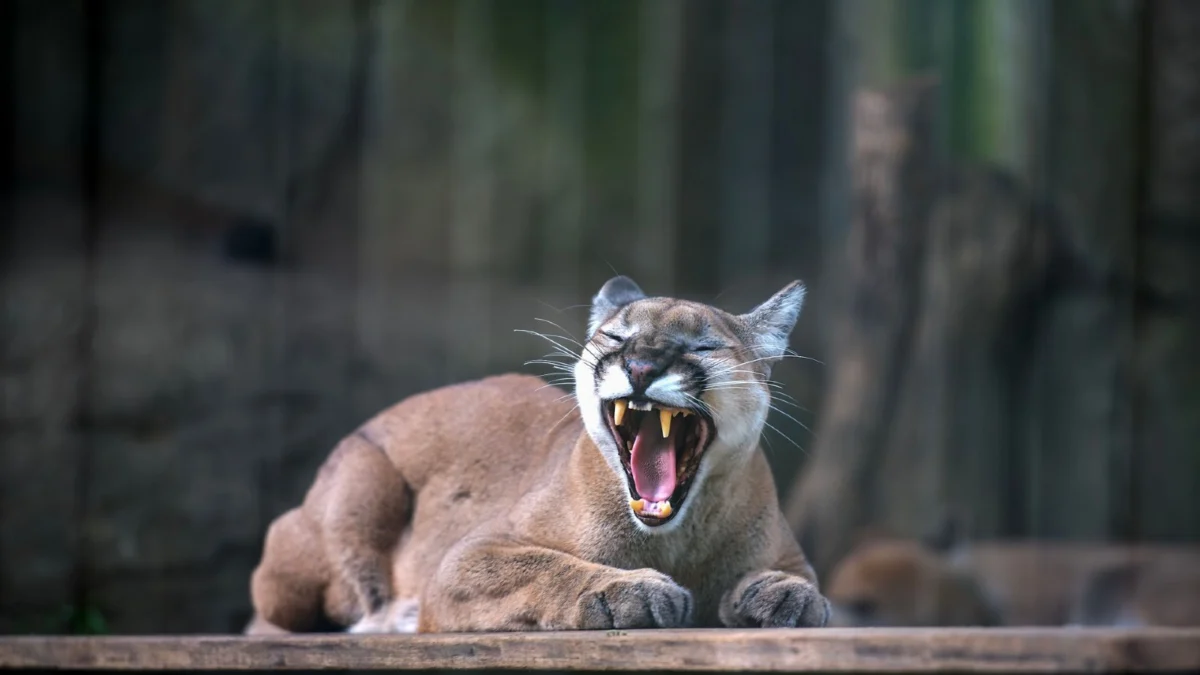
In the quiet, leafy suburbs of Pasadena, California, the boundary between human civilization and the untamed wilderness is often thinner than residents realize. For Bill Dabney, a local homeowner, that boundary vanished in an instant when a routine inspection of his property turned into a harrowing, life-or-death confrontation with one of North America’s most elusive apex predators: a mountain lion.
The incident, which has since sent ripples of unease through the community, serves as a stark reminder of the increasing frequency of human-wildlife conflicts in the state. As wildfires, urban sprawl, and environmental shifts continue to compress natural habitats, the "ghosts of the mountains"—as the cougars are often called—are venturing into backyards with alarming regularity.
The Chronology of an Unexpected Encounter
The sequence of events began on a seemingly unremarkable day at the Dabney residence. Bill Dabney noticed a series of unusual deposits on the roof of his guesthouse. Upon closer inspection, he discovered four separate stools. Recognizing immediately that the droppings were far too large and distinct to be the work of common backyard birds or local pests, Dabney felt a prickle of unease.
“I knew right away this wasn’t anything avian,” Dabney later remarked. His suspicion prompted him to investigate the perimeter of the structure. As he turned the corner of the building, the air seemed to grow still. Standing just ten yards away—a distance that, in the presence of a predator, feels like mere inches—was a large mountain lion.
The animal was not merely passing through; it was positioned in a predatory crouch. “All of a sudden, I look over. Mountain lion. Staring at me,” Dabney recalled, the gravity of the moment still evident in his voice. “He was in position mode, like he was going to spring. That was the moment I knew: it was time to go. I took off running.”
Dabney’s instinctual reaction to flee toward the safety of his main home likely saved him from a physical altercation. The mountain lion, perhaps startled by the sudden movement or deterred by the structural presence of the house, did not pursue. Once inside, Dabney was able to monitor the situation through his home’s CCTV system. The footage confirmed his worst fears: a sleek, powerful, and visibly gaunt mountain lion was stalking his property. “He looked real hungry,” Dabney noted. “I felt bad for him, but not that bad.”
Supporting Data: An Unprecedented Surge in Sightings
The terror did not end with the departure of the cat. Only a few days after the Dabney encounter, another report of a mountain lion sighting surfaced in the same vicinity. While wildlife officials have not yet confirmed that the two sightings involve the same individual, the geographic proximity and the timeline suggest a high probability that a single, displaced predator is navigating the residential sprawl of Pasadena.
Mountain lions, or Puma concolor, are solitary, territorial creatures. Their home ranges can span hundreds of square miles, and they are notoriously shy, preferring to avoid human contact at all costs. Seeing one in a suburban backyard is a statistical anomaly, yet it is a trend that is rising across the state of California.
According to data from the California Department of Fish and Wildlife (CDFW), reported mountain lion sightings have steadily increased over the last decade. While the state’s human population has expanded, pushing deeper into the foothills of the Sierra Nevada and the coastal ranges, the cougar population has remained relatively stable, leading to a crowded landscape where territory overlaps are inevitable.
Expert Analysis: Why Are They Coming Down?
To understand why a mountain lion would trade the solitude of the mountains for the roof of a guesthouse, one must look at the environmental stressors currently plaguing the region. Kevin McManus of the Pasadena Humane Society has been at the forefront of the public discourse regarding these encounters.
"Mountain lions are typically found in the rugged, high-altitude regions of the mountains," McManus explained. "When you see them in a suburban setting like Pasadena, it is almost never a case of ‘curiosity.’ It is a case of survival."
McManus points to the recent Eden Fire as a primary driver of this displacement. The wildfire, which caused significant destruction in areas adjacent to the cougar’s natural habitat, likely decimated the local prey population—such as mule deer—and stripped the landscape of necessary cover. When a predator loses its food, water, and shelter, it does not simply vanish; it expands its search radius.
"The Eden Fire had massive, devastating effects not too far away from the cougar’s natural habitat," said McManus. "It’s very possible that they’re here looking for food, water, and shelter. When a mountain lion is desperate, the traditional boundaries of fear that keep them away from humans start to erode."
The Environmental and Social Implications
The implications of this encounter are twofold: the immediate safety of the public and the long-term conservation of the species.
Public Safety and Preparedness
For residents in the foothills, the Dabney incident serves as a wake-up call. Wildlife experts recommend that those living in areas bordering natural habitats should:
- Clear Brush: Remove overgrown vegetation that provides cover for stalking predators.
- Secure Trash: Do not leave pet food or unsecured garbage outside, as this attracts smaller animals that serve as prey, subsequently drawing in larger predators.
- Install Motion Lighting: Mountain lions are nocturnal and crepuscular; bright lights can discourage them from approaching structures.
- Maintain Situational Awareness: If a mountain lion is encountered, experts advise never to run (which can trigger a chase reflex), but rather to stand tall, make noise, and slowly back away while maintaining eye contact.
The Future of Human-Wildlife Coexistence
The broader issue remains the "fragmentation" of wildlife corridors. As cities like Pasadena continue to grow, the ability for wildlife to migrate safely between mountain ranges is compromised. Projects like the Wallis Annenberg Wildlife Crossing—currently under construction near Los Angeles—are designed to provide safe passage for mountain lions over busy freeways. However, these infrastructure solutions take years to build, and in the meantime, animals are forced to traverse human-dominated landscapes.
The mountain lion that Bill Dabney encountered is a symbol of a larger ecological crisis. It is a creature of the wild, driven by hunger and displaced by fire, now navigating a concrete world that was never designed for its presence.
Conclusion: A Delicate Balance
The incident at the Dabney residence ended without physical injury, but it left a lasting psychological mark. For the homeowner, the roof of his guesthouse will never feel quite as secure as it once did. For the community of Pasadena, the event is a sobering reminder that they are not just residents of a city, but neighbors to an unforgiving wilderness.
As the state of California grapples with the dual challenges of climate-driven wildfires and urban development, encounters like this are likely to become the new normal. The challenge for the future will be to find a way to manage these populations, protect human life, and respect the dignity of the predators that were here long before the first foundation of a Pasadena home was ever poured.
For now, the advice from the Pasadena Humane Society remains simple: keep your distance, secure your property, and respect the fact that the mountain lions are not merely visitors in our world—they are survivors trying to find a way to live in a world that is shrinking around them.












No comments yet. Be the first to join the conversation!