Ammar Sabilarrohman
In the hyper-competitive landscape of the $600 to $800 laptop market, manufacturers are often forced to make binary choices: do you prioritize aesthetics and raw display brilliance, or do you focus on the utilitarian workhorse features that professionals actually need? With the release of the Acer Swift Air 14, priced at $699, Acer has clearly planted its flag in the camp of the utilitarian.
While it lacks the flashy "wow" factor of more expensive ultrabooks, the Swift Air 14 attempts to carve out a niche for itself through robust connectivity and endurance. However, as our recent testing at Tom’s Hardware reveals, this device serves as a poignant reminder that in the modern era of Windows computing, a laptop needs to be more than just a box of ports to truly excel.
The Core Verdict: Balancing Utility and Luxury
The Acer Swift Air 14 arrives at a pivotal time for students and hybrid workers. It is marketed as a "premium budget" device, a paradoxical classification that attempts to bridge the gap between affordable consumer hardware and the sleek requirements of modern office life.
Our testing confirms that the device succeeds in two major pillars: connectivity and battery longevity. Featuring modern Thunderbolt 4 support—a rarity at this price point—and an impressive 16-hour runtime in our standardized battery tests, it is undeniably built for those who spend their days away from a wall outlet. Yet, the experience is hindered by a lackluster display and an intrusive software environment. For the discerning user, the lack of a high-brightness panel and the presence of pre-installed "bloatware" prevents the machine from achieving true luxury status.
Chronology of the Acer Swift Evolution
To understand the position of the Swift Air 14, one must look at the trajectory of Acer’s Swift lineup. Historically, the Swift series was designed to be the "everyman’s" laptop. Over the last three years, the line has undergone a metamorphosis.
- 2021-2022: Acer focused heavily on weight reduction, pushing the "Air" branding as a competitor to the MacBook Air, often at the expense of port selection.
- 2023: Recognizing that remote work required more dongles than ever, Acer began reintroducing legacy ports while transitioning to USB-C charging.
- 2024: The current iteration, the Swift Air 14, represents the culmination of this "practicality first" philosophy. It moves away from the ultra-thin, compromised designs of the past, opting instead for a chassis that accommodates a full suite of connectivity options, acknowledging that professionals are tired of living the "dongle life."
Supporting Data: By the Numbers
Our rigorous testing protocols provide a clear picture of where the Swift Air 14 shines and where it falters.
Connectivity and Expansion
The inclusion of Thunderbolt 4 is the headline feature here. It provides the bandwidth necessary for high-speed external storage, docking stations, and external 4K monitors. For a $699 device, this is a significant "pro" that shouldn’t be overlooked. It allows the machine to act as a desktop replacement, provided the user has the right peripherals.
Battery Performance
In our web-surfing battery test, which cycles through a series of static and video-heavy websites with the screen set to 150 nits of brightness, the Swift Air 14 clocked in at over 16 hours. This puts it in the upper echelon of its price bracket. Users who travel frequently or work in fluid environments will find this endurance transformative.
The Display Deficit
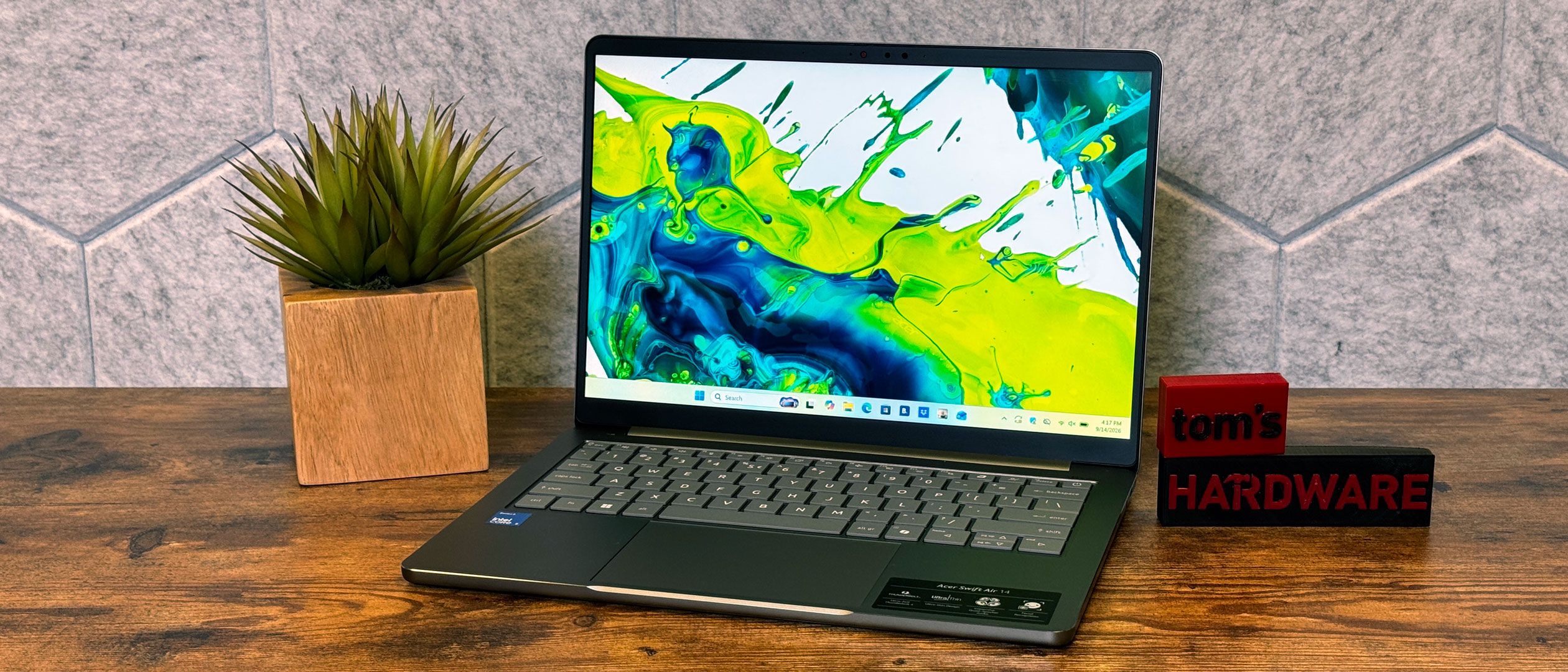
Where the device loses ground is in its visual output. Modern budget laptops are increasingly adopting high-nit panels with deeper color gamuts. The Swift Air 14, by contrast, feels dim. Whether working under bright office fluorescent lights or near a window on a sunny day, the screen lacks the peak brightness required to overcome glare. This is a primary point of friction for a device intended for "premium" use.
The Bloatware Burden
Upon booting the device for the first time, users are greeted by a barrage of third-party software and promotional links. While this is a common strategy for manufacturers to subsidize the cost of the hardware, it detracts from the "premium" feel. A cleaner Windows experience would significantly improve the out-of-the-box user sentiment.
Official Responses and Industry Context
While Acer has not released a specific statement addressing the screen brightness concerns, their product strategy suggests a deliberate trade-off. By keeping the display costs lower, they have managed to allocate more of the bill-of-materials (BOM) to internal components like the Thunderbolt-capable motherboard and a larger battery cell.
Industry analysts note that this is a "segmentation strategy." Manufacturers are aware that customers looking for 500-nit, OLED-grade displays are likely to shop in the $1,200+ price range. By targeting the $699 segment, Acer is appealing to the "value-first" consumer—the student, the budget-conscious administrator, or the small business owner—who values a machine that stays on all day over one that looks stunning in a bright room.
Implications for the Consumer
What does the Acer Swift Air 14 mean for the average buyer? It serves as a litmus test for your priorities.
If your workflow involves moving from meeting to meeting, connecting to various conference room displays, and working for long hours in transit, the Swift Air 14 is a compelling candidate. Its reliability as a functional tool is nearly unmatched at this price point. The Thunderbolt 4 integration is a future-proofing measure that ensures you won’t need to upgrade your laptop just because you bought a new high-speed external drive.
However, if your work involves creative tasks—photo editing, graphic design, or high-fidelity media consumption—the limitations of the display become a critical failure point. You cannot calibrate colors correctly on a screen that lacks the necessary brightness and color accuracy. Furthermore, those who are sensitive to "clutter" on their desktop will find the pre-installed software frustrating to navigate and remove.
Conclusion: A Specialized Tool
The Acer Swift Air 14 is not a "jack of all trades." It is a specialized tool built with a specific set of compromises. By prioritizing the battery and the port selection, Acer has created a device that is essentially a mobile office in a box.
It is not the most beautiful laptop you will see this year, nor is it the fastest. But for the user who views their computer as a vehicle for productivity rather than a lifestyle accessory, the Swift Air 14 offers a pragmatic solution. It challenges the industry standard of what a $699 laptop should look like, even if it leaves some room for improvement in the areas of visual fidelity and software cleanliness.
As the market continues to evolve, the success of the Swift Air 14 will likely depend on whether the average consumer values raw endurance and connectivity over the visual elegance that has become the hallmark of the modern ultrabook. For now, it stands as a robust, if slightly unrefined, testament to the value of practical engineering.


 Iffa Jayyana
 Suro Senen