The intersection of generative AI and video game rendering has reached a boiling point. Today, Nvidia officially integrated its highly anticipated—and deeply controversial—DLSS 5 technology into the open-world wizarding epic Hogwarts Legacy. While Nvidia frames this as a monumental leap forward for real-time neural rendering, the gaming community remains deeply divided, caught between the promise of unprecedented frame rates and the fear that AI is beginning to erode the artistic intent of developers.
The Evolution of DLSS: From Upscaling to Neural Generation
To understand the current friction, one must look at the trajectory of Nvidia’s Deep Learning Super Sampling (DLSS). What began as a simple temporal upscaling solution designed to boost frame rates by rendering games at lower resolutions and using AI to "fill in the blanks" has evolved into a comprehensive suite of visual reconstruction tools.
DLSS 5 represents the next step in this evolution: 3D-Guided Neural Rendering. Unlike its predecessors, which primarily focused on resolution, DLSS 5 utilizes a generative AI model to enhance lighting, texture density, and material quality in real-time. Nvidia’s goal, as stated during the technology’s initial announcement in March, is to move toward "photorealism" by allowing the GPU to act as an on-the-fly digital artist, refining frames as they are rendered.
However, the technology’s path to release has been fraught with unease. When early, unfinished iterations of the DLSS 5 library (specifically the nvngx_dlssnr.dll file) leaked via NBA 2K27 modding communities back in August, the reaction was immediate and visceral. Modders who stress-tested the technology found that the AI’s generative pass often struggled with human geometry. Faces were frequently sharpened to an unnatural degree, skin textures appeared uncanny, and in some instances, characters appeared to undergo an "AI makeover" that fundamentally altered their intended look.
A Chronology of Contention
The controversy surrounding DLSS 5 did not emerge in a vacuum. The timeline of its rollout highlights a significant disconnect between corporate marketing and user expectation:
- March 2024: Nvidia announces the next-generation DLSS, promising photorealistic lighting and material enhancements via a new generative AI model.
- August 2024: A leaked DLL file surfaces online. Early adopters and modders test the tech in existing titles. The internet is flooded with images of characters from Resident Evil: Requiem looking drastically different, leading to viral discussions about the "uncanny valley."
- September–October 2024: Community forums, Reddit, and social media platforms become battlegrounds. Players argue over whether AI-driven sharpening constitutes "enhancement" or "distortion" of the original developer’s vision.
- Today: Official integration into Hogwarts Legacy occurs. The rollout is met with a mix of technical curiosity and skepticism, as players scrutinize whether the final product addresses the issues seen in the leaked tests.
The "Subtle" Reality: Analyzing the Performance
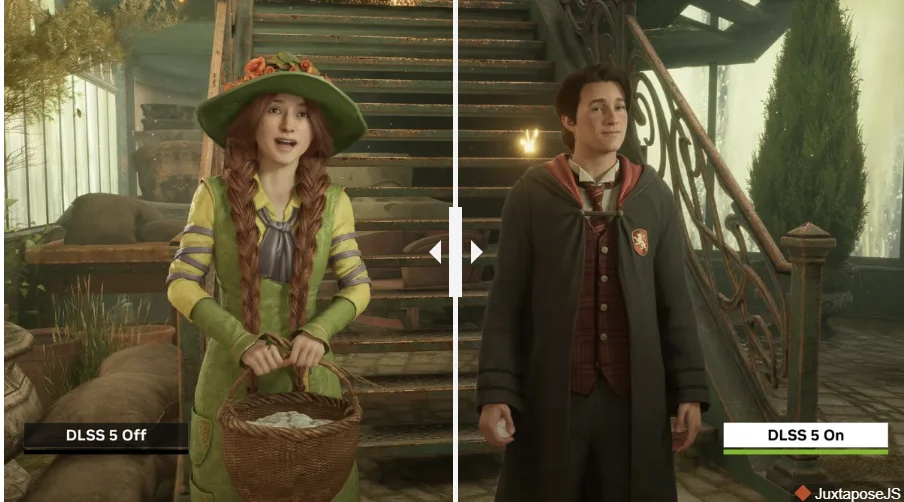
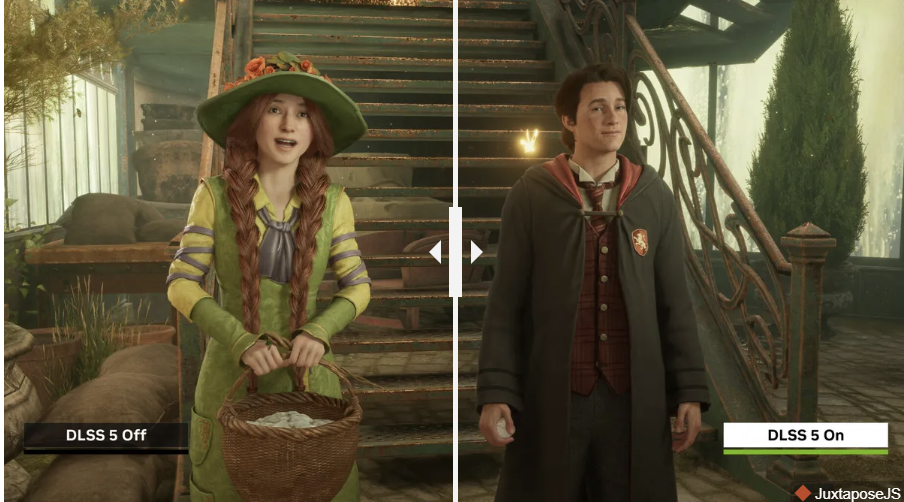
Following the backlash, Nvidia appears to have walked a tightrope. In the official launch trailer for the Hogwarts Legacy integration, the effects of DLSS 5 appear surprisingly conservative. The aggressive sharpening and generative artifacts that characterized the leaked August builds have been significantly reined in.
For many, this presents a new problem. Commenters on official Nvidia channels have expressed confusion, noting that the technology is now so subtle that it is difficult to distinguish from standard DLSS 3 or 4 in many environments.
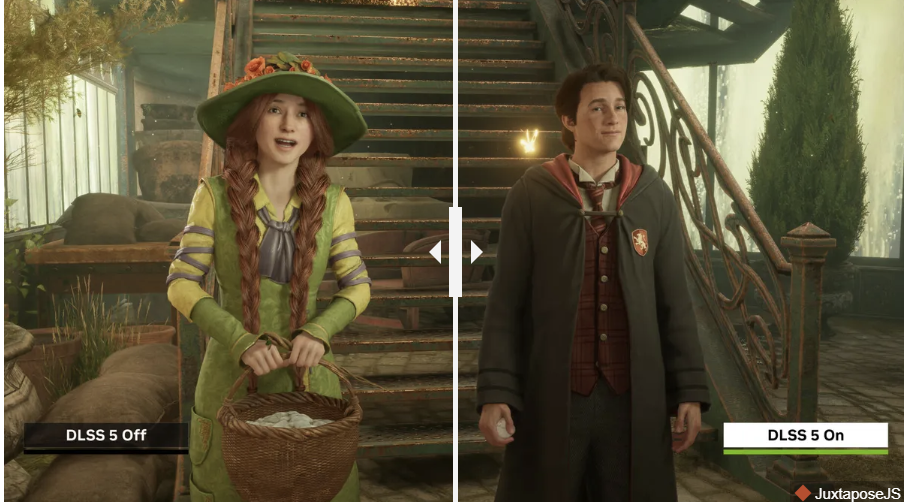
"People complained so much that they completely nerfed it," one user noted in a popular YouTube thread. "Now we just have FPS loss with basically little difference in image quality."
This sentiment captures a paradoxical reality: if the AI is too aggressive, it ruins the art style; if it is too subtle, users question the hardware overhead. With the RTX 5090 being the primary hardware target for this tech, the power draw required to run these new features—sometimes requiring an additional 100–200 watts—is causing many to question the cost-to-benefit ratio of the upgrade.
The Technical Breakdown: What Does DLSS 5 Actually Do?
For those with the necessary hardware—specifically the GeForce RTX 50 Series GPUs and RTX Spark systems—the full suite of DLSS 5 features is now available. Nvidia’s recommendation for an "optimal experience" involves a multi-layered approach:
- DLSS Super Resolution: The baseline upscaling that remains the foundation of the tech.
- DLSS Multi Frame Generation: Using AI to interpolate new frames between rendered ones to boost fluid motion.
- DLSS 3D-Guided Neural Rendering: The headline feature that analyzes geometry to adjust lighting and material shaders dynamically.
- NVIDIA Reflex: To keep input latency as low as possible, essential for the high-frame-rate experience.
- DLSS Ray Reconstruction: A specialized pass that replaces traditional denoisers to improve the quality of ray-traced lighting effects.
When all these systems are active, the RTX 5090 can indeed push Hogwarts Legacy to a staggering 300 frames per second at 4K resolution. However, the question remains: does this level of performance justify the potential loss of atmospheric integrity?
The Philosophical Implications: Art vs. Algorithm
The core of the DLSS 5 controversy is not technical—it is philosophical. For decades, video game development has relied on the deliberate, painstaking work of artists, lighting directors, and shaders programmers who define the "look" of a scene.
Critics of DLSS 5 argue that by allowing an AI to "interpret" a scene in real-time, developers are essentially surrendering control of the final image. When the AI alters the texture of a character’s skin or changes the way light hits a specific surface, it may be creating a "technically" more detailed frame, but it may also be subverting the specific emotional or artistic intent of the game’s creators.
In Hogwarts Legacy, which relies heavily on a specific, nostalgic, and often dark fantasy aesthetic, this concern is amplified. While some players appreciate the increased contrast and sharpness in the environment, others have noted that the AI-enhanced look can make the world feel "sterile" or "too sharp," stripping away the filmic grain or soft-focus atmospheric effects that define the game’s signature style.
Official Responses and Industry Outlook
Nvidia has largely maintained a stance that the technology is a tool for developers, not a replacement for them. They emphasize that the goal is to provide a "boost in environmental uplift while preserving character identity."
Yet, the company is also aggressive in its expansion. Following the launch in Hogwarts Legacy, DLSS 5 is scheduled to arrive in the free-to-play combat game War Thunder in mid-November, followed by the wuxia-inspired title Where Winds Meet on November 23.
This rapid rollout suggests that Nvidia is confident in the tech’s trajectory, regardless of the vocal minority or the "uncanny" complaints. For Nvidia, the path forward is clear: as games become more complex and ray tracing becomes the industry standard, the hardware alone cannot keep up with the rendering demands. AI, in their view, is the only sustainable way to achieve the performance targets of the future.
Conclusion: A New Frontier or a Slippery Slope?
As the industry stands at this crossroads, the implementation of DLSS 5 in Hogwarts Legacy serves as a litmus test. We are witnessing the birth of a new era where "rendering" is no longer just about calculating pixels, but about interpreting them.
For the average gamer, the upgrade might simply mean higher frame rates and a sharper image. For the gaming purist, it represents a fundamental change in how we consume interactive media. Whether DLSS 5 becomes the gold standard for performance or a cautionary tale about the limits of AI in creative fields, one thing is certain: the conversation around "what a game is supposed to look like" has changed forever.
The tech is here, it is powerful, and it is undeniably transformative—but as the community feedback shows, it is still very much in its infancy, struggling to balance the cold, hard efficiency of neural math with the subtle, subjective nuances of human art.