

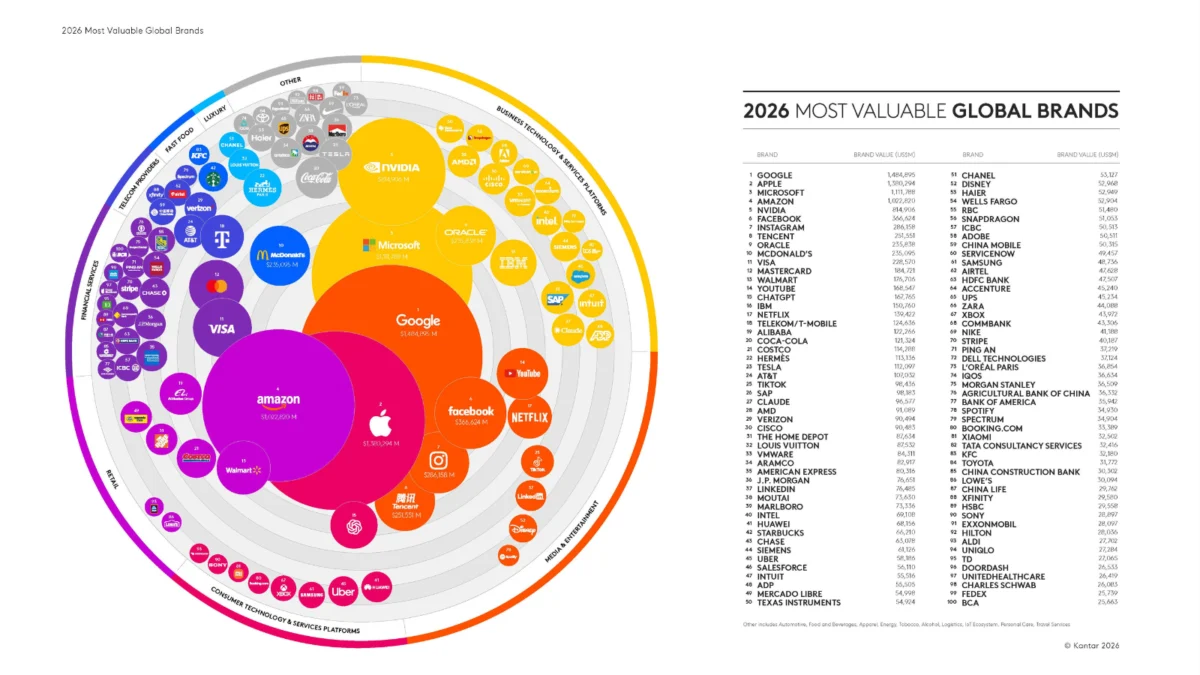
In a seismic shift that reflects the rapidly evolving relationship between artificial intelligence and consumer behavior, Google has officially unseated Apple as the world’s most valuable brand. According to the latest annual BrandZ report released by data and analytics giant Kantar, the Mountain View-based tech titan has surged to the top spot, ending Apple’s four-year reign at the summit of global brand equity.
The transition marks more than just a change in leadership; it signals a fundamental recalibration of what consumers value in the digital age. While traditional analysts once speculated that the rise of generative AI might spell the end of traditional search-based business models, Google has successfully leveraged its technological infrastructure to integrate intelligence into the daily habits of billions.
The New Hierarchy: Main Facts and Financials
The 2026 Kantar BrandZ report, which tracks the 100 most valuable brands globally, places Google at a staggering brand valuation of $1.48 trillion. This represents a monumental 57% growth in brand value over the previous year.
Apple, which held the No. 1 position for four consecutive years, has been pushed to second place. Crucially, Apple’s displacement is not a result of stagnation; the consumer electronics giant saw its own brand value rise by 6%. However, the sheer velocity of Google’s expansion—fueled by its seamless integration of AI—has set a new benchmark for corporate valuation.
Kantar’s methodology, which balances hard financial data with "Brand Contribution"—a measure of a brand’s ability to drive consumer preference—highlights a broader trend: the dominance of technology and AI-native brands. The top of the list is increasingly populated by entities that are not merely providers of hardware or software, but architects of human utility.
A Chronological Evolution: The Road to the Top
To understand how Google claimed the top spot, one must look at the trajectory of the tech landscape over the last half-decade.
- 2021–2024: Apple maintained a stronghold, bolstered by the "walled garden" ecosystem, high-end hardware, and the dominance of the iPhone. During this period, brand value was largely driven by hardware premiumization and service-based revenue models.
- 2025: The "Year of the LLM." As ChatGPT and other generative AI tools entered the public consciousness, the conversation shifted from mobile devices to ambient intelligence. The 2025 BrandZ report confirmed that while traditional tech held strong, the landscape was beginning to fragment.
- 2026: The current status quo. Google’s aggressive pivot toward integrating AI directly into the user experience—making it a core utility rather than an optional tool—has paid off. By embedding intelligence into its existing platforms, Google managed to achieve a scale of adoption that competitors are still struggling to replicate.
Supporting Data: The AI Surge and Market Trends
The 2026 report provides a clear roadmap of where the global economy is heading. Perhaps most striking is the sudden emergence of AI-native brands as major players.
Nvidia, the engine behind much of the current AI boom, has cemented its place at No. 5. Even more impressive is the rapid ascent of specialized AI brands: ChatGPT currently sits at No. 15, while Claude occupies the No. 27 spot. This data correlates with consumer usage patterns, as 64% of respondents in the Kantar study indicated that they now use AI as a primary method for finding information or completing tasks.

Geographic and Sector-Specific Growth
While US tech giants continue to dominate the top 10, other regions are seeing massive gains:
- Chinese Market Resilience: Chinese brands showed a collective 31% increase in brand value. Notably, the Agricultural Bank of China saw a 54% jump, while Xiaomi surged by 48%.
- Diversification: The top quartile of the BrandZ list is not restricted to pure tech. Household names like McDonald’s, Coca-Cola, and Hermès continue to command top-tier status. This confirms that while technology provides the tools, emotional connection remains the anchor for long-term brand equity.
Official Responses: Insights from Industry Leadership
The leadership at Kantar attributes this shift to a precise formula. Jeff Greenspoon, CEO of Kantar, identified four specific pillars that allowed Google to seize the lead.
"It’s four things," Greenspoon told ADWEEK. "They embedded intelligence into everyday behavior at a scale that no one else had. They made it useful for people. They monetized it well. And the behavior shows that it’s integrated into the platform."
Martin Guerrieria, head of BrandZ, emphasized that we are witnessing a maturation of the AI sector. "We are seeing LLMs not just emerging as brands in their own right, but deliberately moving toward emotional brand building," Guerrieria noted. He pointed to the recent wave of "funny, clever, and emotional" Super Bowl advertising campaigns from brands like Gemini, ChatGPT, and Claude as evidence that these companies are no longer just selling code—they are selling a brand persona.
The "Meaningfully Different" Framework
Kantar’s valuation model is unique because it measures the intangible. By multiplying financial value with Brand Contribution, Kantar identifies brands that are "meaningfully different."
Greenspoon explains that "meaning" is derived from trust and emotion, while "difference" is rooted in functional utility and innovation. According to Kantar, brands that successfully balance these two factors drive approximately five times higher market penetration.
"We’re valuing something that’s intangible," Guerrieria added. "But the result is a more nuanced reading of potency than an examination of fiscals alone." This is why, despite the high revenues of energy or insurance companies, they rarely hit the top of the BrandZ list. The companies at the top—like Google, Apple, and Coca-Cola—are those that have become essential components of the consumer’s identity.
Implications: What This Means for the Future of Marketing
The displacement of Apple by Google carries profound implications for marketers and brand strategists globally.

1. The Death of the "Static" Brand
The success of Google proves that brand equity is no longer about maintaining a consistent, static image. It is about the ability to pivot and integrate new technology into the user’s daily flow. Brands that fail to integrate AI utility into their core offering risk being perceived as legacy players.
2. The Emotionalization of Tech
For years, technology was marketed on specs—processor speeds, camera megapixels, and battery life. The 2026 report confirms that the future of tech branding is emotional. As LLMs become more human-like, the "personality" of the AI will become the primary competitive differentiator. Companies that can bridge the gap between technical capability and emotional reliability will be the ones to define the next decade.
3. The Democratization of AI Access
The rise of ChatGPT and Claude into the top 30 brands demonstrates that the barrier to entry for AI is low, but the barrier to brand loyalty is high. Because 64% of consumers are already using AI, the "novelty" phase is over. We have entered the "utility" phase, where brand value is determined by how much time a tool saves the user and how much it improves the quality of their life.
4. Global Interdependence
The strong showing of Chinese firms like Alibaba, TikTok, and Xiaomi suggests that the global brand landscape is becoming increasingly multipolar. Brands that want to compete at the $1 trillion-plus level must be prepared to navigate global markets with localized strategies that respect regional consumer preferences while maintaining a unified global identity.
Conclusion: Beyond the Valuation
The 2026 Kantar BrandZ report is more than a list of winners and losers; it is a diagnostic tool for the global economy. Google’s rise to the top of the list is a testament to the power of integration. By becoming the "intelligence layer" for the internet, Google has effectively moved from being a utility to being a necessity.
As the industry moves forward, the lesson for marketers is clear: the brands that survive will be those that are "meaningfully different." Whether it is through the emotional resonance of a Super Bowl ad or the quiet, background utility of an AI search agent, the brands that can make themselves indispensable to the human experience will continue to command the highest valuations on the global stage.
The battle for the No. 1 spot is no longer just about who has the most users; it is about who has the most influence over the way the world thinks, acts, and creates. For now, that crown belongs to Google.












No comments yet. Be the first to join the conversation!