Jia Lissa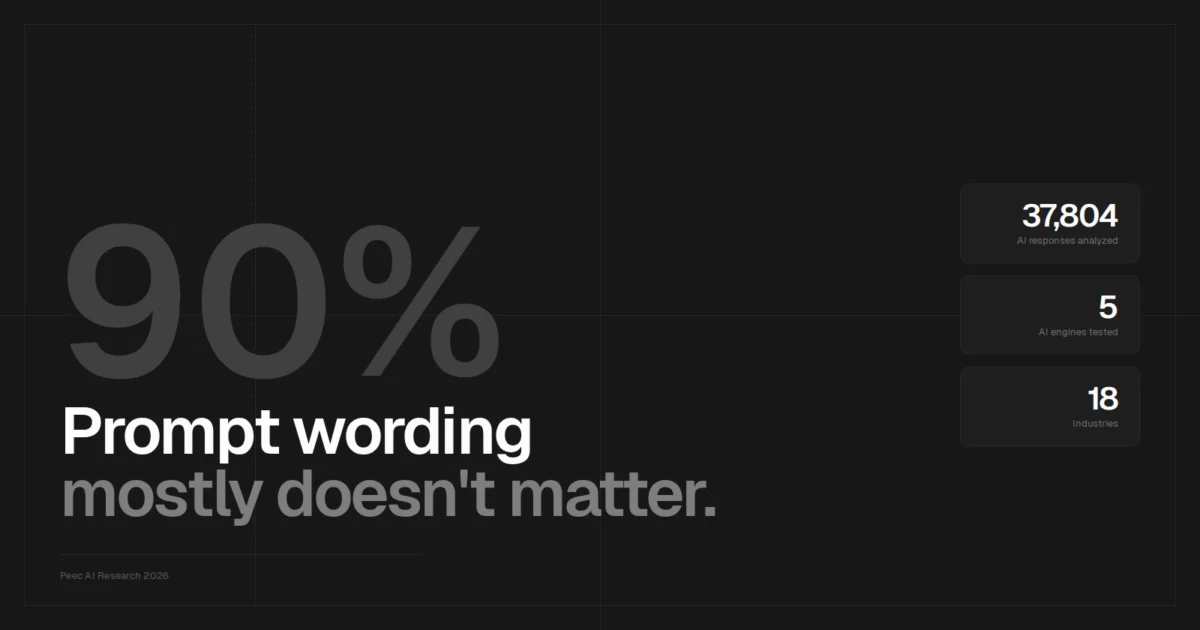
For years, search engine marketers have operated under a singular, rigid mantra: "Keywords are king." SEO professionals have built entire empires based on mapping search volume, chasing long-tail queries, and optimizing for the exact phrasing of a user’s search intent. However, the rise of Large Language Models (LLMs) and AI-driven search—such as ChatGPT, Gemini, Perplexity, and Google AI Overviews—has turned this foundational wisdom on its head.
Marketers are currently grappling with a paralyzing question: Do I need to track every possible variation of a prompt to ensure my brand appears in AI responses? The fear of the "infinite prompt" has led to bloated tracking lists and wasted resources.
A comprehensive new study by Peec AI, which analyzed 1,754 prompts and 37,804 AI responses across five major AI engines, suggests that the reality of AI visibility is far more predictable than previously feared.

The Myth of Chaotic Prompting
Two consumers can approach an AI with the exact same commercial intent but use vastly different language. One might ask, "What are the best noise-canceling headphones under $200?" while another types, "Which budget over-ear headphones have good noise reduction?"
While the wording is different, the underlying intent is identical. Historically, SEO tools treated these as two distinct battlegrounds. Peec AI’s research reveals that while user phrasing appears chaotic on the surface, it is mathematically constrained. By applying semantic embedding—a method that measures the "meaning" of a sentence rather than its character count—researchers found that the vast majority of human prompts cluster tightly together.
In fact, prompts showing significant "semantic drift"—where the meaning is different enough to potentially change an AI’s output—account for less than 10% of total user variations.

Methodology: Decoding the AI Black Box
To understand the relationship between prompt syntax and brand visibility, Peec AI conducted two parallel studies designed to isolate variables in the AI "reasoning" process.
- Study A (Human-Driven): This phase analyzed the natural variance in how humans phrase queries, mapping the semantic distance between various ways to ask for the same product or service.
- Study B (Controlled/Synthetic): This phase introduced incremental changes to prompts, observing the exact "breaking point" where a slight change in wording caused the AI to swap out the recommended brands.
By running these prompts multiple times to account for the inherent volatility of LLM outputs, the researchers were able to quantify the impact of minor phrasing shifts. The study utilized cosine similarity—a metric ranging from 0 to 1—to measure semantic distance, moving beyond simple keyword matching to evaluate how the AI actually "thinks" about a request.
The Semantic Threshold: When Wording Actually Matters
One of the study’s most critical findings is the existence of a "visibility threshold."

Data indicates that as long as a prompt remains within a specific range of semantic similarity (generally above 0.50 to 0.60, depending on the engine), brand visibility remains remarkably stable. The "chaos" that marketers fear only occurs when a prompt drifts into the lowest similarity brackets. When a prompt’s core meaning shifts significantly, the probability of a brand being mentioned drops by an average of 2.40 percentage points—a nearly 50% relative decrease in visibility.
However, because most human users naturally express intent within a consistent semantic range, the actual risk of losing visibility due to minor, everyday phrasing variations is significantly lower than the industry assumes.
The "Style" Variable: Beyond Intent
While the intent of a prompt defines the "what," the style of the prompt defines the "how." The study highlights that the format of a request—such as whether a user asks for a "list," a "comparison," or a "recommendation"—can significantly influence which brands are surfaced.

For instance, a user asking for a "best-of" list receives a different competitive set than a user asking for a "side-by-side comparison." Marketers must move beyond tracking "intent" and begin tagging their prompt variations by "format." This allows brands to see not just if they are appearing, but in what context they are appearing, providing a more nuanced view of their brand health in the AI ecosystem.
Funnel Dynamics: Where Wording Decides Winners
Not all stages of the customer journey are affected equally by prompt variation. The study suggests that "Middle-of-Funnel" (MOFU) prompts—those where a user is evaluating options or comparing specific features—are the most sensitive to wording.
- Top-of-Funnel (TOFU): These are broad, educational queries where the AI provides a general landscape. Wording has a lower impact here.
- Middle-of-Funnel (MOFU): This is the "danger zone." Users are getting specific, and minor tweaks to wording can drastically alter the competitive set.
- Bottom-of-Funnel (BOFU): Highly transactional queries, often involving specific brand names or exact model numbers, leave little room for AI interpretation.
Strategic Implication: Brands should allocate their tracking resources disproportionately toward MOFU prompts. A balanced tracking strategy might look like 25% TOFU, 50% MOFU, and 25% BOFU.

Engine Variance: Why One Size Doesn’t Fit All
The study further warns against treating all AI engines as a monolith. While the direction of the "wording effect" is consistent, the severity varies significantly:
- Perplexity and Google AI Overviews tend to be more sensitive to specific qualifiers due to their reliance on real-time web retrieval.
- ChatGPT and Gemini show different levels of "brand loyalty" based on the creative or analytical nature of the prompt.
Aggregating data across these models without accounting for their individual behavioral tendencies can lead to "data noise," potentially masking true performance trends.
A 6-Step Playbook for Modern AI Measurement
Based on the findings, Peec AI suggests a new framework for brands looking to master AI visibility:

- Define Intent Categories: Group prompts by the underlying need, not the wording.
- Filter by Semantic Distance: Use LLM-as-a-judge tools to ensure you are tracking variations that actually represent different intents.
- Tag by Format: Categorize your prompts by style (e.g., list vs. comparison) to see how format influences visibility.
- Prioritize the MOFU: Focus the bulk of your monitoring on the mid-funnel stage where competitive shifting is most likely.
- Segment by Engine: Do not aggregate performance data; analyze ChatGPT, Gemini, and Perplexity results as distinct channels.
- Monitor for Semantic Blind Spots: Always be on the lookout for "qualifier shifts"—such as location or demographic changes—that turn a similar-looking prompt into an entirely new intent.
Implications for the Future of Search
The era of "keyword stuffing" for AI search is over. The study proves that the AI search experience is governed by semantic meaning rather than syntactic coincidence.
For the modern marketer, this is a relief. It means that the "infinite ways" a user might phrase a prompt are actually, at their core, a finite number of intents. By focusing on the meaning behind the prompt, rather than the raw text, brands can regain control over their AI visibility. The "Semantic Blind Spot" is the only true threat; as long as marketers understand the core qualifiers—location, product specifications, and brand preferences—they can stop chasing every phrasing variation and start focusing on what truly matters: providing the most relevant, helpful, and high-quality information to the AI models that serve their customers.



 Raul Delapena Setiawan