Introduction: A Chromatic Enigma
In the hushed, cavernous spaces of Harper’s gallery, a new, singular vision has emerged. New York-based artist Sophia Huitema has unveiled Prussian Blue, her inaugural solo exhibition with the gallery, marking a significant milestone in her rapidly evolving career. The exhibition, which invites viewers into a series of seven oil paintings characterized by haunting, dreamlike narratives, will remain on public view through April 25, 2026.
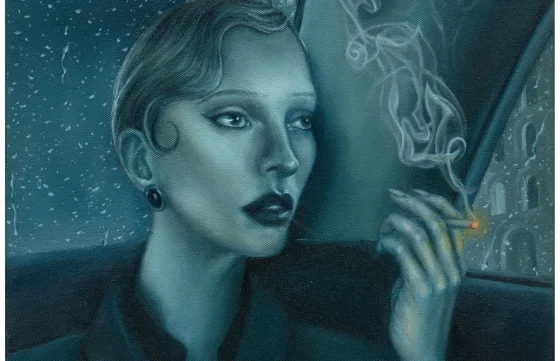
Huitema’s latest body of work acts as a masterclass in atmospheric tension. By limiting her palette to the cool, spectral harmonies of blues and greens, she constructs a visual lexicon that is as intellectually demanding as it is aesthetically seductive. At the heart of this collection lies the titular pigment, Prussian Blue—a substance that serves as both the aesthetic anchor of the paintings and a potent, multi-layered metaphor for the duality of human experience.
Main Facts: The Anatomy of Prussian Blue
The seven works presented in Prussian Blue function as a cohesive suite, bound by the recurring presence of elongated, watchful female figures. These figures inhabit interiors that feel simultaneously opulent and claustrophobic. Huitema’s choice of pigment is not merely stylistic; it is deeply rooted in the history of science.
Historically, Prussian Blue is derived from complex chemical processes that were once linked to the production of cyanide. Paradoxically, in contemporary medicine, the same compound serves as a vital antidote for heavy metal poisoning. This rare convergence of toxicity and protection provides the conceptual scaffolding for Huitema’s work. Her protagonists—women dressed in the trappings of Gatsby-era decadence—embody this very tension. They are simultaneously the architects of their own protection and the potential harbingers of a dangerous, unseen threat.
Chronology: A Trajectory of Stylized Narrative
To understand the significance of Prussian Blue, one must examine the progression of Huitema’s practice. Eschewing the conventional path of formal academic training, Huitema has cultivated her distinctive visual vocabulary through a rigorous, self-directed studio practice.
- Early Development: Huitema’s early output was characterized by a focus on the intersection of fashion illustration and narrative painting. She spent years observing the streamlined aesthetics of early 20th-century designers.
- Refinement of Voice: Over the past three years, the artist began experimenting with the specific constraints of the blue-green spectrum, moving away from a polychromatic approach toward a more focused, "moody" color theory.
- The Current Exhibition: The works in Prussian Blue represent the culmination of this evolution. By narrowing her chromatic range, Huitema has successfully forced a focus on gesture, posture, and the subtle interplay of light and shadow.
- The Future: The exhibition at Harper’s serves as the definitive public unveiling of this specific period of her development, establishing her as a formidable presence in the New York contemporary art scene.
Supporting Data: Art-Historical Synthesis
Huitema’s paintings operate within a dense web of historical references, yet they manage to remain startlingly contemporary. Her work draws from several distinct streams of art history, synthesizing them into a unique, modern dialect:
The Influence of Early 20th-Century Design
The attenuated, elongated proportions of Huitema’s figures bear the unmistakable mark of Art Deco sensibilities and the fluid, dramatic lines of early fashion illustrators like Erté. These influences are not merely decorative; they serve to heighten the sense of artifice within the paintings. The subjects are draped in pearl necklaces, jewel-studded headdresses, and backless gowns, suggesting a world where status and performance are inseparable.
Symbolism and Surrealism
The architecture of Huitema’s spaces—compressed, shallow, and phantasmagoric—finds its roots in the works of the Symbolists and Surrealists. Her interiors are not literal representations of rooms but are rather manifestations of subconscious states. Like the dreamscapes of Giorgio de Chirico or the psychological interiors of late-period Symbolist painters, Huitema’s settings exist to externalize the internal turmoil or hidden motives of her subjects.
Cinematic Staging
Perhaps the most striking aspect of the work is its debt to film noir. In pieces like Sleeper Car, the lighting is sharp, directional, and dramatic. The composition is cinematic, capturing a "still" from a psychological thriller. By utilizing a narrow aisle, rain-streaked windows, and a figure poised between aggression and defense, Huitema forces the viewer to become a participant in the unfolding suspense.
Official Responses and Curatorial Context
Harper’s gallery has long been recognized for its commitment to artists who challenge the boundaries between classical technique and contemporary narrative. The decision to host Prussian Blue underscores the gallery’s belief in Huitema’s ability to anchor a show in a single, rigorous concept.
Critics and curators who have previewed the show have noted the "poise and quietly calculating air" of the figures. One common observation in the preliminary critical discourse is that Huitema’s work manages to feel both timeless and urgent. The figures do not look at the world around them; they look at the viewer, engaging in a silent, often confrontational dialogue that disrupts the passive act of looking. The gallery’s official press release emphasizes that this duality—the "lure of a seductive ruse" versus the "cunning to evade danger"—is what gives the exhibition its enduring power.
Implications: The Psychology of the Femme Fatale
The implications of Prussian Blue extend beyond the canvas, offering a commentary on the archetypal "femme fatale." In traditional art and cinema, this figure is often a vessel for male anxiety—a dangerous, beautiful catalyst for the protagonist’s downfall. Huitema, however, reclaims this archetype.
By placing her figures in settings where they are actively managing their own safety or manipulating their environment, she imbues them with a sense of agency. The "toxic" elements of the pigment represent the external pressures of the society these women inhabit, while the "protective" qualities mirror their internal resilience.
The Viewer as Accomplice
One of the most profound implications of the exhibition is the role of the viewer. Through the use of direct gazes and physically aggressive poses—such as the hand braced for impact in Sleeper Car—Huitema refuses to let the viewer remain a detached observer. The viewer is cast as the potential intruder, the subject of the gaze, or the observer of a crime in progress. This shift in the power dynamic forces a deeper engagement with the work, moving the experience from passive aesthetic appreciation to active psychological navigation.
A New Visual Language
Ultimately, Prussian Blue establishes Sophia Huitema as an artist who is not merely referencing the past, but dismantling and reconstructing it. By working outside the constraints of traditional academic painting, she has crafted a visual vocabulary that is entirely her own. This exhibition suggests that the future of figurative painting lies not in the rejection of historical tropes, but in their deliberate, thoughtful hybridization.
As the exhibition continues through the spring of 2026, it serves as an invitation to reflect on the nature of color, the history of materials, and the enduring power of the painted figure. Huitema’s world is one of deep shadows and sharp edges—a world that demands to be seen, even as it warns us to keep our distance. Whether one views these works as a nod to the cinematic glamour of the past or as a psychological exploration of modern precarity, Prussian Blue stands as a testament to the fact that the most compelling stories are often those told in the quiet, dimly lit corners of the imagination.