Laily UPN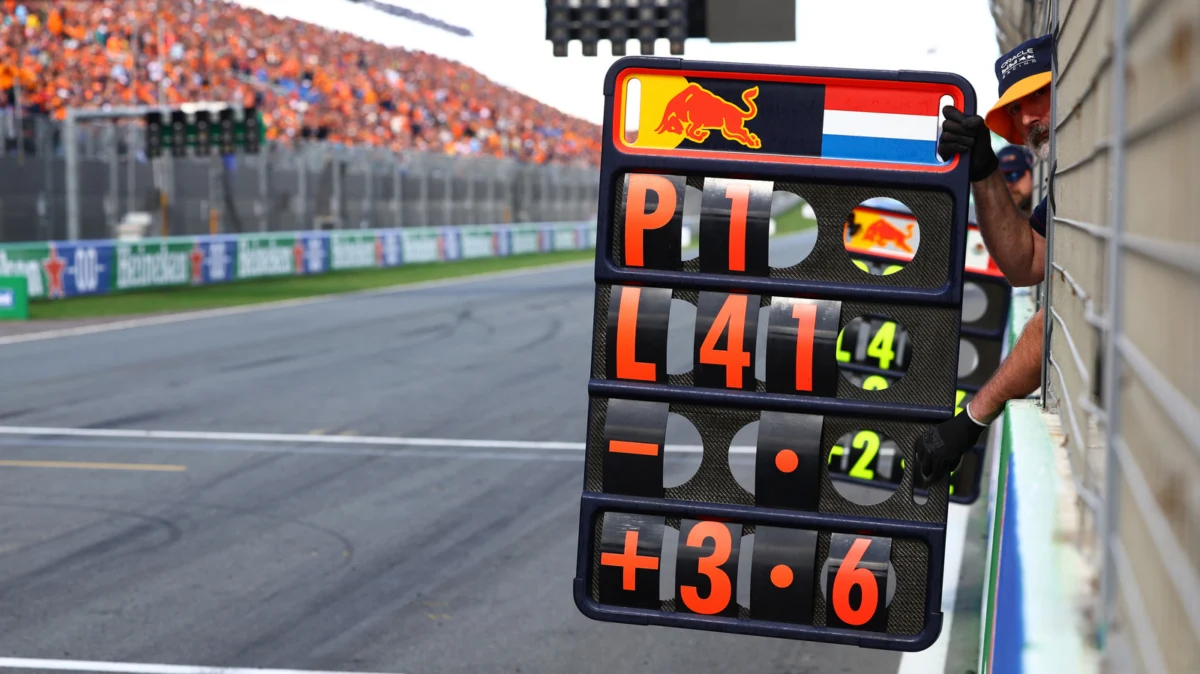
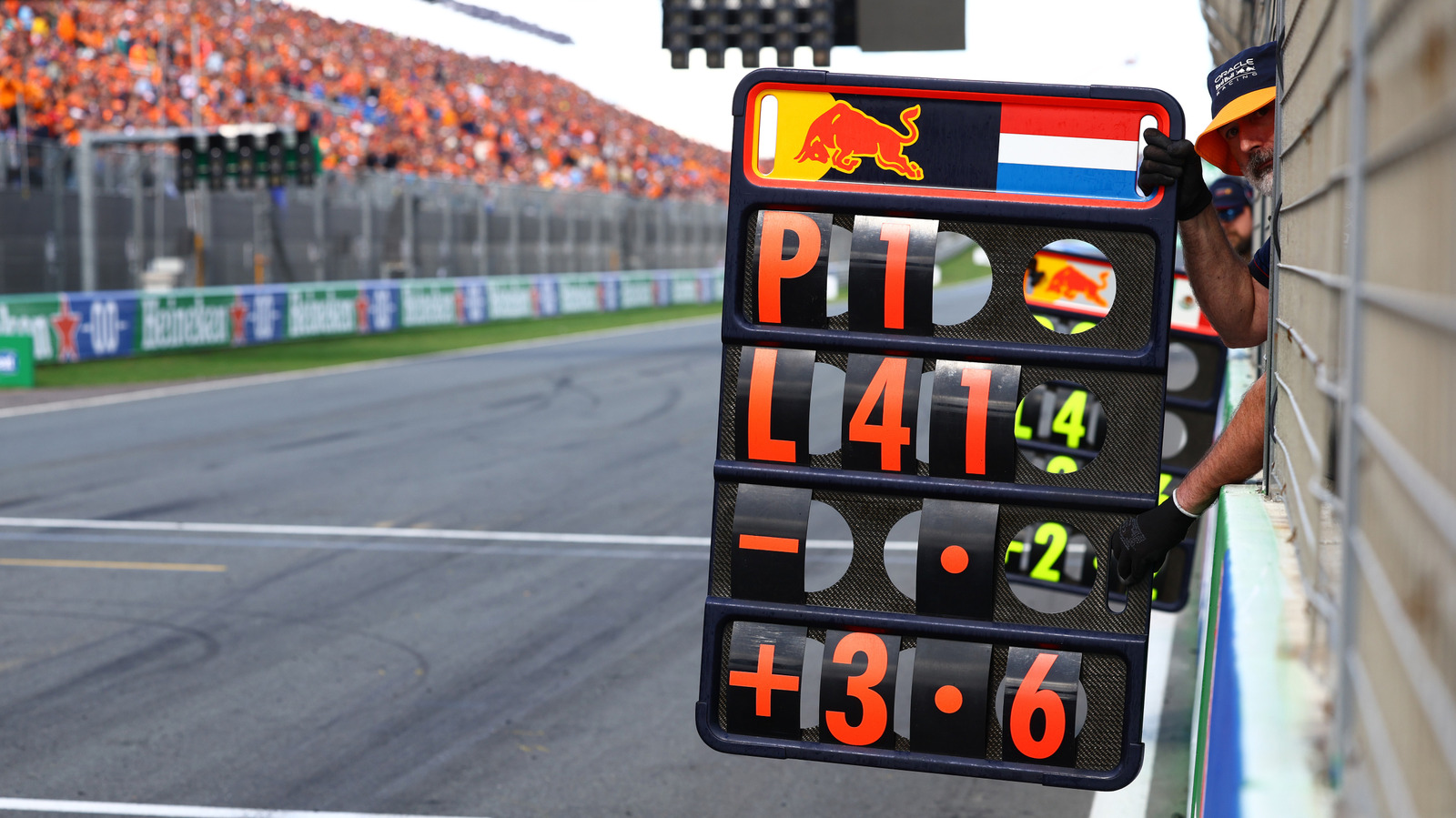
In the high-tech theater of Formula 1, where cars are essentially flying supercomputers capable of processing billions of data points per second, the sight of a mechanic leaning over a pit wall holding a physical, hand-arranged board seems like a jarring anachronism. Yet, despite the presence of sophisticated telemetry, encrypted high-fidelity radio channels, and advanced steering wheel displays that provide drivers with more data than the Apollo 11 moon mission, the humble pit board remains an omnipresent fixture of every Grand Prix weekend.
Why does the pinnacle of motorsport, an industry that spends hundreds of millions of dollars on aerospace-grade engineering, still rely on a piece of plastic and some velcro-backed numbers? The answer lies in the unforgiving nature of the sport, where redundancy is not just a safety feature—it is a competitive necessity.
The Core Utility: Redundancy in a High-Stakes Environment
At its most fundamental level, the pit board serves as a crucial backup communication channel. In Formula 1, clear communication between the pit wall and the driver is the difference between standing on the podium and a DNF (Did Not Finish). While team radios are the primary method of information transfer, they are susceptible to a wide array of failures: electronic interference, signal dropouts in tunnels or behind grandstands, or simply the sheer acoustic chaos of a screaming internal combustion engine that can make voice communication unintelligible.
Unlike in consumer technology, where a failed Wi-Fi connection is an annoyance, a failed radio link in F1 can lead to missed pit windows, incorrect tire strategies, or dangerous misunderstandings during safety car periods. The pit board is immune to software bugs, battery depletion, and signal jamming. It is the ultimate "analog fallback," ensuring that no matter what happens to the electronic infrastructure, the team can always pass a vital instruction to their driver.
Chronology: From Chalkboards to Carbon Fiber
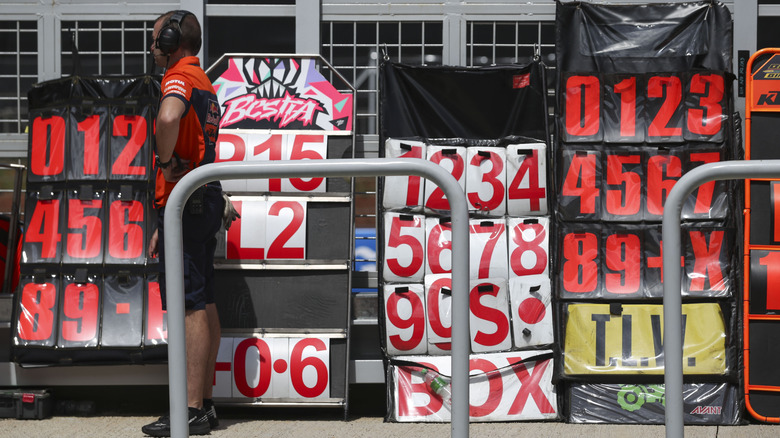
The evolution of the pit board is a reflection of the sport’s broader history. In the early decades of Grand Prix racing, pit boards were rudimentary—often just small wooden planks with hand-written chalk notes. They were used because radios did not exist, or if they did, they were unreliable, heavy, and impractical for the cockpit.
- The 1950s–1960s: During this era, drivers were essentially flying blind once they left the grid. Pit signals were used primarily to indicate when to come in for fuel or tire changes. Information was sparse, and boards were small.
- The 1970s–1980s: As the sport became more professional, the pit board grew in sophistication. Teams began using standardized color-coded numbers to make the boards easier to read at high speeds. This was the golden age of the "manual" board, where pit crew members would scramble to update numbers as a car crossed the start-finish line.
- The 1990s–2000s: The rise of digital radio brought the pit board into a "supporting role." It was no longer the primary means of communication, but rather a tool for confirmation. Teams realized that a driver, already overloaded with sensory input, might mishear a radio instruction. Seeing it in writing on the pit straight provided a cognitive "second opinion."
- The Modern Era: Today, while we see digital LED boards in some support series, the classic manual board remains the standard in F1. The tactility and reliability of the physical board have kept it relevant even in the era of artificial intelligence and real-time predictive modeling.
Supporting Data: The Psychology of Information Overload
Human factors engineering in motorsport reveals that the cognitive load on an F1 driver is immense. During a lap, a driver must monitor brake bias, tire temperatures, energy deployment (ERS), and differential settings, all while navigating traffic at speeds exceeding 200 mph.
Cognitive Load vs. Information Clarity
Studies in motorsport ergonomics suggest that visual signals are processed faster and with less cognitive strain than auditory signals. When a driver is under extreme physical stress—g-forces pulling at their neck and adrenaline pumping—the ability to process complex verbal sentences via radio decreases.
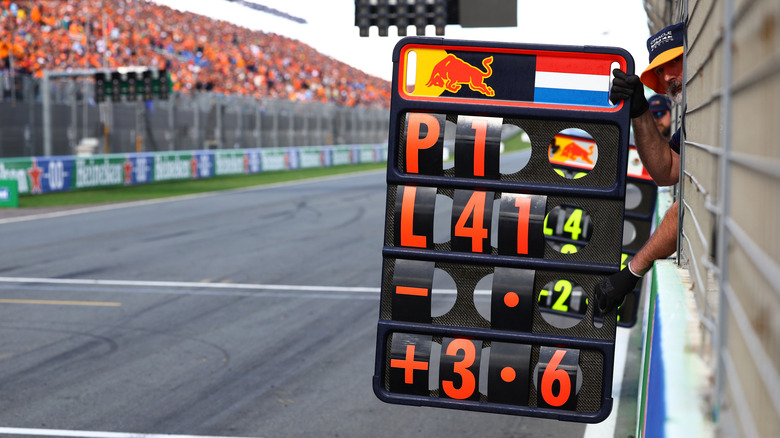
A pit board, by contrast, is designed for "glanceability." A driver traveling at 180 mph doesn’t need a sentence; they need a symbol. A "BOX" command or a "P2 +1.2" (Position 2, gap of 1.2 seconds) provides the necessary context without requiring the driver to listen to, interpret, or confirm a message via radio. It reduces the "chatter" on the airwaves, leaving the radio open for more urgent tactical discussions.
Official Responses and Tactical Application
Team principals and racing engineers have long defended the use of the board. Mercedes and Red Bull Racing, two teams known for their data-driven approaches, both employ dedicated "board men" in their pit crews.
"The radio is great, but the board is absolute," says one senior race engineer. "If the engine cuts out or the electrical system goes into a fail-safe mode, the radio might be the first thing to die. But as long as the driver has their eyes, they can see that board. It’s a piece of mind that no software update can replicate."
Furthermore, teams use boards to provide information that is intended to be kept away from rivals. While radio signals can be intercepted and analyzed by competitors, a board is only visible to the driver as they pass the pit wall. It is a secure, localized broadcast that, for a split second, puts the team and the driver in their own private bubble.
Implications: The Future of Trackside Communication
Will the pit board ever disappear? The march toward full digitalization suggests it might, but the history of the sport suggests otherwise. Even if F1 transitions to augmented reality (AR) visors that project data directly onto the driver’s field of vision, the pit board will likely persist as an emergency measure.
The sport of Formula 1 thrives on a delicate balance between the cutting-edge and the foundational. By retaining the pit board, the sport acknowledges a fundamental truth of engineering: the most complex systems are only as reliable as their simplest components.
Key Takeaways for the Future:
- Redundancy as Philosophy: As F1 cars become more complex, the need for low-tech "failsafes" actually increases, not decreases.
- Psychological Stability: The pit board provides a grounding, familiar element for drivers in an increasingly automated cockpit.
- Strategic Secrecy: The board remains one of the few ways to communicate sensitive data that cannot be intercepted by the "listening ears" of rival teams’ data analysts.
Ultimately, the pit board is more than just a piece of equipment; it is a symbol of the human element in an era of automation. As long as there are drivers pushing the limits of physics on the track, there will be someone on the pit wall, frantically changing numbers to ensure their driver has the information they need to cross the line first. It is a tradition that persists because, in the high-speed, high-stakes world of Formula 1, simple and reliable is almost always better than complex and fragile.

 Asro
Asro