

By Jamie Lang | May 20, 2026
In the quiet corners of contemporary animation, where the clamor of CGI blockbusters often drowns out the intimate whispers of the handmade, British filmmaker Elizabeth Hobbs continues to carve out a singular space. Known for a visceral, tactile animation style characterized by loose mark-making and layered textures created directly beneath the lens of a rostrum camera, Hobbs has spent years refining a visual language that feels as much like an archaeological dig as it does a film production.
Her latest short, The Daughters of the Late Colonel, marks a pivotal evolution in this career-long pursuit. Premiering at the prestigious Directors’ Fortnight in Cannes before heading to the Annecy International Animation Film Festival, the nine-minute piece is a sharp, funny, and profoundly resonant adaptation of Katherine Mansfield’s 1921 short story. It is a work that captures the suffocating, yet strangely elastic, nature of memory and social ritual, signaling a new chapter in Hobbs’s visual maturity.
The Genesis of a New Aesthetic
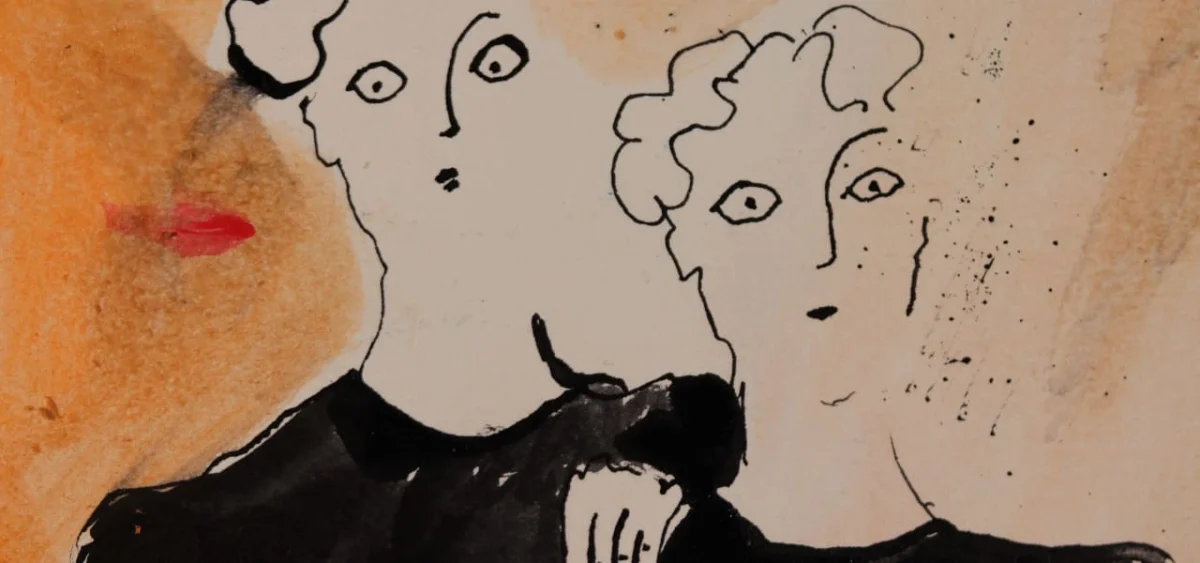
For those familiar with Hobbs’s previous work, The Daughters of the Late Colonel may feel like a departure in density, if not in spirit. Where her earlier films were often rich with complex, layered textures, this new production favors a striking minimalism. Hobbs has traded visual maximalism for a "less is more" philosophy, placing her trust in the power of negative space.
"I think I’m trying to get to a point in which I’m not doing anything ‘too much,’" Hobbs explains, reflecting on her creative process. "It’s about reducing the image and reducing the materials. In a way, it is an attempt to make something without too many processes getting in the way of what your hands and your brain are trying to do."
This shift has resulted in a film defined by delicate linework and silhouettes. A twitching finger or a single, piercing eye against an otherwise barren screen carries more emotional weight than a thousand frames of elaborate background art ever could. The result is an animation style that feels stripped back to the nerves, allowing the audience to engage directly with the characters’ psychological states.
A Chronology of Creation: From Paper to Screen
The production of The Daughters of the Late Colonel, produced by the esteemed studio Fabian&Fred, was not a linear trajectory but a rhythmic, improvisational journey. Hobbs describes the process as a "daily practice"—a ritual of creation and destruction.
The Experimental Phase
The film’s aesthetic was born from a near stream-of-conscious approach to production. Over the course of her residency in the studio, Hobbs engaged in a dizzying cycle of experimentation. Her initial explorations included:
- Cel Painting: Testing the boundaries of color and transparency.
- Collage: Integrating found materials to evoke the textures of the early 20th century.
- Pixilation: Bringing a stop-motion, human quality to the movement of objects.
- Puppetry: Utilizing physical models to explore depth and shadow.
The Iterative Cycle
This experimental period was exhaustive. Hobbs estimates that she produced roughly 45 minutes of raw footage for a film that, in its final, refined state, clocks in at just nine minutes. This ratio speaks to the rigor of her editing process, conducted in close collaboration with editor Mark Jenkins. By treating the production as a series of iterations, Hobbs allowed the film to reveal its own truth, shedding the extraneous until only the essential narrative remained.
Literary Adaptation as Psychological Excavation
Katherine Mansfield’s 1921 story is a landmark of modernist literature, known for its "immaculate" dialogue and biting social commentary. For Hobbs, the text provided a "head start" in terms of character and tone, yet the transition from page to screen demanded a ruthless distillation.
Hobbs made the bold decision to excise several characters from the original text, narrowing the narrative lens to the claustrophobic relationship between two sisters, their deceased father, and a manipulative priest. "I just thought, I’m going to keep it in this one relationship between the father and daughters and see where I can go with that," she says.
The Rebellion of the Animated Form
Perhaps the most intriguing aspect of this adaptation is the autonomy the characters began to exert over their creator. In Mansfield’s original story, the sisters are ultimately trapped by the social conventions and patriarchal expectations of their time—a fate that is, by all accounts, "doomed."
However, during the animation process, Hobbs found her characters resisting that trajectory. "In this process of making and drawing these characters, they didn’t really want to do what happens at the end of the written story," she chuckles. "They didn’t want that. So, I allowed them to act it out in a different way." This agency transforms the film from a faithful period adaptation into a subversive act of liberation.
The Role of Distance: Why the Past Matters
Hobbs has long gravitated toward historical settings and classic literature. While some might view this as a retreat from modern life, Hobbs sees it as a tool for clarity. By working with century-old sources, she avoids the friction of contemporary politics, allowing the themes of patriarchal control and female dependency to stand out in high relief.
"I think it’s about having some perspective," she notes. "The differences between men and women, or those relationships, seem more stark or less nuanced [in the past]. In commenting on them, you’re not sort of butting up against current events that are unfolding. It’s much clearer."
By removing the "noise" of the 21st century, Hobbs is able to examine the mechanics of power and trauma with a surgical precision that feels paradoxically more relevant to modern audiences than a literal retelling of current events might.
Humor as a Survival Mechanism
Despite the heavy subject matter, The Daughters of the Late Colonel is, at its core, a comedy. This juxtaposition of "experimental animation" and "deadpan humor" is a hallmark of the Hobbs style. She attributes this to her upbringing, noting that her father was a natural storyteller.
"My dad’s very funny, tells lovely stories, and so it’s part of our family culture to entertain and to deliver," she says. This sense of humor is not just a stylistic choice; it is an active part of her workflow. She describes laughing to herself while animating the minute, nervous gestures of the film’s priest character.
"When you’re animating, those are the things that bring joy in the moment," she explains. "The whole thing is organic and developing in time, and I’m laughing and enjoying the colors, and I’m enjoying the shapes." This infectious joy permeates the final work, preventing it from feeling emotionally sealed off or overly academic.
Implications for the Future of Independent Animation
As the film makes its rounds on the festival circuit, it serves as a powerful testament to the value of "specificity." In an era where animation is often designed for broad, international appeal, Hobbs argues that the opposite approach is what truly resonates.
"Often with animation, people talk about how this broad international audience is going to relate to a piece of work," Hobbs says. "As an animator, you really shouldn’t worry about that." Instead, she believes in diving deep into one’s own lived experience and specific cultural rhythms. "I think just sort of diving in more deeply into your own experience, it resonates more broadly."
Looking Ahead
Despite the accolades and the international attention, Hobbs remains grounded in her process. For her, the premiere at Cannes is merely a brief interruption in a four-year production cycle that is already churning toward the next project. "I quite like not to interrupt the practice," she says, already looking toward the next four years in the studio.
The Daughters of the Late Colonel stands as a masterclass in the economy of expression. It proves that the most profound stories do not necessarily require the most complex tools—only a keen eye, a sharp sense of humor, and the courage to let one’s characters defy their own destiny. As she continues to evolve, Elizabeth Hobbs is not just creating films; she is refining a philosophy of life through art, proving that even in the shadow of a colonel, there is always room to dance.










No comments yet. Be the first to join the conversation!