In an era defined by extreme wealth inequality and the digital-age phenomenon of the "trillionaire class," the cultural appetite for class-conscious satire has reached a fever pitch. Enter Feed the Pit, a title that, on its surface, promises the simple, visceral catharsis of hunting down the ultra-wealthy and consigning them to a ravenous, tectonic void. Yet, beneath its blood-soaked premise lies a narrative-heavy, surrealist horror experience that challenges the conventions of the extraction genre.
While one might expect a cynical roguelite, Feed the Pit delivers something far more nuanced: a slow-burn, atmospheric mystery that blends the social commentary of a Hunt: Showdown with the claustrophobic, psychological dread of indie horror darlings like Mouthwashing.
The Core Concept: Ritualizing the Purge
At its heart, Feed the Pit is an extraction game with a supernatural twist. Players assume the role of "The Seeker," a recent recruit to a mysterious, occult-leaning congregation. The group’s objective is as straightforward as it is bizarre: venture into the deep, encroaching wilds, locate the "well-heeled"—the obscenely wealthy—and drag them back to a scarlet, intestine-like cavern to be offered to "The Pit."
The Pit is not merely a hole in the ground; it is a sentient, pulsating entity that resides within a cavern wall, decorated with incongruous, domestic furniture. Communication with this entity is facilitated through an archaic blue telephone, a choice that immediately signals the game’s commitment to "weird fiction" aesthetics.
The game’s brilliance lies in its transformation of class warfare into an arcane summoning ritual. In the real world, extreme wealth functions as a protective spell, rendering the ultra-rich effectively untouchable. Feed the Pit systematically dismantles this protection, using occult mechanics to strip away the artifice of luxury until nothing remains but "eminently stabbable flesh."
Chronology and Gameplay Loop: The Hunter’s Burden
The gameplay loop of the first act, which spans a robust three to four hours, is built upon a foundation of deliberate, methodical tension. The player is not merely a predator; they are an investigator.
The Map and the Cardmaster
Each mission begins in a dense, forested hillside. Navigation is handled via a physical paper grid map and a torch, grounding the player in a tactile, low-tech reality. To isolate a target, the player must utilize a series of Tarot-style cards. These cards, emblazoned with blocky, occult iconography—fish, pyramids, medicinal pills—are provided by a recurring, headless NPC known as the Cardmaster.
The Cardmaster, a figure wreathed in smoke who teleports across the map, forces the player to engage in a high-stakes game of "Hot or Cold." Each card incinerated narrows the potential location of the target on the grid. However, this process is not without cost:
- Time Sensitivity: As cards are burned, the day cycle shifts toward night, fundamentally changing the environment.
- Exposure: By moving across the map to locate the Cardmaster, the player exposes themselves to the hostile flora and fauna of the woods.
- The Hunt: Once the target square is identified, the game shifts into a heart-pounding tracking sequence, where the player must follow footprints and the escalating rhythm of a heartbeat to ambush the quarry before the quarry turns the tables.
Supporting Data: An Evolving Menagerie
The environment of Feed the Pit is as much an antagonist as the targets themselves. Drawing inspiration from the "low-poly" aesthetic popularized by titles like Lethal Company, the woods are populated by glitchy, nightmarish abominations.
These entities are not mere obstacles; they are designed to exploit the player’s dwindling resources. As the player burns through their cards to locate the target, the ambient light fades. The monsters of the woods adapt to these shifting conditions, becoming increasingly difficult to spot in the dark. This creates a mechanical synergy where the player’s need to progress the narrative (the hunt) directly conflicts with their survival instincts.
The Human Element: A Cult of Charisma
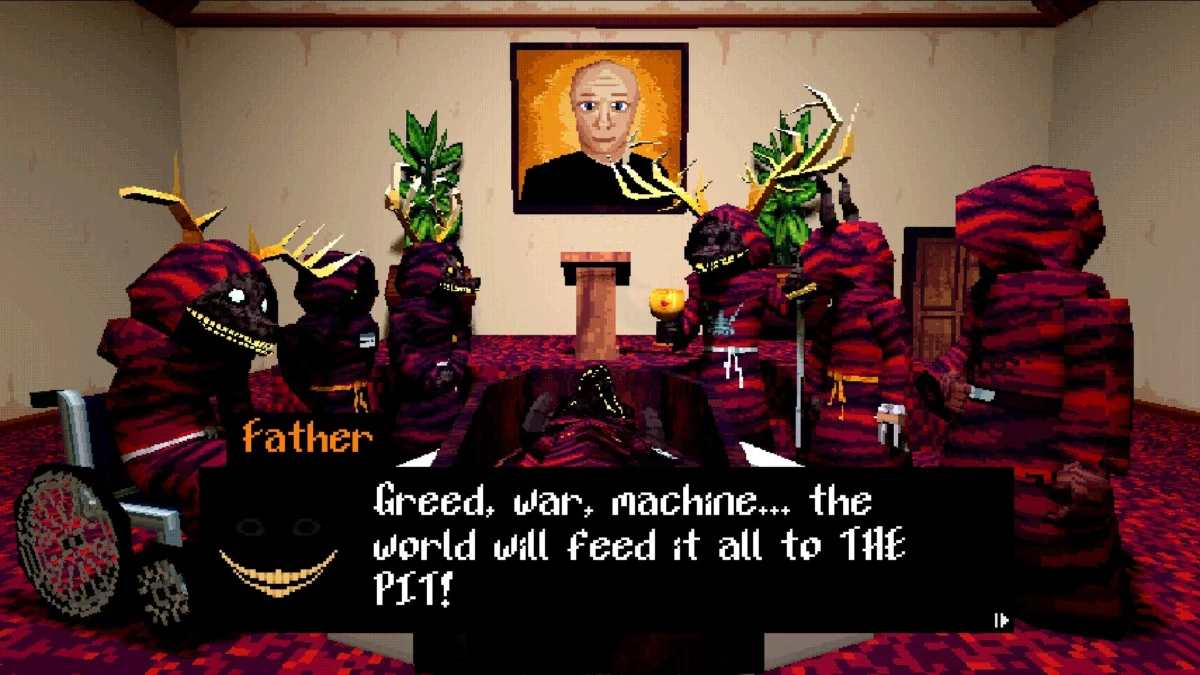
Perhaps the most surprising aspect of Feed the Pit is the "found family" dynamic within the church. Newcomers might expect the cultists to be one-dimensional villains, but the developers at Curious Fox Sox have imbued them with a disarming, grounded humanity.
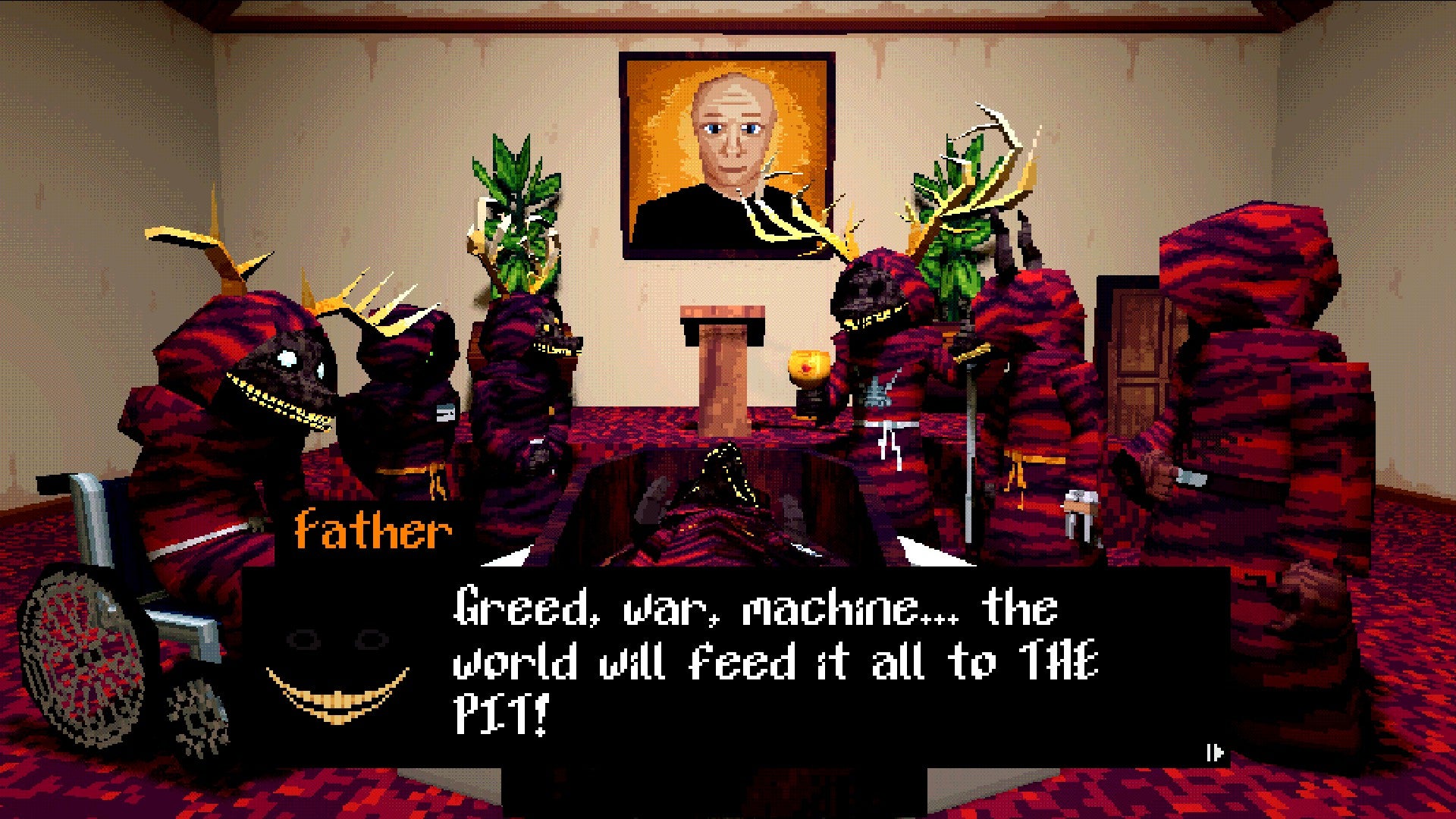
The cultists, characterized by their haunting, lipless canine masks and red hoods, initially appear terrifying. However, as the player spends time at the home base—conveniently located beneath a portrait of a messianic bald man bearing a striking, albeit coincidental, resemblance to Jeff Bezos—these characters begin to reveal their idiosyncratic personalities.

- The Relatable Cultist: One member of the group is an enthusiast of a portable gaming console (a fictionalized Nintendo DS), while another expresses a love for rock music, openly welcoming the player’s dissenting opinions.
- The Narrative Anchor: This juxtaposition between the mundane, domestic habits of the group and their horrific, sacrificial mission creates a unique narrative texture. It humanizes the player’s companions, making the stakes of their success or failure feel personal rather than purely transactional.
Implications for the Extraction Genre
The success of Feed the Pit‘s first act suggests a shift in the extraction genre. For years, the focus has been on "emergent gameplay" through PvP encounters and high-stakes looting. While Feed the Pit shares some of these traits, it prioritizes atmosphere, environmental storytelling, and a structured narrative arc.
The "Free-to-Expand" Model
Crucially, the developers have confirmed that the remaining two acts of the story will be released as free updates in the coming months. This model suggests a move away from the "games as a service" monetization model that has plagued many extraction titles. By opting for a complete, episodic narrative experience, the developers are prioritizing player retention through quality storytelling rather than seasonal battle passes.
Philosophical Undertones
The game serves as a critique of modern capitalism, but it does so without the heavy-handedness often found in political satire. By framing the ultra-rich as "monsters" in a literal, mythological sense, the game bypasses the complexities of economic policy and moves directly to the primal urge for retribution. It is a game that understands its audience—a generation frustrated by the opacity of modern power—and provides a digital outlet for that frustration.
Conclusion: A Worthy Plunge
While some players may find the arcane detective work and the reliance on card-based mechanics to be cumbersome, these elements are essential to the game’s identity. Feed the Pit is not a game designed for efficiency; it is a game designed for dread.
The requirement to constantly navigate the map while dodging glitch-horror entities forces the player into a state of perpetual anxiety. This anxiety serves the story, ensuring that when the player finally corners their target, the climax feels earned.
In a market saturated with generic shooters and hollow survival titles, Feed the Pit stands out as a unique, deeply textured experience. It proves that the horror genre has plenty of room to grow, provided it is willing to look at the world’s true monsters and, quite literally, throw them into the fire. Whether you are a fan of psychological thrillers or simply someone who has spent too much time scrolling through news of the world’s elite, Feed the Pit is a journey worth taking. Keep an eye on the upcoming acts—the narrative trajectory suggests that the worst is yet to come, and for fans of horror, that is a promise, not a warning.