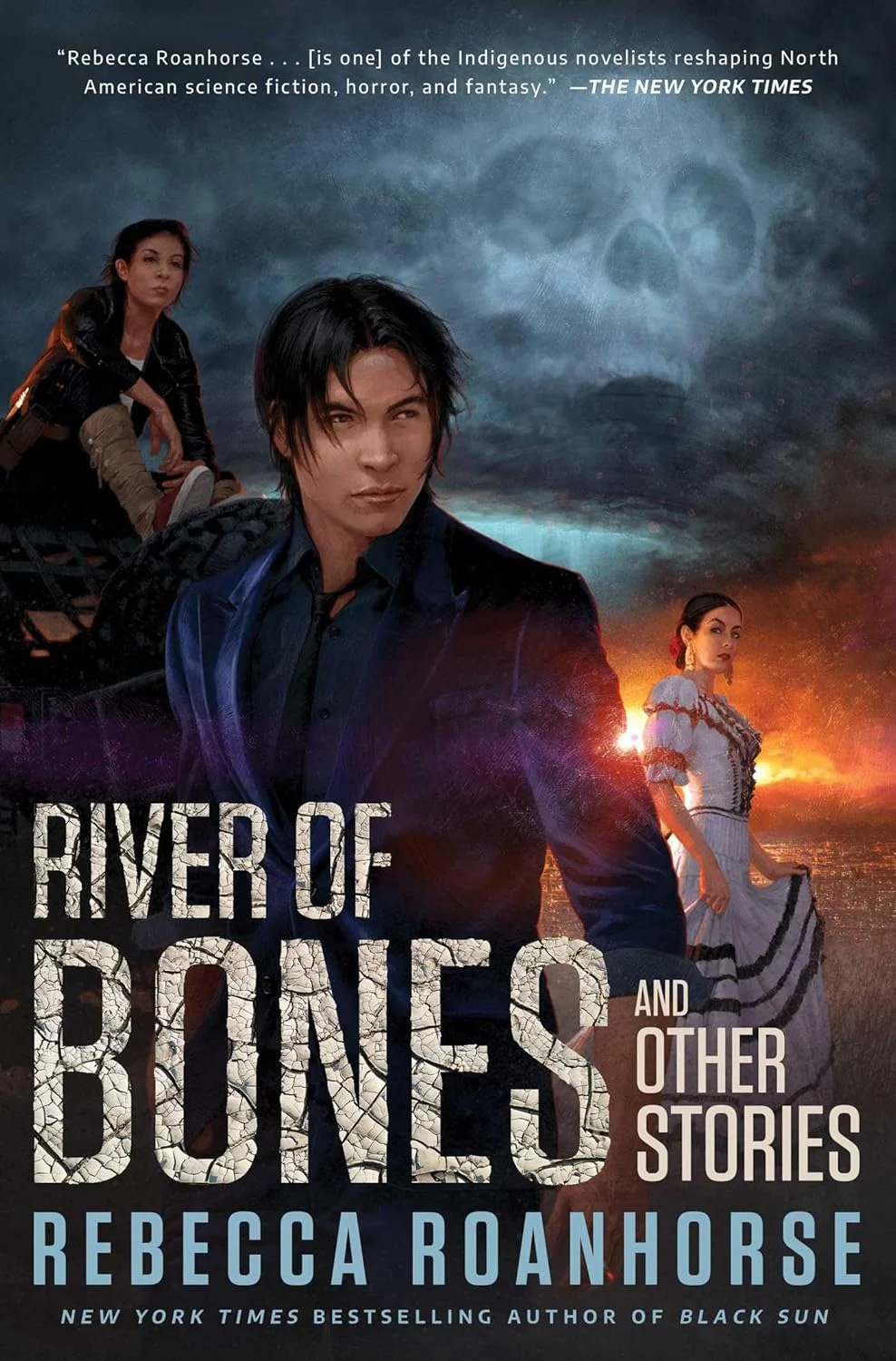
In the landscape of contemporary speculative fiction, few voices have resonated with the visceral, cutting clarity of Rebecca Roanhorse. Following the monumental success of her Between Earth and Sky trilogy—which concluded in 2024 and secured the 2025 Hugo Award for Best Series—Roanhorse has returned to the short form. Her latest collection, River of Bones, serves as both a retrospective of her prolific career and a bold, new thematic manifesto.
Through a tapestry of short stories and a concluding novella set within the universe of her seminal The Sixth World series, Roanhorse interrogates the fraught, often painful intersections of heritage, power, and the human instinct for retribution. More than a mere anthology, River of Bones acts as a mirror, forcing readers to confront the "hyperreality" of cultural perception and the moral costs of survival in a world that often demands we trade our authenticity for acceptance.
A Career in Context: From Trail of Lightning to the Hugo Stage
To understand the weight of River of Bones, one must first acknowledge the trajectory of Roanhorse’s career. Her rise to prominence began in 2018 with the publication of Trail of Lightning, the inaugural novel of The Sixth World series. By centering Navajo culture and cosmology within a post-apocalyptic framework, Roanhorse shattered the glass ceiling of urban fantasy, proving that Indigenous futurism could command mainstream literary prestige.
The subsequent Between Earth and Sky trilogy (2020–2024) saw her scale these concepts to an epic level, drawing heavily from pre-Columbian civilizations to craft a narrative of empire, religion, and revolution. The 2025 Hugo Award for Best Series was not merely an accolade; it was a validation of the cultural shift she helped spearhead. River of Bones compiles stories written throughout this decade of rapid ascent, culminating in a brand-new novella that returns to the geography of The Sixth World. For fans and scholars alike, this collection offers a rare glimpse into the evolution of an author who has become the definitive architect of contemporary Indigenous speculative fiction.
The Performance of Authenticity: Deconstructing the "Real"
The collection opens with the Hugo and Nebula award-winning short story "Welcome to Your Authentic Indian Experience." Written in the second person, the narrative functions as a brutal indictment of cultural tourism and the insatiable white desire for "authentic" Indigenous experiences.
In this story, the protagonist works at a VR resort, performing curated, stereotypical versions of Native American life for tourists. The conflict ignites when he is slowly replaced by a white man who—steeped in colonial expectations—is better at performing the "Indian" than the protagonist himself. Roanhorse deftly employs the post-structuralist concept of "hyperreality," where the caricature becomes more "real" to the observer than the actual, lived experience of the performer.
The implications are profound: when society demands a specific, static image of an identity, the individual is forced to either conform to that fiction or face erasure. This theme sets the tone for the entire collection, posing a series of uncomfortable questions: Who holds the authority to define an identity? What happens when a community rejects a member for failing to meet an arbitrary standard of "authenticity"? And ultimately, what is the cost of becoming a caricature to survive?
The Ethics of Ambiguity: In-Groups, Out-Groups, and the "Devil’s Bargain"
A central pillar of River of Bones is the interrogation of the "false binary." Humans are evolutionarily wired to categorize, yet Roanhorse delights in blurring the lines between oppressor and oppressed, insider and outsider.
In "The Boys from Blood River," the reader is introduced to Lukas, an Indigenous, gay teenager struggling with isolation and the looming tragedy of his mother’s terminal illness. His search for belonging leads him to a group of vampire boys, bound by a shared, blood-soaked history of racialized trauma. The story avoids the trap of simple victimhood; instead, it presents a "devil’s bargain." Lukas finds the community he craves, but the price of admission is the sacrifice of a white friend—a moral test that forces the reader to weigh the validity of revenge against the necessity of compassion.
This theme of the "impossible choice" repeats throughout the volume:
- "White Hills": A white-passing Indigenous woman, having ascended to the upper echelons of wealth, is forced to choose between the safety of her life of privilege and the truth of her ancestry when her mother-in-law attempts to weaponize racial pseudo-science against her.
- "Wherein Abigail Fields Recalls Her First Death…": Here, Roanhorse touches upon the post-colonial theories of Frantz Fanon and Aimé Césaire. The protagonist seeks revenge against a corrupt sheriff, only to find him already spiritually and physically rotting from the very hatred he propagated. The story moves from a quest for vengeance to a meditation on whether the victim should even care to finish the destruction of a colonizer who has already destroyed himself.
Sociopolitical Speculation: Beyond Allegory
One of the collection’s most poignant entries is "Falling Bodies," a far-future narrative that examines the complex position of the "intermediary." Set on a space station, the story follows Ira, the human son of a colonizing alien senator, who finds himself caught between his upbringing and the ideologies of human rights activists who kidnap him.
"Falling Bodies" serves as a masterclass in sociopolitical science fiction. It eschews the "easy" path of one-to-one allegory, instead providing a concrete framework for a universal dilemma: What recourse does an individual have when they belong to both the oppressor and the oppressed, and neither side will claim them?
In the introduction to the collection, Roanhorse notes that while these stories are rooted in her specific experience as a woman of Indigenous and African American descent, they have struck a chord with readers across the spectrum of marginalized identities. This universality is not accidental; it is the result of an author who understands that the psychological toll of systemic oppression is not monolithic, but rather a spectrum of varied, often contradictory responses.
The Concluding Novella: A Return to the Sixth World
The collection’s coda is a novella set within the Sixth World universe, featuring the character Kai Arviso. In many ways, the novella functions as a distillation of the entire collection’s anxieties. Kai is a character defined by his position on the threshold—caught between his ancestral obligations and the seductive promise of a life of ease and social mobility.
By placing this story at the end of the collection, Roanhorse invites the reader to look back at the preceding tales through the lens of Kai’s final, difficult choice. Does he choose the safety of his future or the sanctity of his past? Does he abandon his peers for a reward, or does he lean into the discomfort of moral integrity? Roanhorse provides no easy answers. She purposefully avoids the "happy ending" that would provide the reader with a moral safety net. Instead, she leaves us with a lingering, unresolved tension.
Implications: The Mirror Held Up to the Reader
The true power of River of Bones lies in its refusal to comfort the audience. In the modern literary landscape, where readers often demand tidy moral resolutions, Roanhorse offers the grit of reality. Her characters are neither purely heroes nor villains; they are human beings navigating the wreckage of systems they did not create.
The implications for the reader are twofold. First, the collection serves as an invitation to self-examination. As we move through these stories—witnessing characters struggle with the siren song of vengeance or the temptation of assimilation—we are forced to ask where our own allegiances would lie under such duress. Second, the collection challenges the genre of speculative fiction to do more than build worlds; it demands that it build mirrors.
River of Bones is a triumph of empathy and intellect. By refusing to simplify the complexities of identity, Rebecca Roanhorse has produced a work that is as challenging as it is necessary. It is a collection that does not ask us to agree with its characters, but rather to sit with the discomfort of their choices—and in doing so, perhaps understand the complexities of our own.