

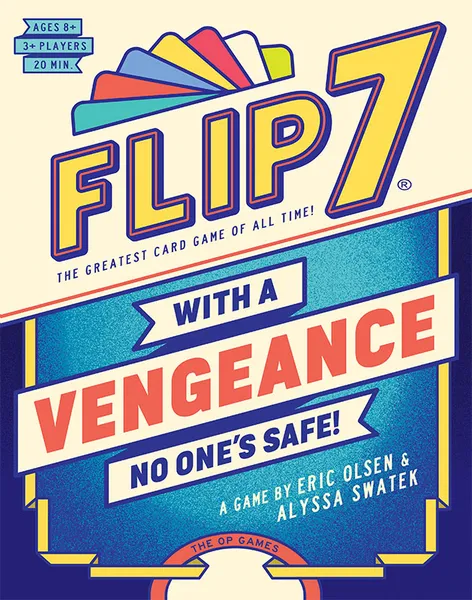
The landscape of tabletop "filler" games—those bite-sized, high-energy experiences designed to bridge the gaps between longer, more complex sessions—is notoriously competitive. Few titles, however, have managed to capture the frantic, high-stakes tension of the original Flip 7. Now, the franchise returns with a sharper edge and a noticeably darker sense of humor. Flip 7: With a Vengeance is not merely an expansion; it is a fundamental recalibration of a beloved formula, injecting a dose of "take-that" hostility into a game that was previously defined by polite, individual risk-taking.
For those unfamiliar with the pedigree, Flip 7 was a masterclass in minimalist design. Its return to the table, sporting the subtitle With a Vengeance, promises a transformation from a solitary test of nerves into a cutthroat social arena. But does this shift toward aggression enhance the experience, or does it undermine the elegance of the original?
The Mechanics of Risk: A Brief How-To
At its core, Flip 7: With a Vengeance remains faithful to the addictive push-your-luck foundation that made its predecessor a breakout hit. The objective is deceptively simple: be the first player to accumulate 200 points. Players achieve this by flipping number cards from the deck into their personal tableau.
On each turn, the dealer presents a binary choice: "Hit" or "Stay." Choosing to "Hit" requires the player to reveal the top card of the deck and add it to their tableau. The catch—and the source of the game’s primary tension—is the bust mechanic. If a player reveals a number that already exists in their current tableau, they immediately "bust," scoring zero points for that round. Conversely, if a player successfully gathers seven unique numbers, they are rewarded with a coveted 15-point bonus, a vital milestone in the race to 200.
While the fundamentals are unchanged, the "Vengeance" edition introduces a deck of specialized, high-impact cards. These aren’t your standard numbered digits; they are instruments of disruption. Whether through stealing opponent cards, forcing mandatory draws, swapping tableau assets, or mathematically manipulating scores through division, the game is designed to force interaction. Unlike the original, where your safety was determined solely by your own restraint, With a Vengeance introduces effects that can strike even after you have chosen to "Stay," ensuring that no score is truly secure until the final card is played and the round is officially closed.
A Chronology of Chaos: From Polite Play to Calculated Cruelty
To understand the significance of this update, one must look at the evolution of the game’s pacing. The original Flip 7 was lauded for its "blink-and-you-miss-it" speed. A round was a flurry of activity: "Hit or stay?" was the only mantra, creating a rhythmic, almost meditative flow of rapid decision-making.
With a Vengeance preserves this speed but changes the texture of the downtime. In the early stages of a round, the game moves with its signature, breakneck efficiency. However, as the deck thins and the special "Vengeance" cards enter the rotation, the pacing shifts from a sprint to a tactical ambush. The inclusion of thirteen 13s—a high-risk, high-reward inclusion—creates massive scoring volatility. A player might be sitting on a comfortable lead, only to see their entire hand dismantled by a well-timed sabotage card played by an opponent who has nothing left to lose.
The result is a game that feels significantly more "lived-in" and rowdy. In the original, the tension was internal—it was you against the deck. Now, the tension is external—it is you against the person sitting across from you. This shift has successfully turned the game into a social experience where table talk, table-flipping (figuratively, of course), and "king-slaying" are not just encouraged; they are the primary engines of the game’s replayability.
Supporting Data: Why the "Mean" Mechanic Matters
The decision to pivot toward aggressive, confrontational gameplay is a bold move in an era where many modern board games lean toward "multiplayer solitaire" or low-conflict mechanics. However, data from early playtests suggests that this specific brand of "cruelty" is exactly what the Flip 7 community craved.
The replayability metrics are high. Because the game is easy to teach and finishes in a fraction of the time of a standard board game, it functions as a "gateway" to higher engagement. In groups that enjoy titles like No Thanks!, SCOUT, or the notoriously ruthless 6 nimmt!, Flip 7: With a Vengeance consistently hits the table three or four times in a single sitting.
The scaling is another point of success. Whether you have three players or a full table of six, the core tension remains intact because the turn structure is so concise. There is never a moment of "dead air" where a player is waiting for a complex turn to resolve. The brutality of the new cards also acts as a natural equalizer; if one player begins to dominate the scoreboard, the collective incentive for the other players to use their special cards against the leader creates an organic, self-balancing "catch-up" mechanic that keeps the score gap narrow until the final moments of the game.
Official Stance: Design Philosophy and Production
When speaking with the designers regarding the lack of a formal "theme," the consensus is clear: Flip 7: With a Vengeance is a game of pure mechanics. By avoiding the clutter of a forced narrative or heavy lore, the game remains accessible to anyone. The designers argue that the "theme" is the players themselves—the reactions, the groans of disappointment, and the cheers of triumph are the only narrative the game needs.
The production quality reflects this philosophy of functional minimalism. The cards are durable, easy to read, and, perhaps most importantly, priced in a way that encourages physical handling. This is not a "precious" game. It is designed to be shuffled, spilled upon, and passed around in pubs or backpack-bound camping trips. The absence of a premium, collector-grade box is a deliberate choice, signaling that the game’s value lies in the experience of play rather than the prestige of the components. It is a refreshing departure from the "deluxe" trend currently dominating the hobbyist market, returning to the humble, egalitarian roots of the deck-of-cards tradition.
The Implications: Is It Right for Your Group?
The primary implication of Flip 7: With a Vengeance is the clear line it draws in the sand. This is not a game for those who prefer cooperative play or low-conflict puzzles. If your gaming group values "nice" games where everyone builds their own engine in silence, this title will likely be perceived as hostile. The "take-that" mechanics are pervasive; if a player is sensitive to having their plans thwarted, this game will feel like a targeted attack rather than a tactical challenge.
However, for the target demographic—those who find joy in the "social brutality" of UNO or the tense, high-speed decision-making of modern filler games—this is a triumph. The added layer of malice creates a level of emotional investment that the original simply could not reach. It transforms a simple, math-based card game into a series of stories. Every round concludes with a post-mortem discussion, as players recount the specific moment their strategy was sabotaged or their luck finally ran out.
Ultimately, Flip 7: With a Vengeance is a testament to the idea that sometimes, the most effective way to update a classic is to stop playing nice. It is loud, it is mean, and it is entirely unapologetic about both. It is a rare example of a sequel that understands exactly what its predecessor was missing and provides it with surgical precision. Whether it stays in your collection for years or simply serves as the chaotic highlight of your next game night, one thing is certain: it will be played until the cards themselves start to fray.
For the modern gamer, this level of engagement is not just a feature—it is the point. And if the goal was to get people talking, yelling, and reaching for the deck one more time, then With a Vengeance has succeeded in every possible category.











No comments yet. Be the first to join the conversation!