

In the rarified air of the Telluride Film Festival, where cinematic ambitions are often measured in silent pauses and lingering gazes, Jesse Eisenberg has managed to stir a tempest with something far more kinetic. His third feature as a director, The Debut, world-premiered to a thunderous reception, instantly positioning itself as a formidable heavyweight in the upcoming awards season.
There is a delicious, meta-textual irony at the heart of the film: it is a story about a "nobody" who treats a bit part with the gravitas of a life-defining epic. Yet, in its execution, the film has arrived as one of the fall’s most significant Best Picture contenders, effectively transforming its two leads—Julianne Moore and Paul Giamatti—into the early favorites for Oscar gold.
The Narrative Architecture: A Fever Dream in New Jersey
To understand the tonal tightrope Eisenberg walks in The Debut, one might imagine a collision between the psychological unraveling of Black Swan, the rhythmic, high-stakes intensity of Whiplash, and the dry, mockumentary absurdity of Waiting for Guffman. It is a project that feels like a fever dream staged within the fluorescent-lit confines of a New Jersey community center.
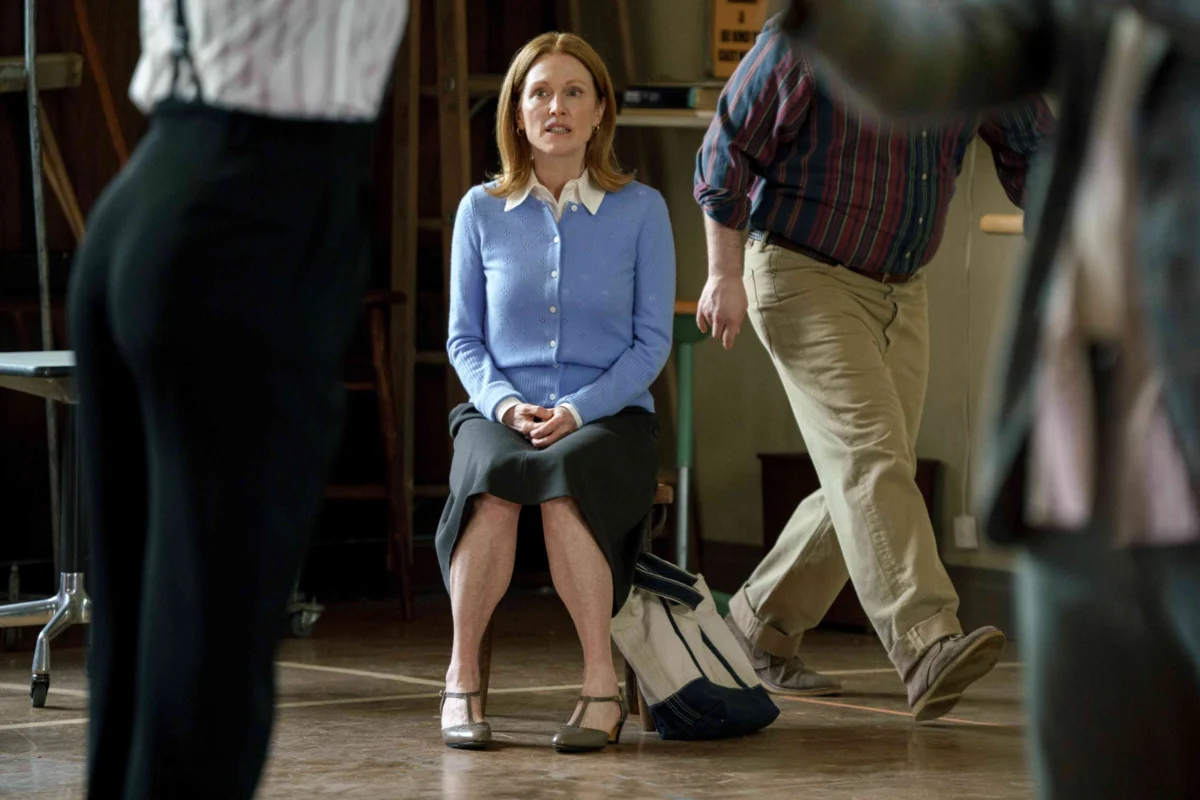
The plot centers on Mona Friedman (Julianne Moore), a meek, suburban housewife whose life has been defined by domestic invisibility. She has not sung in public since her days in a church choir, yet she finds herself unexpectedly cast in a local theater production. What begins as a modest creative outlet soon spirals into a display of zealous, borderline-feral method acting. Mona is a woman possessed, willing to wage total war over a role that is, by any objective metric, entirely marginal.
Opposite her stands Jerry (Paul Giamatti), the production’s tyrannical, ego-driven director. Billed without a shred of irony as "the biggest name in New Jersey community theater," Giamatti’s character is a masterclass in petty despotism. The film navigates a tricky path—shifting from uproarious comedy to psychological intensity and, finally, to a profound, humanistic resonance. It serves as definitive confirmation that Eisenberg—who previously guided Kieran Culkin to an Oscar-winning performance in A Real Pain—possesses a singular gift for crafting showcases that allow actors to inhabit the absolute extremes of their range.
Chronology of a Festival Sensation
The trajectory of The Debut at Telluride was marked by palpable momentum. The screening, held on a brisk Saturday afternoon, served as the film’s first public unveiling. The atmosphere in the theater was electric, punctuated by moments of spontaneous, mid-scene applause for Moore—a rarity for a festival audience that usually prides itself on disciplined restraint.
Following the screening, an intimate Q&A session was moderated by NBC News’ Rebecca Keagan. The panel featured Eisenberg, Moore, and Giamatti. The event was notable for a particularly poignant detail: it was Paul Giamatti’s first time seeing the finished film. His visible reaction to the final cut underscored the collaborative trust Eisenberg has fostered with his leads.
The film’s arrival at Telluride was not merely a screening; it was a coronation. Having arrived with a modest, if intriguing, resume, the project departed the mountainside as a bona fide frontrunner, with industry insiders and critics alike scrambling to adjust their predictions for the coming months.
Supporting Data: The A24 Factor and Oscar Mathematics
A24 has strategically slated The Debut for a December 11 release. This date is not incidental; it is a calculated "long game" maneuver. The studio has a storied history of taking unlikely projects and shepherding them to Best Picture glory. From the underdog victory of Moonlight—which famously toppled the favored La La Land—to the absurdist, genre-bending triumph of Everything Everywhere All at Once, A24 has mastered the art of the late-year surge.
The Case for Julianne Moore
Moore is currently the film’s clear frontrunner-in-waiting. A five-time nominee who took home the statuette for Still Alice over a decade ago, she is currently experiencing a career renaissance. Her portrayal of Mona is a tragicomic tour de force, reminiscent of the "all-in" fearlessness associated with Natalie Portman or Cate Blanchett. With the Academy’s recent historical trend of rewarding repeat winners—seen in the recent wins for Anthony Hopkins, Emma Stone, and Frances McDormand—a second statuette for Moore is not only possible; it is statistically probable. Notably, Emma Stone, herself an Academy darling, serves as a producer on the film, adding a layer of industry heavyweight support to the project.
The Case for Paul Giamatti
For Giamatti, the stakes are both different and deeply personal. Despite being one of the most respected actors of his generation, he has yet to secure an Oscar. His omission for Sideways remains one of the most cited snubs in recent Academy history, and his loss for The Holdovers to the Oppenheimer juggernaut only increased the desire among the voting body to honor him. As Jerry, Giamatti delivers the film’s most quotable lines, including the haunting, "That’s where everyone wants to be… center stage." Industry analysts suggest his most viable path to victory is in the Supporting Actor category—a lane that Kieran Culkin successfully navigated for Eisenberg just two years ago.
Official Perspectives and Behind-the-Scenes Craft
The production values of The Debut are elevated by a top-tier creative team. Cinematographer Drew Daniels, coming off his stunning work on Anora, provides a visual language that manages to make the mundane setting of a community center feel as epic as a Broadway stage. The score, composed by Minari nominee Emil Mosseri, acts as the film’s emotional heartbeat.
The ensemble is further bolstered by the inclusion of Broadway royalty Bernadette Peters and the versatile Halle Bailey, who bring authentic theatrical pedigree to the production. Eisenberg, who recently earned a screenplay nomination for A Real Pain, has penned a script that functions as a savage, razor-sharp critique of the creative process. By focusing on an original, fictional musical rather than an established hit, Eisenberg gives himself the narrative freedom to deconstruct the "theater bug" with surgical precision.
Implications: A Love Letter to the Craft
The presence of The Debut alongside other high-profile festival entries—such as the theater-centric Elsinore—suggests a broader trend in current cinema: a collective industry interest in turning the camera inward. These films serve as love letters to the act of performance, exploring the vulnerability, ego, and sheer madness required to stand in the spotlight.
For Jesse Eisenberg, the implication of this success is profound. He has effectively transitioned from an actor-turned-director to a filmmaker with a distinct, auteurist voice. He understands that the best way to tell a story about "no small parts" is to treat every character as if they are the protagonist of their own life-or-death drama.
As the industry pivots toward the awards circuit, The Debut stands as a reminder of the power of the medium to elevate the common to the mythic. The film’s thesis is simple: the desperation to be seen is a universal human condition. Whether the Academy chooses to validate this thesis with a gold-plated statue remains to be seen, but as the dust settles on Telluride, the narrative momentum is undeniably in Eisenberg’s favor. The stage is set, the cues are marked, and for the cast and crew of The Debut, the wait for the final curtain call begins.










