Nana Wu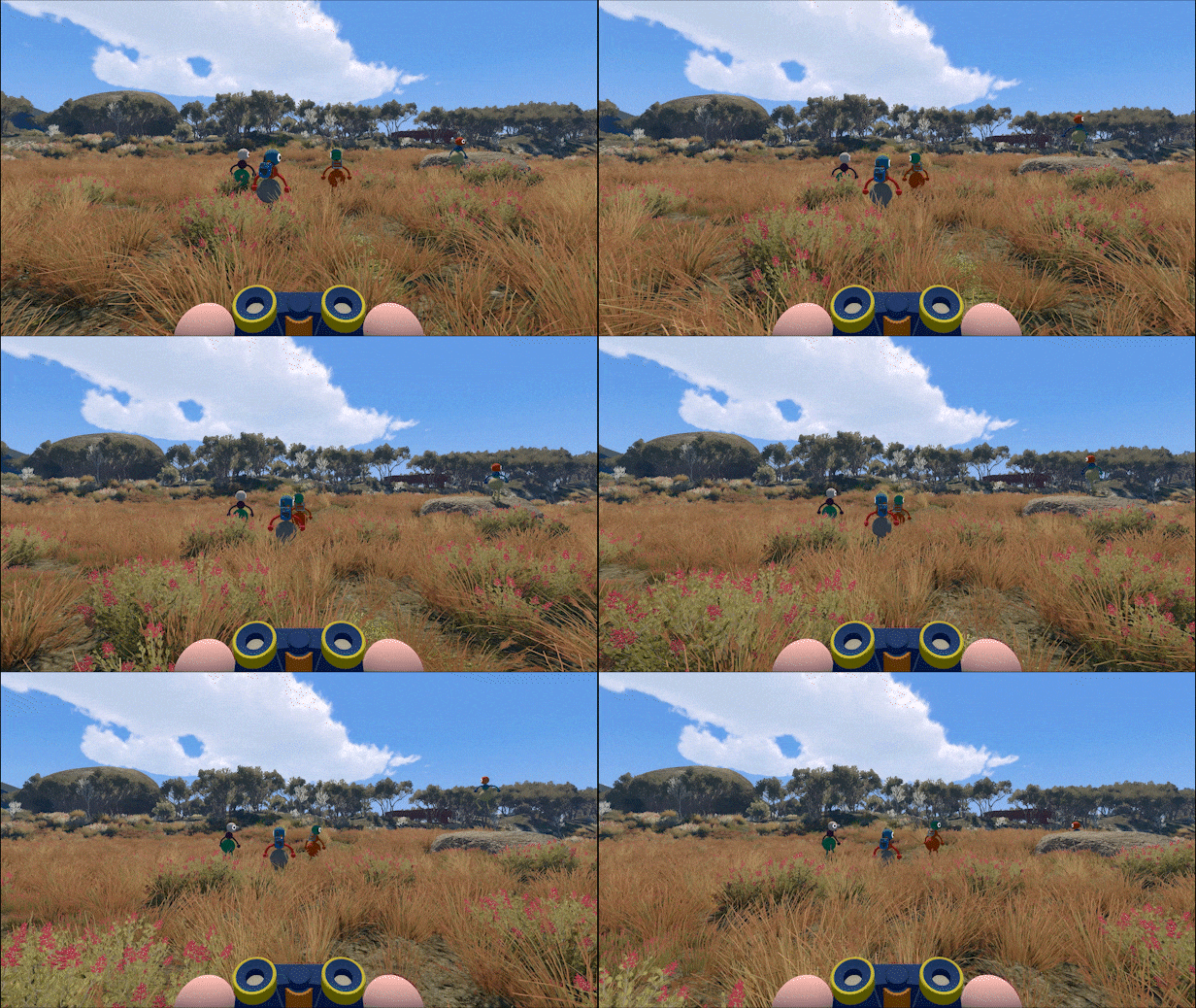
In an industry currently dominated by the high-octane adrenaline of battle royales and the relentless pressure of competitive survival sims, the concept of a "leisurely walk" as a core gameplay mechanic feels almost radical. Yet, this is the exact proposition from Melbourne-based studio House House, the visionary team behind the global phenomenon Untitled Goose Game. Their latest project, Big Walk, is poised to flip the script on open-world design, trading gunfights and resource grinding for collaborative exploration, surreal landscapes, and the simple joy of companionship.
The Core Concept: A New Paradigm for Multiplayer
Big Walk is not merely a game about traversing terrain; it is a "cooperative online walker-talker." At its heart, the game strips away the aggressive tropes of modern gaming, replacing them with a focus on communication and collective problem-solving. In a market where players are often conditioned to view others as either threats or fleeting NPCs, Big Walk necessitates a shift in perspective.
The game’s environment acts as a puzzle in itself. As players navigate dreamy, abstract landscapes, they are frequently confronted with scenarios that require genuine verbal coordination. The developers have designed certain segments to leave players momentarily speechless or perplexed, compelling them to innovate their methods of communication to overcome obstacles. It is the antithesis of the high-stakes, high-stress atmosphere found in titles like Fortnite or Grand Theft Auto V. Instead, the experience is defined by the cadence of a conversation—a digital stroll through a gallery of interactive art.

A Chronology of Anticipation
The trajectory of Big Walk began with the shadow of its predecessor’s success. When House House released Untitled Goose Game in 2019, they proved that a title with low stakes and a distinct, charming aesthetic could captivate millions. The studio established a reputation for "mischief-as-a-mechanic," a design philosophy that favored wit over raw power.
- Initial Development: Following the success of the Goose, the team at House House sought to explore a different kind of human—or in this case, character—interaction. Development on Big Walk commenced with the aim of capturing the feeling of a long, aimless hike with friends.
- The Announcement: The game was teased in industry showcases, quickly garnering attention for its vibrant, minimalist art style and the intriguing premise of a game that encourages "not really doing anything at all."
- Release Date Confirmation: After months of speculation, the studio officially confirmed that the journey begins on August 4. The game will launch simultaneously across Steam (PC), PlayStation 5, and the highly anticipated Switch 2, positioning it as a significant cross-platform title for the mid-year release cycle.
Supporting Data: Why This Matters for the Industry
The gaming market is currently experiencing a "cozy game" boom. Data from market analysts suggests a growing appetite for non-violent, collaborative, and relaxing experiences. Players are increasingly suffering from "competitive burnout," leading to a surge in the popularity of games that prioritize community over combat.
- The "Cozy" Market Shift: Titles like Animal Crossing: New Horizons and Stardew Valley proved that there is a massive, multi-billion-dollar market for games that prioritize social connection. Big Walk taps into this by treating the "walk" as the primary objective rather than a transition between missions.
- Collaborative Design: By focusing on the "walker-talker" dynamic, House House is challenging the traditional UI/UX standards of multiplayer games. Rather than relying on ping systems or objective markers, the game forces players to rely on their own linguistic creativity. This increases "social density"—the quality and depth of interaction between players—rather than just the number of players on a map.
Official Perspectives: The Philosophy of "Just Walking"
In various promotional materials and developer insights, House House has been clear about their intentions: they aren’t interested in building a better battle royale; they are interested in building a better hangout space.

"As much as Big Walk is a game about walking and talking, it’s also about exploring, and getting lost, and doing challenges, and sometimes, not really doing anything at all," the team shared in a recent project trailer.
This philosophy highlights a rejection of the "engagement loop" seen in many modern games. Often, developers design systems to keep players clicking, shooting, or looting to maintain engagement metrics. House House is doing the opposite: they are providing a space that is valuable because of its openness. By allowing for moments of stillness, they are inviting players to project their own narratives and friendships onto the game world, rather than forcing them to follow a pre-scripted path of conquest.
Implications for Future Game Development
The launch of Big Walk on August 4 will serve as a bellwether for the industry. If the title succeeds, it could pave the way for a new sub-genre of "social-first" games that focus on environment and dialogue over traditional mechanics.

1. The Death of the "Grind"
If Big Walk finds a massive audience, it may signal that players are finally tiring of the "grind"—the repetitive loops of leveling up, looting, and grinding for gear. The success of this title would prove that an experience can be sustained solely through the quality of the interactions between players and the beauty of the world they inhabit.
2. The Evolution of Multiplayer Communication
We are currently in an era where voice chat is often toxic or non-existent in public lobbies. By creating a game where communication is a puzzle element, House House is gamifying the social experience itself. This could inspire other developers to create mechanics that incentivize positive, necessary, and creative communication between strangers.
3. Cross-Platform Accessibility
By launching on Steam, PS5, and the Switch 2, House House is ensuring that the barrier to entry is as low as possible. The technical challenge of syncing these platforms is significant, but the implication is clear: this is a game designed to be played by anyone, regardless of their preferred hardware ecosystem.

Conclusion: A Walk Worth Taking
As we look toward the August 4 release, the excitement surrounding Big Walk isn’t driven by flashy graphics or high-octane trailers. Instead, it is driven by a collective curiosity. In a digital landscape that feels increasingly crowded and noisy, the promise of a quiet, cooperative, and thoughtfully designed walk through a surrealist world feels like an essential antidote.
Whether you are looking to solve intricate puzzles with friends or simply want to wander through a beautifully rendered landscape while catching up on life, Big Walk invites you to slow down. It reminds us that in the vast, open-world pantheon of video games, sometimes the most exciting thing you can do is not to fight, not to build, and not to conquer—but simply to walk.
As the industry shifts toward more meaningful, player-driven experiences, Big Walk stands as a testament to the fact that when you remove the barriers of competition, you often find the best parts of gaming are found in the simplest of human connections. Keep your eyes on the horizon for August 4th; the walk is almost ready to begin.


 Sagoh
Sagoh
 Lina Irawan