

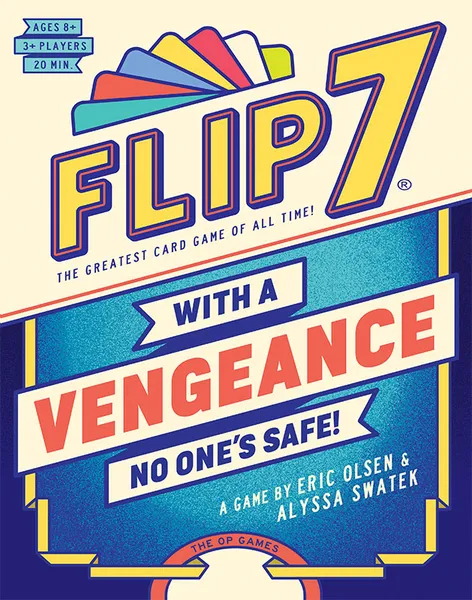
The landscape of modern tabletop gaming is often dominated by sprawling, multi-hour "eurogames" that prioritize engine building and resource management. However, there remains an unshakeable, primal desire for the "filler" game—the quick, punchy, and often ruthless experience that can be played in the time it takes to order a round of drinks. Enter Flip 7: With a Vengeance, the latest iteration of the cult-classic push-your-luck card game.
If the original Flip 7 was a polite game of risk-taking, With a Vengeance is its rebellious, antisocial sibling. It takes the core mechanics of the series and injects them with a volatile dose of "take-that" mechanics, transforming a solitary calculation of probabilities into a high-stakes arena of social manipulation and tactical sabotage.
The Evolution of the Gamble: Main Facts and Gameplay Mechanics
At its core, Flip 7: With a Vengeance retains the fundamental DNA that made its predecessor a hit. Players compete to be the first to reach a cumulative score of 200 points. On each turn, the dealer acts as the facilitator for the active player, asking the perennial, anxiety-inducing question: "Hit or stay?"
When a player chooses to "hit," they reveal the top card of the deck and add it to their personal tableau. The goal is to collect seven unique numbers without busting. A bust occurs if a player reveals a duplicate number already present in their tableau, instantly voiding their score for that round. Conversely, completing a set of seven unique numbers triggers a lucrative 15-point bonus, a vital mechanic for those looking to reach the 200-point threshold ahead of the pack.
However, the "Vengeance" subtitle is not merely marketing flourish. The deck has been overhauled to include a suite of aggressive special cards designed to disrupt the status quo. These cards allow players to:
- Steal: Directly expropriate cards from an opponent’s tableau.
- Swap: Exchange a high-value card for a lower one or force an opponent to take a potential "bust" card.
- Sabotage: Reduce scores, divide totals, or force unwanted draws.
Perhaps most cruelly, some of these effects bypass the "stay" phase, meaning a player who has safely banked their points can still find themselves targeted by a rival’s well-timed special card. In this version, safety is an illusion, and the round is never truly over until the final tally is recorded.
A Chronology of Chaos: From Polite Play to Calculated Cruelty
To understand why With a Vengeance is making waves, one must look at the trajectory of the Flip 7 franchise. The original game was lauded for its elegance—a minimalist design that relied entirely on the tension of the deck. It was a "gentleman’s game" of math and nerves.
As the game grew in popularity, feedback from the community suggested a desire for more player interaction. In many gaming circles, the original felt "too clean." The development of With a Vengeance appears to be a direct response to this feedback loop. By introducing the "thirteen 13s" into the deck, the designers created a high-risk, high-reward ecosystem that demands constant attention.
In the early stages of a game, players might play conservatively, building small sets to chip away at the 200-point goal. However, as the game progresses and players approach the finish line, the "king-slaying" mentality takes over. The chronology of a single session typically follows a predictable arc:
- The Opening Phase: Players test the waters, focusing on their own boards.
- The Escalation: Special cards begin to circulate, forcing players to hoard defensive assets.
- The Climax: A flurry of attacks occurs, with players burning through their special cards to prevent leaders from closing out the game.
This shift in pacing has redefined how the game is played, turning what was once a quiet exercise in probability into a loud, interactive experience where table talk—bluffing, negotiating, and outright goading—is as important as the cards themselves.
Supporting Data: Why the Pacing Works
One of the most impressive feats of Flip 7: With a Vengeance is how it manages to increase the game’s complexity without sacrificing its velocity. In the world of tabletop gaming, "interaction" is often synonymous with "downtime." Adding more moving parts to a turn-based game usually slows down the proceedings.
However, With a Vengeance keeps turns lightning-fast. Because the core action remains a simple "hit or stay" prompt, the game avoids the paralysis-by-analysis that plagues heavier titles. Data from playtesting sessions suggests that even with four or five players, the game moves with a fluidity that few other card games achieve.
The inclusion of the 13s is the secret sauce. By injecting high-volatility cards into the deck, the game creates "swingy" turns. A player who seems down and out can suddenly pull a combo of cards that wipes out an opponent’s lead. This volatility ensures that even when a player is behind, they are never truly out of the game. The psychological effect of this is significant; players remain engaged, watching the deck with hawk-like intensity, waiting for the one card that will flip the board in their favor.
Official Stance and Design Philosophy
While the designers have kept a relatively low profile regarding the "meaner" aspects of the game, the design choices speak for themselves. The move away from a theme is a deliberate statement. Flip 7 does not need a narrative of space exploration or medieval fantasy to justify its existence; it is an abstract exercise in tension.
The production quality reflects this utilitarian philosophy. The cards are designed to be used, not displayed. They are meant to be shuffled, dropped, spilled upon, and passed around a pub table. By choosing a lower price point and durable, functional card stock, the developers have positioned With a Vengeance as a "beater" game—the kind that gets shoved into a coat pocket or a glove compartment.
In a statement regarding the game’s design, the creative team noted, "We wanted to create a game that lives on the table, not on the shelf. If you’re worried about bending the cards, you aren’t playing the game correctly." This philosophy extends to the "take-that" mechanics. They view the inherent hostility of the gameplay as a feature, not a bug, designed to cultivate a specific, high-energy atmosphere that caters to groups who enjoy "rowdy" gaming.
Implications for the Hobby Gaming Industry
The success of Flip 7: With a Vengeance provides a clear indicator of where the casual gaming market is heading. Players are increasingly seeking "high-interaction" fillers that can bridge the gap between non-gamers and hobbyists. It fits snugly into a category alongside titles like No Thanks!, SCOUT, and 6 nimmt!.
However, its extreme nature raises an interesting question about player preference. Is the market ready for games that are intentionally designed to be "mean"? The industry has spent years moving away from player elimination and direct attacks, favoring games where players build their own engines in isolation. Flip 7: With a Vengeance serves as a counter-cultural movement against this trend. It is a reminder that for many, the joy of gaming is not in the quiet satisfaction of a perfect engine, but in the social friction of outsmarting—and occasionally sabotaging—one’s friends.
For retailers and publishers, the implication is clear: there is a significant, untapped demographic for games that lean into conflict. With a Vengeance is not for the person who wants a calm evening of cooperative puzzle-solving. It is for the group that wants to shout, laugh, and walk away from the table with a sense of "I can’t believe you just did that to me."
Final Verdict: The "Vengeance" Experience
Flip 7: With a Vengeance is a rare example of a sequel that successfully redefines its identity without losing its soul. It takes a proven, addictive mechanic and dares to make it abrasive, resulting in a game that feels more alive, more dangerous, and more memorable than its predecessor.
It earns an 8.5/10, not because it is a masterpiece of deep strategy, but because it is a masterpiece of social engineering. It knows exactly what it wants to be: a catalyst for chaos. Whether you view that as a triumph or a challenge depends on the temperament of your gaming group. For those who find the "polite" games of the current market a bit too sterile, Flip 7: With a Vengeance is the perfect, stinging antidote. It is loud, it is mean, and it is undoubtedly one of the most essential additions to the "filler" shelf in years.











No comments yet. Be the first to join the conversation!