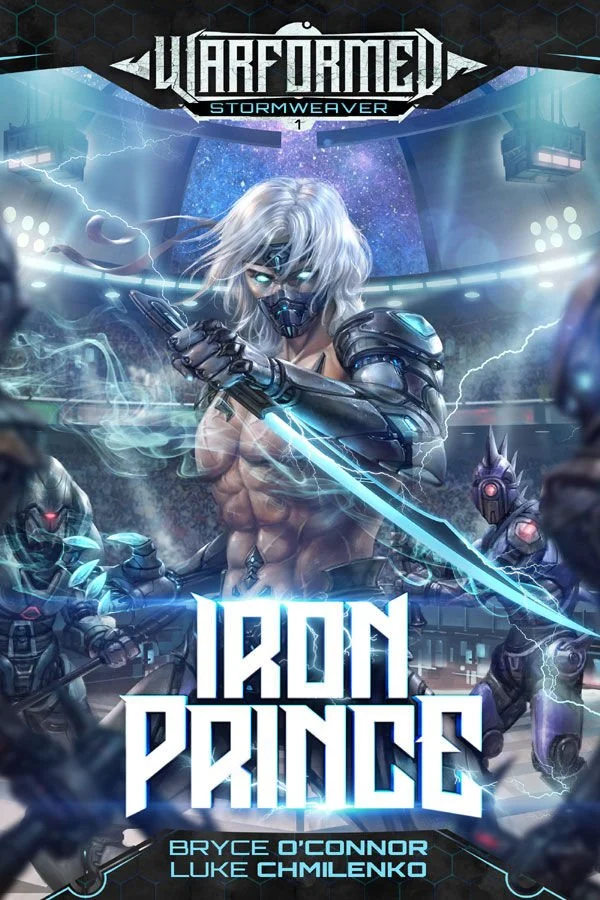
In the rapidly expanding landscape of contemporary science fiction, few titles have captured the imagination of the "progression fantasy" community quite like Warformed: Iron Prince. Authored by the collaborative duo Bryce O’Connor and Luke Chmilenko, this novel serves as a masterclass in modern power-fantasy storytelling. By blending high-stakes military academy tropes with sophisticated, game-like progression mechanics, the authors have crafted a narrative that feels both comfortingly familiar to fans of shounen anime and strikingly innovative in its execution.
The Genesis of an Underdog: Core Narrative Facts
The story centers on Reidon "Rei" Ward, an individual defined by adversity. Born into a world that values physical prowess and military capability, Rei is afflicted with a debilitating bone condition that has rendered him frail and sickly since birth. Abandoned by his parents and forced to navigate a society that views his existence as a disadvantage, Rei’s life is a testament to sheer, unyielding perseverance.
His trajectory shifts dramatically when he is granted a Combat Assistance Device (CAD)—a piece of alien technology that acts as both a weapon and a suit of power armor. While most CAD users receive hardware with stable, predictable specifications, Rei’s device is an anomaly. It possesses "awful" initial specs but carries the latent potential for infinite, exponential growth. Enrolling in the prestigious Galens Institute, one of the elite military academies within the Collective, Rei finds himself at the bottom of the rankings. Alongside his steadfast friend, Viviana "Viv" Arada, Rei begins a grueling ascent through the competitive tournament circuits that have become the cornerstone of human entertainment and national pride.
Chronology of a Power Fantasy
The progression of Warformed: Iron Prince mirrors the classic "hero’s journey" structure, yet it is uniquely accelerated by its internal mechanics.
Phase 1: The Inciting Incident
Rei’s journey begins with his desperate bid to meet the bare minimum physical requirements for CAD registration. This phase highlights the severity of his medical condition and establishes the stakes: a CAD is not merely a weapon; it is a potential cure for his terminal illness.
Phase 2: The Academy Crucible
Upon receiving his unique CAD, Rei is thrust into the Galens Institute. This segment of the novel utilizes the "academy" trope effectively, establishing a hierarchy of talent, wealthy prodigies, and systemic bias. Rei is immediately positioned as the target of institutional bullying, serving as the narrative’s primary engine for conflict.
Phase 3: The Growth Loop
The core of the book’s chronology is its training-and-sparring loop. Drawing parallels to the "Saiyan" biology of Dragon Ball Z, Rei’s CAD adapts and evolves based on the data gathered from his losses. Each defeat provides the system with new parameters, allowing for rapid, non-linear power scaling. This creates a compelling narrative rhythm: Rei fights, loses, learns, and undergoes an implied "level-up" period, leading to a visible shift in his capabilities.
Supporting Data: The Mechanics of Progression
To understand the success of Warformed: Iron Prince, one must examine the specific mechanics of the "Progression Fantasy" subgenre. Unlike traditional fantasy, which often relies on mystical artifacts or magical destiny, this novel utilizes "hard" progression systems reminiscent of MMORPGs or Solo Leveling.
The CAD System
The Combat Assistance Device is the central technological pillar of the universe. It is not merely a tool but an extension of the user’s biology. The device functions as a literal interface for growth, tracking:
- Stats: Measuring raw capabilities like speed, strength, and endurance.
- Evolution: The ability for the device to rewrite its own code, changing its form and function in response to combat stress.
- Physics Defiance: High-level users demonstrate feats that challenge conventional physics, elevating the combat from standard military skirmishes to near-superhuman displays.
The Shounen Influence
The authors lean heavily into the structural DNA of shounen battle manga. By incorporating tropes such as the "tournament arc," the "rival-turned-ally," and the "overpowered secret ability," the book satisfies the reader’s craving for catharsis. The narrative provides the reader with "inside knowledge"—we know Rei is destined for greatness, and we are invited to watch as the arrogant characters around him are forced to reckon with their own underestimations.
Perspectives and Character Dynamics
While the spectacle of power escalation draws the reader in, the emotional resonance of the story is anchored by its ensemble cast. The banter between Rei, Viv, and their circle of allies provides the necessary levity to balance the intensity of the combat training.
The Prodigy Paradigm
One of the most compelling aspects of the narrative is the subversion of the "rival" archetype. In many progression stories, rivals remain static obstacles. In Warformed, these characters undergo genuine development. The transformation of a high-status prodigy from a dismissive bully to a genuine ally who forces Rei to improve through brutal sparring sessions is a standout element. It reinforces the theme that in a meritocratic, high-stakes environment, the only logical response to superior growth is either to adapt or to be left behind.
The Risk of Irrelevance
A recurring concern for the series, and one frequently voiced by genre enthusiasts, is the "power creep" trap. As Rei’s power scales exponentially, there is a risk that his companions—who lack his unique, growth-accelerating CAD—will be relegated to the sidelines. To maintain long-term narrative tension, the authors must ensure that the supporting cast remains strategically relevant, even if they cannot match Rei’s raw output.
Implications for the Future of the Franchise
Looking ahead, the horizon for the Warformed series appears both bright and fraught with challenges. The authors have effectively seeded the world with "veteran" characters whose power levels set the ceiling, providing a clear roadmap for the scale of future conflicts. Furthermore, the inclusion of an overarching alien threat suggests a transition from internal, academy-based competition to grand, intergalactic stakes.
The Reader’s Dilemma: The Waiting Game
For readers, the primary implication is the wait time between installments. Because Warformed is a high-investment, long-form narrative, the danger of "series fatigue" is real. The recommendation for many is to adopt a patient approach—allowing multiple sequels to hit the shelves before diving in. This ensures a seamless reading experience, preventing the common frustration of forgetting established lore during long gaps between publication dates.
Final Assessment
Warformed: Iron Prince is a triumph of its subgenre. It successfully synthesizes the high-octane excitement of Japanese animation with the structured, satisfying progression mechanics of Western sci-fi. It is a story about the intersection of human willpower and technological potential, and how the two, when combined, can overcome even the most debilitating physical and social barriers.
Whether the series can sustain its momentum remains to be seen, but as it stands, Iron Prince has solidified its place as a cornerstone of modern progression fiction. For those who enjoy the feeling of seeing an underdog dismantle the hierarchy of a world that once discarded him, this series is an essential addition to any reading list. The ascent of the Stormweaver has only just begun, and if the early stages are any indication, the journey promises to be nothing short of explosive.