Iffa Jayyana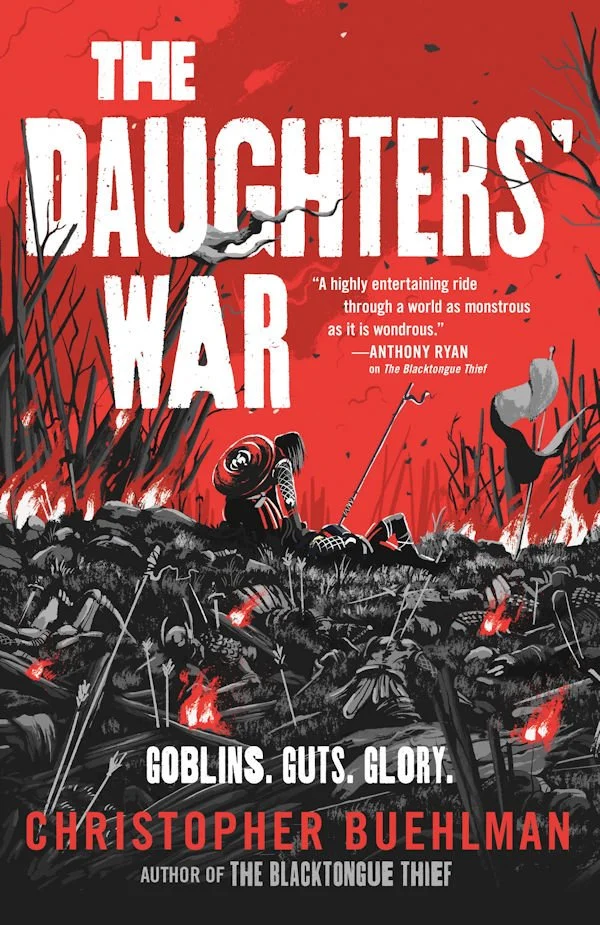
The landscape of modern grimdark fantasy has been irrevocably altered by the arrival of Christopher Buehlman’s latest offering, The Daughters’ War. Serving as a harrowing prequel to his acclaimed The Blacktongue Thief, the novel plunges readers into a world where the thin veil between civilization and extinction is held together by little more than desperation, steel, and the wings of magically engineered predators.
As the goblin tide—referred to as "Biters"—systematically dismantles human society, treating the populace as mere livestock, a new generation of defenders rises from the ruins of noble houses. At the center of this maelstrom is Galva, a woman who abandons her birthright to join the Raven Knights, an all-female unit that serves as the last, desperate hope for survival.
The Genesis of a Conflict: Core Facts and Premise
The Daughters’ War does not concern itself with the high-minded political machinations typical of epic fantasy. Instead, it provides an intimate, gut-wrenching look at a continent under total siege. The premise is stark: the goblins have decimated the traditional military, annihilated the cavalry, and laid waste to the fields that sustain humanity. With men dying in droves, the burden of survival has shifted to the daughters of the realm.
Galva, born into the influential Dom Braga family, finds herself drawn to the front lines, joining the Raven Knights. This unit is defined by its unconventional weaponry: giant, magically forged corvids. These birds, terrifying in both size and intellect, act as both companions and killing machines. The novel chronicles Galva’s evolution from a reluctant soldier to a seasoned veteran, all while navigating a world where the enemy is not merely a soldier, but a predator that views humanity as cattle to be caged and consumed.
A Chronology of Survival: The Path of the Raven Knights
The narrative follows a linear, albeit brutal, progression. Readers are thrown into the conflict without the comfort of extensive world-building exposition; instead, the reality of the war is revealed through the grime of the trenches and the terror of the battlefield.
- The Departure: Galva forsakes her family’s expectations to join the front, marking the transition from a sheltered noble life to the harsh reality of the killing grounds.
- The Formation: The training and integration of the Raven Knights with their corvid partners, establishing the unique, often dangerous, bond between human and beast.
- The Campaign: A series of harrowing engagements as the unit marches toward a besieged city, experiencing the visceral reality of a war where death is constant and unpredictable.
- The Climax: A high-intensity confrontation that pushes the survivors to their emotional and physical limits, providing a cathartic, albeit bloody, conclusion.
Throughout these events, the narrative is punctuated by the journal entries of Galva’s younger brother, Amiel. His introspective, often romanticized view of the conflict serves as a vital counterpoint to Galva’s increasingly pragmatic and hardened perspective. These interludes highlight the generational trauma and the disparate ways individuals process a world being consumed by violence.
Supporting Data: The Anatomy of Horror and Heroism
Buehlman’s depiction of the "Biters" sets a new benchmark for antagonist design in contemporary fiction. These are not the comic-relief goblins of traditional tabletop tropes, but rather creatures derived from the darkest corners of folklore.
The Threat of the Biters
The horror of the Biters lies in their complete lack of empathy. They do not fight for honor or territory; they fight to harvest. By portraying humans as "kynd"—cattle to be slaughtered—the goblins represent an existential threat that is deeply unsettling to the reader. This dehumanization forces the protagonist, and by extension the audience, to confront the fragility of human sentience when faced with a force that sees no value in it.
The Role of the Corvids
Central to the tactical survival of the human forces are the corvids. These creatures are not merely weapons; they are a manifestation of the dark magic required to combat the goblin plague. Their presence introduces an element of uncertainty: they are powerful, yes, but they are also unpredictable, requiring a level of trust that is difficult to cultivate in a war zone. The bond between Galva and her corvid is a testament to the desperate lengths to which humanity will go to survive.
Critical Perspectives: Pacing and Character Evolution
While the novel is undeniably grim, its brilliance lies in its pacing. Buehlman avoids the pitfall of "action-fatigue," where relentless combat scenes blur together. Instead, he utilizes "stillness"—quiet, reflective moments that allow the reader to catch their breath and process the gravity of the events.
The Protagonist’s Arc
Initial readers may find Galva difficult to connect with. Her early demeanor is sharp, perhaps even one-dimensional. However, this is a calculated choice by the author. As the narrative progresses, Galva’s layers are peeled back. Her hardening is not the result of a lack of humanity, but a survival mechanism. Her journey—which includes the exploration of her sexuality and the deepening of her bonds with her brothers and her avian companions—is profoundly human. Her evolution is gradual, making the eventual payoff feel earned rather than forced.
The Prose and Atmosphere
The combat scenes are described with a visceral, unflinching intensity. Buehlman ignores the technical minutiae of strategy in favor of the raw, chaotic carnage of the front lines. This "boots-on-the-ground" approach places the reader directly into the fray, creating an atmosphere of persistent dread that persists from the first chapter to the last.
Implications: The Legacy of The Blacktongue Thief
As a prequel, The Daughters’ War fulfills its primary objective: it provides context, weight, and tragedy to the world established in The Blacktongue Thief. By grounding the conflict in the experiences of a single character, Buehlman ensures that the epic scale of the war never overshadows the personal cost.
The book raises significant questions about the nature of heroism and the long-term effects of conflict. Is a person defined by the wars they fight, or by what they retain of themselves after the smoke clears? Galva’s refrain, "Short life, bloody hand," serves as the thematic anchor for the entire series. It is a promise of violence, but also a recognition of the brevity of existence and the necessity of forging one’s own path in a world that wants to consume you.
Conclusion: A New Standard for Grimdark
The Daughters’ War is an essential read for fans of the genre. It succeeds because it refuses to pull its punches, yet it finds beauty in the most horrific circumstances. The emotional depth—the unconditional love, the pride, the pity, and the hate—is what elevates the story from a mere war chronicle to a character study of profound significance.
As readers await the October release of The Thrice-Bound Fool, it is clear that Buehlman has crafted a saga that will be remembered for its uncompromising vision. The novel does not merely tell a story of survival; it demands that the reader bear witness to the cost of that survival. In the mire of the battlefield, amidst the shadows of the corvids and the screams of the Biters, we find a story that is as haunting as it is unforgettable. For those brave enough to step into Galva’s boots, the experience is, quite simply, transformative.



 Siti Muinah