Siti Muinah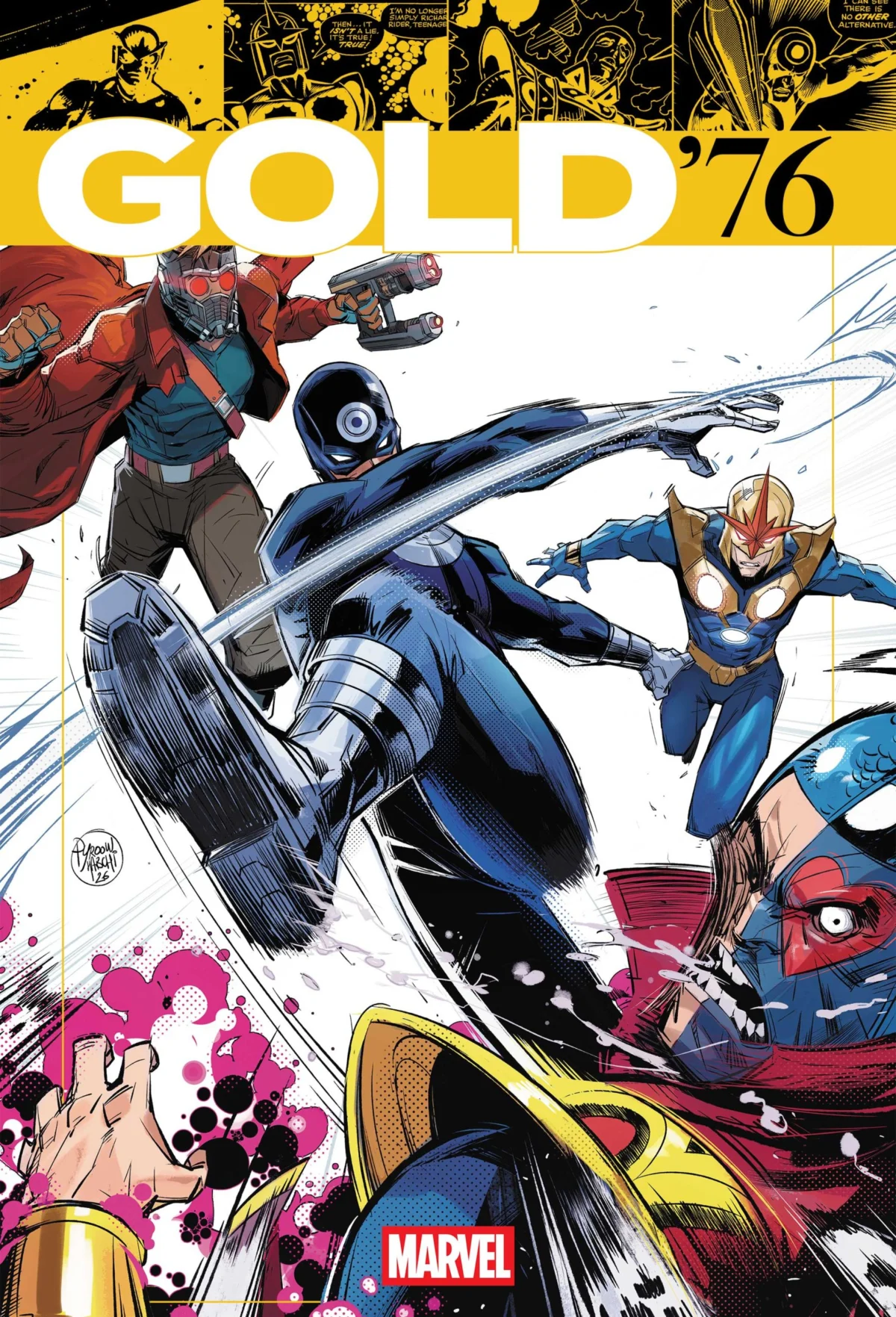
In a move that promises to bridge the gap between the gritty, street-level brutality of Marvel’s darker corners and the expansive, high-octane spectacle of the cosmos, Marvel Comics has announced a daring new one-shot. Marvel Gold ’76 #1, arriving this September, brings together an unlikely quartet: the lethal precision of Bullseye and the celestial heroism of Nova, Star-Lord, and Jack of Hearts.
This project is more than just an action romp; it is a commemorative celebration of the 1976 era, a pivotal year in the publisher’s history that birthed or elevated some of its most enduring icons. By placing a human hitman in the crosshairs of god-like entities, Marvel is crafting a narrative experiment that challenges the traditional power dynamics of its universe.
The Core Conflict: A Contract with Death
The premise of Marvel Gold ’76 #1 is deceptively simple yet carries the weight of universal annihilation. Bullseye—arguably the most lethal marksman in the Marvel Universe—has been commissioned by a mysterious, high-profile benefactor with an ominous connection to Thanos and the personification of Death herself.
The contract is clear, but the target is of such monumental importance that the mission inevitably draws the attention of three cosmic heavyweights: Richard Rider (Nova), Peter Quill (Star-Lord), and the volatile energy-wielder Jack of Hearts. As the narrative unfolds, the quiet, concrete corridors of New York City become a makeshift theater for a conflict that threatens to spill out into the stars. The juxtaposition of a man who throws playing cards with lethal force against heroes capable of manipulating gravitational fields and intergalactic energy creates an immediate, palpable tension.
Chronology: The 1976 Legacy
To understand why these four characters were chosen for this specific one-shot, one must look back to 1976. That year served as a crucible for the Marvel Universe, introducing concepts and characters that would define the next five decades of storytelling.
The Class of ’76
- Bullseye: Debuting in Daredevil #131, Benjamin Poindexter immediately established himself as a terrifying force of nature, redefining what it meant to be an assassin in a world of super-powered vigilantes.
- Jack of Hearts: First appearing in The Deadly Hands of Kung Fu #22, the character’s complex origin and tragic, radioactive existence made him an instant cult favorite.
- Nova: Richard Rider made his bow in The Man Called Nova #1, introducing the Nova Corps and the concept of a galactic police force to the Marvel mythos.
- Star-Lord: Though his origins have shifted through various retcons, Peter Quill’s debut in Marvel Preview #4 (1976) laid the groundwork for the modern cosmic epic.
By bringing these figures together, the creative team is essentially hosting a high-stakes reunion of the "Class of ’76," examining how their divergent paths—one toward the shadows of Hell’s Kitchen and the others toward the silence of the vacuum—have culminated in this singular, explosive collision.

Behind the Creative Vision
Writer Stephanie Phillips, known for her ability to balance character-driven drama with high-stakes action, has expressed her enthusiasm for the project. For Phillips, the challenge lay not just in the action, but in the legacy of the icons involved.
"It was such an exciting opportunity to write a story that celebrates these characters and their legacies, which have helped shape not just comics, but pop culture as a whole," Phillips remarked. "I can’t wait for readers to dig into this action-packed story and see the incredible artwork from Madibek Musabekov."
The artistic direction falls to Madibek Musabekov, whose style is expected to bridge the gap between the grounded, visceral violence associated with Bullseye and the vibrant, kaleidoscopic energy of the cosmic heroes. The visual language of the book will be crucial; the reader must believe that a man with a knife can hold his own against a hero who can survive the vacuum of space.
Editor’s Perspective: Why This Matchup Matters
Editor Mark Paniccia, the architect behind the Marvel Gold initiative, views this one-shot as the quintessential example of what the series aims to achieve.
"You might find this one of the strangest assemblies in comics, but pitting Bullseye against three characters who could punt him into the sun is one of the coolest hooks ever," Paniccia said. "MARVEL GOLD is about assembling the best talent to celebrate these characters with big swings, great stories, and a fresh spotlight that reminds readers why they’ve endured for decades."
The "hook" here is the power scale. In typical comic book logic, the heroes should end the fight in seconds. However, the brilliance of the Marvel Gold concept is its willingness to throw caution to the wind, forcing characters into situations where their specific power sets are tested by the "impossible." By forcing the cosmic trio to operate in a dense, civilian-heavy environment like New York, the odds are subtly shifted, giving the assassin a fighting chance.

Supporting Data: The Power Scale Dilemma
The central intrigue of Marvel Gold ’76 #1 lies in the sheer disparity of power between the combatants.
- The Assassin’s Advantage: Bullseye operates on pure, kinetic skill. He is not fighting fair; he is utilizing the environment, psychological warfare, and his preternatural aim to neutralize opponents who are physically superior.
- The Cosmic Burden: Nova, Star-Lord, and Jack of Hearts possess enough raw power to level a city block. The "catastrophic consequences" mentioned in the synopsis likely refer to the collateral damage caused by their struggle to stop a single man who refuses to stay down.
This dynamic creates a "zero-room-for-error" scenario. If the cosmic heroes miss, they hit the city. If they hold back, they fall to the assassin. If they use their full power, they become the villains of the story. It is a classic "trolley problem" in spandex, elevated by the involvement of cosmic-level entities like Thanos lurking in the background.
Implications: A New Era for Nostalgia
What does this tell us about the current state of Marvel publishing? The Marvel Gold initiative suggests a move toward "event-lite" storytelling—narratives that are self-contained but carry the weight of legacy.
By focusing on 1976, Marvel is acknowledging its "middle-age" period. These are characters who have survived numerous reboots, shifts in tone, and changes in editorial mandate. They are the bedrock of the modern Marvel Universe. By pitting them against each other in a high-stakes, one-shot format, the publisher is testing whether these classic iterations still resonate with a modern audience that has grown accustomed to the cinematic versions of these characters.
Furthermore, the involvement of Thanos—even as an unseen employer—signals that this isn’t a mere "What If?" side-story. It is a piece of the tapestry, a moment in time where the cosmic and the grounded meet in a way that will likely have lasting implications for the reputations of the four main players.
Anticipation and Availability
As of June 2026, the anticipation for Marvel Gold ’76 #1 is reaching a fever pitch. The announcement of the variant covers—featuring heavy hitters like Leinil Francis Yu, Alex Maleev, and the legendary John Romita Jr.—underscores the importance Marvel is placing on this release.

The book is scheduled to hit comic shop shelves and digital platforms on September 9th.
The Creative Team & Logistics
- Writer: Stephanie Phillips
- Artist: Madibek Musabekov
- Main Cover: Leinil Francis Yu
- Variant Covers: Alex Maleev, Hicham Habchi, John Romita Jr., Kendrick "Kunkka" Lim
For fans of classic 70s Marvel, this is a love letter to a bygone era. For new readers, it is an accessible, high-stakes introduction to four of the most unique figures in the publisher’s roster. Whether you are rooting for the cold, calculated precision of Bullseye or the grand, cosmic justice of the trio, the battle of September 9th promises to be one of the most intense superhuman conflicts in Marvel history.
In a universe where the stakes are always "the end of the world," sometimes it’s the smaller, more focused battles—like a hitman in New York—that leave the deepest scars. Prepare for the impact.

 Sagoh
Sagoh
 Ammar Sabilarrohman