

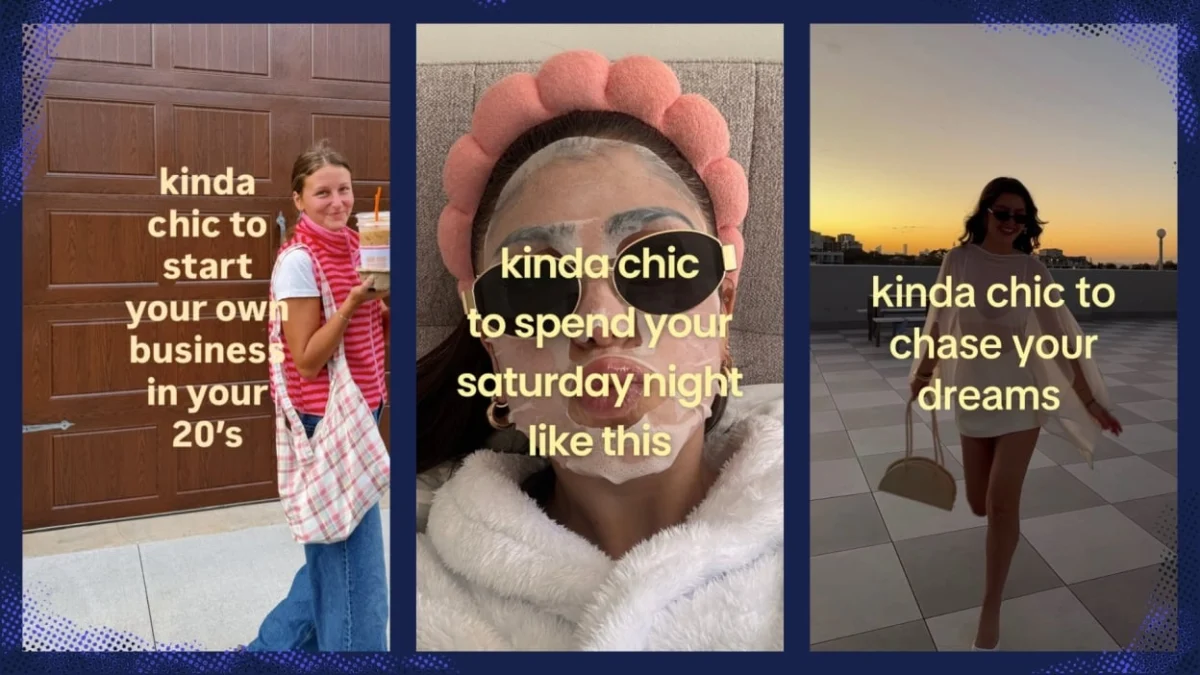
If you have spent any significant time scrolling through TikTok or Instagram over the past few months, you have likely been informed—by an acquaintance, a lifestyle influencer, or a major retail brand—that something remarkably mundane is, in fact, "kinda chic."
The trend is inescapable. It posits that everything from repeating an outfit and taking a mid-work coffee walk to setting healthy boundaries or deciding to embrace a new hobby is "kinda chic." What started as a benign, feel-good captioning format has metastasized into a universal social media shorthand, prompting a fierce debate about the dilution of language, the "slop" of algorithmic content, and the inevitable fatigue that follows when the internet collectively decides to use the same joke until it breaks.
The Anatomy of the Trend
The format itself is deceptively simple, which is precisely why it spread with such viral efficiency. Users select a piece of visual media—often a candid photograph or a short, looping video—and overlay text in a signature pale-yellow, sans-serif font. The formula requires the user to complete the sentence: "It’s kinda chic to…"
The content filling that blank ranges from the performative to the deeply personal. On one end of the spectrum, creators use the tag to highlight aspirational habits: spending time outdoors, wearing vintage, or moving to a new city. On the other end, it serves as a platform for radical vulnerability, with users declaring it "kinda chic" to accept one’s body, navigate loneliness, or pursue a career change while terrified.
But the trend has also become a catch-all for the absurd. It is "kinda chic" to eat cold pizza, to be "overdressed" for a grocery run, or to harbor an irrational love for Joe Jonas. By stripping the word "chic"—historically associated with high-fashion, exclusivity, and effortless elegance—of its weight, the internet has effectively democratized the term. In the "kinda chic" economy, the aesthetic value of an object or behavior is determined not by its price tag, but by its capacity to make the user feel self-assured.
A Chronology of the "Kinda Chic" Wave
While the exact genesis of the trend is difficult to pinpoint, digital culture historians and data aggregators like Know Your Meme trace the initial surge to late April 2026. One of the earliest documented instances features plus-size creator Maria Castellanos, known online as @MariaBegins. In a carousel post dated April 27, Castellanos encouraged her followers to engage with the prompt, asking them to define what was "kinda chic" about their own lives.

From that relatively humble beginning, the trend accelerated through the early summer. By mid-June, it had moved beyond the realm of personal accounts and into the territory of celebrity lifestyle curation. Stars such as Reese Witherspoon, Ashley Graham, and Drew Barrymore integrated the phrase into their personal brands. Witherspoon leaned into the wholesome, aspirational side of the trend, posting about the virtues of "cheering on other women" and "calling your mom." Barrymore, meanwhile, framed the transition into her 50s as a "kinda chic" milestone.
By August, the trend had officially jumped the shark, moving from human creators to corporate marketing teams. Brands saw an opportunity to humanize their advertising by mimicking the casual, "low-effort" aesthetic of the trend. Boots, the pharmacy giant, used it to market skincare routines; Virgin Atlantic used it to celebrate the "chic" nature of requesting a window seat. Even Aldi, the budget supermarket, leaned into the irony by suggesting that finding a foldable sock hanger in the aisle was "kinda chic."
Supporting Data: The Rise and Fall of a Keyword
The meteoric rise of the term is backed by stark metrics. Google search interest in the word "chic" hit its highest level since the search giant began tracking data in 2004, a paradoxical achievement given that many fashion critics have spent the last few years declaring the word "dead." According to The Guardian, searches for the specific phrase "kinda chic" surged by 5,000 percent between June and August 2026, while the hashtag accumulated over 60,000 unique posts on Instagram alone.
However, the raw numbers tell a tale of diminishing returns. Madé Lapuerta, the fashion data analyst behind the Data, But Make It Fashion platform, conducted a sentiment analysis on online articles and social discourse involving the word. Her findings were revealing: positive sentiment toward the word "chic" has declined by an average of 14 percent every month since March.
What the data suggests is a classic case of cultural saturation. As the word became synonymous with every facet of daily life—from the mundane to the monumental—it lost its distinctiveness. When everything is "kinda chic," the word no longer functions as a descriptor; it functions as noise.
Official Responses and Creator Backlash
As the format saturated the Instagram Explore page and TikTok’s "For You" feed, the tone of the conversation shifted from participation to annoyance. This "trend fatigue" has become a rallying cry for users who feel that the current landscape of social media is increasingly hollow.

Prominent stylists and cultural commentators have begun to speak out. Coco Schiffer, a New York-based stylist, famously declared that the "kinda chic" trend had been "officially revoked" in a mid-August video that garnered significant traction. Similarly, Naomi May’s Cultural Memory newsletter published a scathing editorial calling for the immediate retirement of the adjective "for the sake of humanity."
The backlash is not aimed at the content of the posts—very few people are offended by the idea of being kind to oneself or calling one’s mother—but rather at the process. Critics argue that the trend represents a wider crisis of originality in digital culture. The reliance on pre-made templates, specific color palettes (the ubiquitous "butter-yellow" font), and copy-pasted hooks makes the internet feel like a hall of mirrors.
The Implications: "Template Slop" and the Crisis of Originality
The "kinda chic" phenomenon is a microcosm of what fashion editor and creator Brenda Weischer has termed "template slop." In an era where algorithms favor familiarity and repeatable formats, creators are increasingly incentivized to prioritize speed and recognizable structures over genuine innovation.
This leads to a flattening of the internet experience. When every creator uses the same template to share their "cool girl" advice or lifestyle recommendations, the resulting content becomes interchangeable. As Weischer noted in her newsletter, "Everyone is getting good at making content. No one is getting better at being original."
The implications for social media users are profound. We are witnessing a transition from a web of personal expression to a web of aesthetic homogeneity. The "kinda chic" trend is just one symptom of a platform economy that rewards the path of least resistance. When a platform is designed to prioritize engagement via trends, the nuances of individual voice are the first casualties.
Ultimately, the exhaustion surrounding "kinda chic" is a sign of a maturing digital audience. Users are beginning to recognize the formulaic nature of their feeds and are increasingly rejecting the "content factory" model. The irony, of course, is that the most "chic" thing a user could do today is to abandon the template entirely. In a digital world screaming to be noticed, the most radical act may be to simply, quietly, be yourself—without a yellow-font label to explain why.











