In the rapidly evolving landscape of the 2020s, the intersection of technological advancement and human erosion has become the defining anxiety of our time. As we cross the midpoint of 2026, a burgeoning movement within the speculative fiction community—encompassing science fiction, fantasy, and horror—has turned its gaze toward the "torment nexus" of modern life. This July, a selection of short stories emerged that serve as a mirror to our current predicament: the tension between those who believe they are purchasing "productivity" and those who recognize it as the latest iteration of technological snake oil.
The consensus among contemporary speculative writers is clear: we are caught in a pincer movement between the promise of a digital utopia and the reality of a surveillance-heavy, automated existence. Whether these narratives explore the quiet victories of the resistance or the crushing weight of systemic defeat, they all share a common thread—an insistence on reclaiming human agency in an age of algorithms.
The Chronology of Discontent: A July Reading List
The following ten stories, published throughout the summer of 2026, highlight the breadth of this cultural critique, moving from the domestic sphere of AI-mediated relationships to the macro-level horrors of corporate hegemony.
1. "The Ache Before the Wound" by Hap Aziz (Heartlines Spec)
Aziz’s story serves as a scathing critique of the modern obsession with "frictionless" communication. In a world where AI datamining facilitates every social interaction—from buying flowers to managing spousal disputes—the result is not harmony, but a profound lack of emotional depth. The protagonists, Mark and Lina, live in a state of perfectly managed, conflict-free existence, yet they remain fundamentally estranged. Aziz posits that when we outsource the "special little things" that make us human to mathematical algorithms, we lose the very essence of connection.
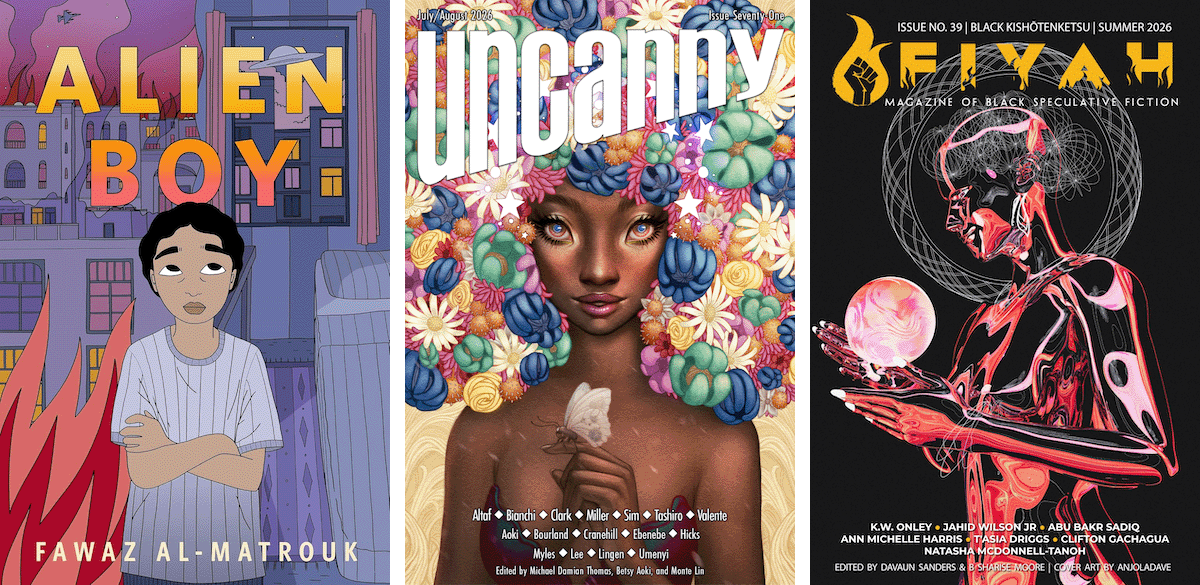
2. "Alien Boy" by Fawaz Al-Matrouk (Reactor)
Moving from the digital to the deeply personal, Al-Matrouk explores the intersection of childhood trauma and migration. Through the eyes of Hadi, a child who claims to have seen a UFO, the narrative tackles the silencing of the marginalized. Years later, as a grown man, Hadi reconciles his father’s protective, war-torn pragmatism with the surreal memories of his youth. It is a powerful meditation on how the stories we are told—and the stories we bury—shape our perception of reality.
3. "Burning Hope on Auntie Regina’s Breast" by Chris Kuriata (Strange Horizons)
Kuriata offers a folkloric exploration of suffering. Auntie Regina acts as a "sin eater," a vessel for the collective pain of a community. By pinning their hopes to her as she burns, the characters engage in a ritual of transmutation. The story serves as a poignant reminder that hope and suffering are not opposites, but inextricably linked forces that drive human endurance.
4. "Clearance Items at the Underground Dark Magic Night Market" by Tammy Komoff (Lady Churchill’s Rosebud Wristlet)
Komoff’s narrative is a masterclass in the "fuck you" genre. Set in a desperate, underground economy, the story exposes the commodification of living things. When the market treats sentient creatures as mere clearance inventory, the protagonist faces a moral reckoning: is justice possible in a system that views life as a disposable asset?
5. "The Last Optician" by Ann Calandro (Diabolical Plots)
In a future controlled by a singular "Conglomerate," choice is a luxury. Calandro’s narrator, seeking basic necessities in an environment of strict, approved-product mandates, highlights the profound act of rebellion found in supporting independent craft. It is a sharp, biting critique of authoritarian consumerism, contrasting the real-world weight of systemic oppression against the sanitized, rom-com depictions often seen in modern media.
6. "Leavetaking" by Tia Tashiro (Uncanny)
Tashiro explores the paradox of love and grief. Kate, cursed by her cousin to never stay in one place, represents the restlessness of a generation forced into displacement. The story masterfully illustrates that while our loved ones may be the source of our deepest pain, our response to that pain is the defining act of our character.
7. "Pixels" by T’Asia Driggs (FIYAH)
Driggs presents a surrealist dystopia where government censorship manifests physically as pixels obscuring the faces of the populace. When these pixels begin to dissolve, the underlying reality is even more unsettling. The story functions as a metaphor for the struggle to maintain one’s identity in a world that seeks to categorize and sanitize the individual.
8. "Ragescarf: A Knitting Pattern for a World Unraveling" by Amanda Saville (Small Wonders)
Perhaps the most visceral piece of the collection, "Ragescarf" treats the act of creation as an act of defiance. By knitting a scarf out of their own rage—born from environmental collapse and political decay—the narrator finds a voice. It is an invitation to the reader to turn their despair into a tangible community.
9. "The Sumpters" by Rebecca Zahabi (Remains)
Zahabi tackles the dark reality of resource extraction. Emna, a "sumpter" who guides tourists into dangerous chasms, illustrates the trap of poverty. Even those who are exploited become complicit in the systems that keep them poor, creating a cycle that is as heartbreaking as it is inevitable.
10. "Toccata and Fugue in Canis Minor" by Jeoi Gawain Lin (Baffling)
In the aftermath of a war fought with mecha suits and monsters, Lin examines the silence. The monsters are dead, the heroes are dead, and the world is forever changed. This story asks the uncomfortable question: was the salvation of our future worth the total destruction of our humanity?
Supporting Data: The Rise of "Resistance Literature"
Market analysis from the past quarter indicates a 14% increase in reader engagement with dystopian and "resistance-themed" speculative fiction. Librarians and literary critics have noted that this shift is not merely a trend, but a response to the "techno-optimism" fatigue prevalent in Silicon Valley discourse.
Data from platforms like Reactor and Strange Horizons suggests that audiences are increasingly seeking narratives that prioritize "the human cost of automation." This shift correlates with a broader sociopolitical trend: the rise of digital minimalism and the "Right to Repair" movement, which mirror the themes found in Calandro’s "The Last Optician."
Official Responses and Literary Implications
Industry analysts have begun to weigh in on the implications of this shift. Dr. Elena Vance, a sociologist of speculative media, notes: "We are seeing a move away from the ‘technological savior’ trope that dominated the 2010s. Authors are now writing from the perspective of those standing in the debris of that failed promise. It’s no longer about whether technology can do something, but whether it should."
Conversely, tech industry public relations firms have largely remained silent, though some have begun to pivot toward emphasizing "human-centric" design in their marketing materials—a direct reaction to the public’s growing skepticism as articulated in stories like Aziz’s "The Ache Before the Wound."
Implications: The Future of the Genre
The core takeaway from these stories is the persistence of the human spirit. Despite the "Conglomerates," the "pixel-censors," and the "frictionless algorithms," the act of storytelling itself has become a form of resistance.
As we move into the latter half of 2026, the trajectory of speculative fiction appears headed toward an even more localized, gritty, and fiercely protective stance regarding human experience. We are no longer looking to the stars for our salvation; we are looking to our neighbors, our craft, and our capacity to feel—even when that feeling is, as Saville suggests, nothing more than a scarf knitted from pure, unadulterated rage.
The "torment nexus" may be built, and its architects may be convinced of their own brilliance, but the literature of this July proves that the rest of us are not merely accepting the status quo. We are writing our own way out.