

With the calendar currently counting down roughly 31 weeks until Christmas, the traditional retail rush feels like a distant horizon. However, according to Pinterest’s latest strategic guidance, the race for holiday market share has already begun. In a recent push to educate advertisers on maximizing platform performance, the visual discovery engine is championing a shift away from the "last-minute scramble" toward a philosophy of "always-on" engagement.
As the retail landscape becomes increasingly saturated with short-term, high-cost ad auctions during the final quarter of the year, Pinterest is positioning itself as a platform where the early bird—and the early advertiser—reaps the most significant rewards.
The Core Thesis: Pinterest as a Planning Engine
To understand why Pinterest is pushing for early Q4 mobilization, one must first understand the unique psychological state of the platform’s 631 million monthly active users. Unlike social platforms defined by reactive scrolling or ephemeral entertainment, Pinterest functions primarily as a digital planning board.
Users do not visit Pinterest to see what their friends are doing; they visit to manifest what they intend to do, buy, or create. This "future-focused" mindset creates a distinct consumer journey. Users search for inspiration, save items to boards, and narrow their purchase intent weeks—and often months—before they are ready to swipe their credit cards.
"On Pinterest, the dynamic is different," the company noted in a recent briefing. "People come here to plan. They search for ideas, save what they like, and narrow down what they want to buy, often weeks or months before they are ready to spend."
For brands, this creates a window of opportunity that is often ignored by those fixated solely on the high-conversion, high-competition weeks of November and December. By the time a consumer is ready to finalize a purchase in late Q4, their "shortlist" of preferred brands has often already been curated during the discovery phase months prior.
Chronology of a Successful Holiday Campaign
Pinterest’s strategic framework suggests a departure from the traditional linear campaign structure. Instead of a sharp, intense burst of spending in Q4, the platform advocates for a tiered, long-horizon approach.
Phase 1: The Inspiration Phase (Current Period)
With over seven months until the peak of the holiday season, brands should be focusing on "evergreen" interest targeting. This is the time to populate boards with broad seasonal themes—such as home decor, holiday recipes, and gift guides—that align with general search trends. The goal here is not immediate conversion, but brand discovery and inclusion in early user "idea boards."
Phase 2: The Optimization Phase (Mid-Year)
As the calendar turns toward late summer and early autumn, advertisers should begin A/B testing their creative assets. By testing different product photography, video hooks, and call-to-action buttons now, brands can gather significant data on what resonates with their specific target audience. This allows for the refinement of ad sets long before the cost-per-click (CPC) rates spike in November.
Phase 3: The Peak Performance Phase (Q4)
When the retail season officially kicks off, brands that have followed this timeline are no longer "scrambling." They are not in the experimental phase; they are in the scaling phase. They have already identified their top-performing creative, their most responsive audiences, and their most effective bidding strategies. While competitors are frantically trying to figure out which products will sell, the "always-on" brand is simply increasing budget behind proven winners.
Supporting Data: Why Longer Is Better
The data supporting this strategy revolves around the machine learning capabilities of Pinterest’s ad platform. Advertising algorithms require time and data volume to learn who is the most likely to interact with a specific brand.
Pinterest explicitly states: "The longer your campaigns run, the better the system gets at matching your products and creative to the right people."
When a campaign is launched only for the holiday crunch, the platform’s algorithm is forced to perform "cold starts." It must rapidly test thousands of variables in a high-cost environment, leading to inefficient spend and suboptimal placement. By running campaigns over an extended duration, the system accumulates a historical data set that informs better targeting, leading to higher ROAS (Return on Ad Spend).
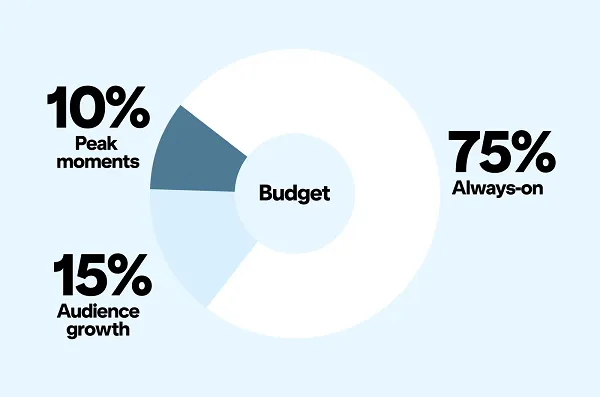
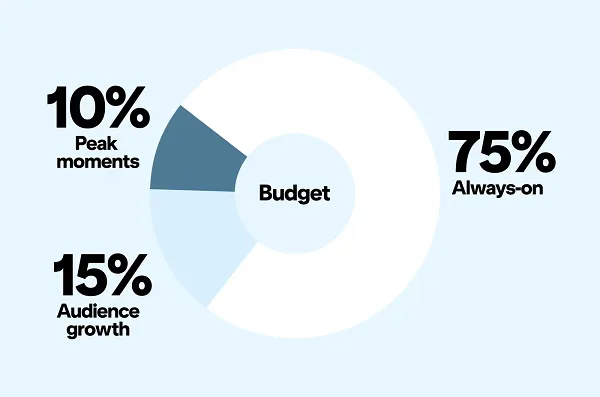
Pinterest’s internal analysis recommends that brands devote approximately 75% of their total annual platform budget to these "always-on" initiatives. This ensures that the engine is constantly primed, keeping the brand top-of-mind even when the immediate impulse to buy hasn’t yet been triggered.
Official Guidance: The Myth of the November "Big Bang"
"Peak performance isn’t built in November," Pinterest emphasized in their recent outreach to the advertising community. This statement serves as a direct critique of the "all-in" approach that has defined digital advertising for the past decade.
The platform argues that by starting now, advertisers benefit from lower costs. Auction dynamics in the digital ad space are largely supply-and-demand driven. When every retail brand on the planet enters the auction at the same time in November, prices naturally inflate. By contrast, current ad inventory is relatively more affordable, allowing brands to reach a wider audience for the same amount of capital.
For CMOs and marketing managers, this presents a significant budgetary argument. If you can achieve the same number of impressions or clicks in June and July at a fraction of the cost, you are effectively extending the reach of your total marketing budget for the year.
Strategic Implications for Modern Brands
The shift toward long-term planning has profound implications for how brands manage their creative pipelines.

1. Shift in Creative Strategy
Brands must transition from "campaign-based" content to "content ecosystems." Instead of producing one high-budget commercial, the strategy now favors smaller, varied assets that can be tested, iterated upon, and recycled throughout the year.
2. Organizational Siloing
The "always-on" model requires closer collaboration between brand teams, performance marketing teams, and data analysts. If a brand waits until October to brief its creative agency on Q4 needs, it has already missed the window to build the necessary data profile.
3. Inventory and Supply Chain Integration
Marketing isn’t the only department that benefits from this shift. Early data from Pinterest’s platform can act as a "canary in the coal mine" for product demand. If a specific type of product sees a surge in early interest in July, procurement teams can adjust their inventory levels for Q4, preventing out-of-stock scenarios during the peak season.
The Competitive Edge: The "Shortlist" Theory
Ultimately, the primary goal of this strategy is to secure a spot on the consumer’s "shortlist." In a world of infinite choice, the consumer journey has become increasingly complex. A shopper may encounter a product on Pinterest in June, see it again in an email newsletter in September, and finally purchase it in November.
If a brand is absent during that initial discovery phase, it is effectively invisible to the shopper by the time they are ready to finalize their decision. By maintaining an always-on presence, brands ensure they are the default choice when the shopper’s intent transitions from "planning" to "purchasing."
Conclusion: A New Standard for Digital Retail
The advice from Pinterest is clear: the era of the high-intensity, short-duration campaign is becoming an outdated relic. In an ecosystem where 631 million users are actively curating their future purchases, the most successful brands will be those that view the entire year as a continuous sales funnel.
While this approach requires a change in mindset and a commitment to long-term budget allocation, the potential for increased efficiency and reduced stress during the most competitive time of the year is significant. As the digital marketplace becomes increasingly crowded, the competitive advantage will no longer go to the brand with the loudest voice in November, but to the brand that has been speaking to the consumer since May.
For marketers looking to maximize their ROI, the message is simple: start now, test often, and let the algorithm do the heavy lifting. The holiday season is no longer just a quarter—it is a year-round conversation.












No comments yet. Be the first to join the conversation!