This week’s cultural landscape is defined by a blend of poignant remembrance, critical discourse, and the ongoing dialogue between humanity and its technological creations. From the tragic loss of trailblazing artists and dedicated members of the fandom community to the intersection of extraterrestrial inquiry and institutional policy, this report covers the major developments within the speculative fiction and broader arts spheres as of mid-June 2026.
I. In Memoriam: Celebrating Lives of Influence
The week has been marked by the passing of three significant figures whose contributions spanned the realms of literature, film, and fandom.
Marjane Satrapi (1969–2026)
The international literary and artistic community is mourning the loss of Marjane Satrapi, the French-Iranian visionary whose seminal graphic memoir, Persepolis, fundamentally altered the global perception of Iran. Satrapi, 56, reportedly passed away due to "grief-related complications" following the death of her husband, producer Mattias Ripa, in April 2025.

French President Emmanuel Macron led the tributes, describing Satrapi as a "great artist who turned her Iranian childhood into a universal tale." Her work was not merely a series of books but an act of political and social defiance, giving a voice to the Iranian revolution and the ongoing struggle for women’s rights. Her legacy remains embedded in the cultural fabric of modern graphic literature.
Anthony Head (1954–2026)
Beloved stage and screen actor Anthony Head passed away on June 5, 2026, due to complications from pneumonia. He was 72. Head’s career was defined by a remarkable range, most notably his portrayal of Rupert Giles, the scholarly and steadfast "Watcher" in the cult classic Buffy the Vampire Slayer. In his later years, he endeared himself to a new generation through his role as Rupert Mannion in the global phenomenon Ted Lasso. Colleagues have remembered him as a consummate professional and a gentle presence, whose ability to balance gravitas with dry, quintessentially British humor made him a staple of television history.
Robin Postal White (1946–2026)
A pillar of the New York science fiction fandom, Robin Postal White died on June 3, 2026, following a battle with liver cancer. Active since the 1960s, White was a member of the Fanoclasts and a significant contributor to various fanzines, including Void. Her life was deeply entwined with the history of the community; she was married to fellow fan icon Ted White for a decade. Beyond her contributions to the literary scene, she was a dedicated fiber artist who spent her later years in Tucson, Arizona.

II. The Interplay of Labor and Fiction
A central theme in recent intellectual discussions within the science fiction community is the relationship between work, identity, and the "useless" machine.
The Do-Nothing Machine
The Unofficial Hugo Book Club Blog recently explored the thematic resonance of "The Do-Nothing Machine Wakes." The discussion posits that the post-apocalyptic robot story serves as a contemporary mirror for David Graeber’s Bullshit Jobs: A Theory. By analyzing the "Asimovian robot" as a metaphor for the modern worker, the critique invites us to reconsider what "meaningful work" looks like in an era of increasing automation. It suggests that our fears of AI are, in fact, fears of our own obsolescence within a rigid, performative employment structure.
Eoin Colfer’s My Real Life
Shifting from the page to the stage, Artemis Fowl author Eoin Colfer is revisiting his acclaimed play, My Real Life. Currently opening for the Four Rivers production, the play features Garrett Lombard and is directed by Heather Hadrill. The narrative follows Noel, a man with advanced Multiple Sclerosis, as he spends his final hour recording a deeply personal, blackly comedic, and moving message for his best friend. The production, which will tour the Wexford Arts Centre and the Theatre Royal Waterford, continues to draw attention for its unflinching look at life, death, and human connection.

III. Science, Policy, and the Extraterrestrial Question
The boundaries between speculative fiction and reality continue to blur, particularly in the halls of government and scientific institutions.
The Exorcist and the Alien
A startling intersection of theology and ufology occurred this week as the Archdiocese of Washington removed Monsignor Stephen Rossetti from his role as an official exorcist. The decision, handed down by Cardinal Robert McElroy, followed public statements by Rossetti—a noted psychologist and clergyman—suggesting that U.F.O.s and extraterrestrial sightings are, in fact, demonic in origin.
This move comes in the wake of the U.S. government’s ongoing disclosure of U.F.O. files, a process initiated by the current administration earlier this year. The incident highlights a growing tension within conservative religious circles regarding the theological implications of non-human intelligence, with some figures moving to categorize these phenomena as spiritual threats rather than biological ones.

MAVEN’s Final Transmission
In the realm of physical science, NASA has officially decommissioned the MAVEN (Mars Atmosphere and Volatile Evolution) orbiter. After over 11 years of providing critical data on the Martian atmosphere, the spacecraft stopped responding in December 2025 following a technical anomaly that drained its power reserves. While the loss is mourned by the scientific community, the mission is being celebrated for its success in explaining how Mars transitioned from a habitable world to the arid planet observed today.
IV. Memory Lane: The Truman Show at 28
On June 5, 1998, Peter Weir’s The Truman Show premiered, changing the landscape of speculative cinema forever. As Cat Eldridge notes in this week’s retrospective, the film—starring Jim Carrey—was a prescient look at the rise of voyeurism, the death of privacy, and the construction of media realities.
Originally conceived as a darker science fiction thriller set in New York, the finished product evolved into a profound satire. Critics at the time praised its "sugar-spun nightmare" quality, which feels even more relevant in today’s world of curated digital personas. Winning the Hugo Award for Best Dramatic Presentation at Aussiecon Three, the film remains a high-water mark for high-concept, human-centered science fiction.

V. Preserving Cultural Heritage: The Alice Mural
In a victory for public art, the 16-panel Alice in Wonderland mural by Abram Champanier has been fully restored. Painted between 1938 and 1940 as part of the W.P.A.’s Federal Art Project, the mural once graced a children’s hospital in Lower Manhattan. After a precarious 86-year history—including a daring 1981 "guerrilla" rescue—the complete cycle is now on display at the Museum of the City of New York before moving to a permanent home at NYC Health + Hospitals/Gouverneur. This effort signifies a growing municipal commitment to treating public art as a vital component of community health and cultural identity.
VI. Podcast and Media Updates
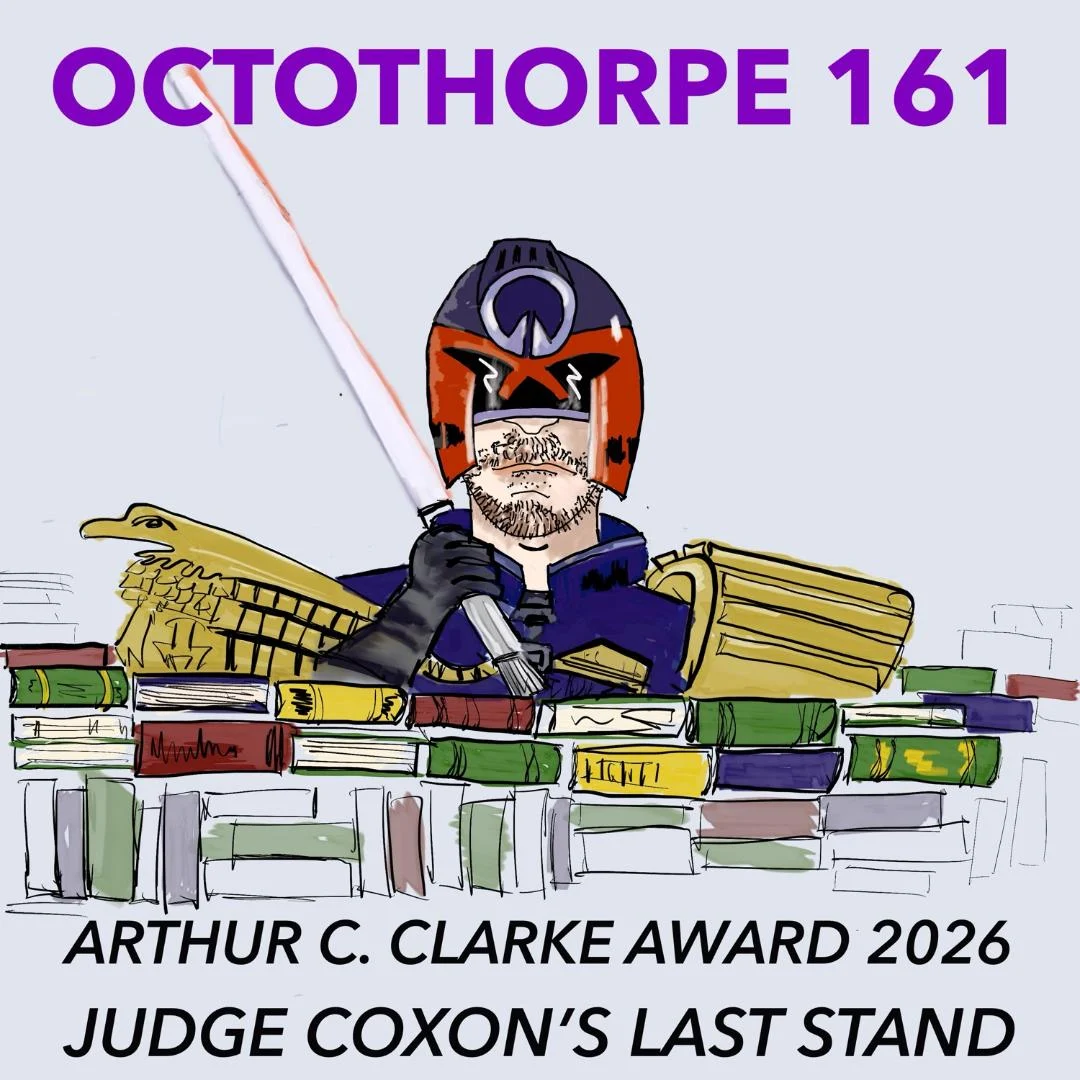
For those seeking critical engagement with the current field, Octothorpe podcast’s 161st episode, "You Pay Your Money, You Send Your Books," offers a deep dive into the 2026 Arthur C. Clarke Award shortlist. The episode features an irreverent examination of the judging process, with John Coxon put through his paces by Alison Scott and Liz Batty.
Additionally, Nature magazine’s recent career-focused column provides a curated list of nine "lab-life" novels for beach reading. While some debate remains regarding the distinction between "science fiction" and "fiction about science," the list serves as a reminder of the enduring fascination with the realities of scientific labor.

Implications and Future Outlook
The events of the past week underscore a society grappling with its own creations. Whether through the lens of a satirical film about surveillance, the decommissioning of a decade-long Martian mission, or the complex emotional labor of characters in Eoin Colfer’s plays, we are consistently forced to confront the gap between our expectations and our reality. As the government continues its U.F.O. disclosures and the arts community mourns the loss of titans like Satrapi and Head, the role of speculative thought—to interpret, to critique, and to mourn—has never been more essential.
We wish to thank our contributors: Mike Kennedy, Andrew Porter, John King Tarpinian, Olav Rokne, Daniel Dern, James Bacon, Cat Eldridge, Jonathan Cowie, Chris Barkley, Mark Roth-Whitworth, Kathy Sullivan, and Steven French for their invaluable assistance in compiling this week’s report.