

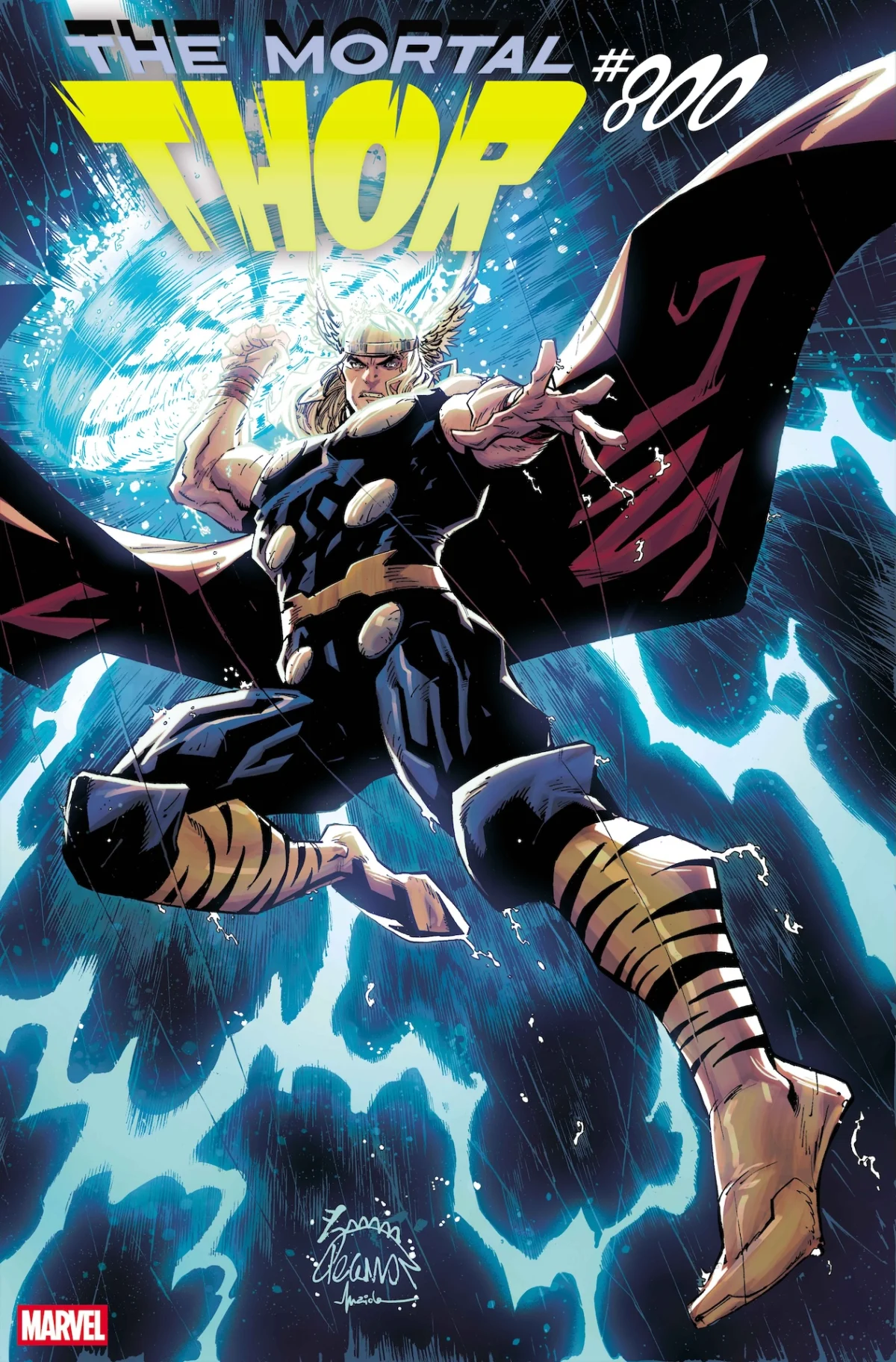
In a monumental publishing event that challenges the very foundations of Asgardian lore, Marvel Comics is set to release Mortal Thor #14 this August. This landmark issue, which carries the legacy numbering of #800, represents a radical departure for one of the publisher’s most iconic franchises. As the God of Thunder remains missing—erased from memory and reality following the cataclysmic events of the Immortal Thor arc—the mantle of the protagonist has been assumed by a man defined not by Mjolnir or divine heritage, but by human grit: Sigurd Jarlson.
This anniversary issue is not merely a celebration of longevity; it is a narrative pivot point that explores the nature of heroism when the "gods" are no longer there to save us.
The State of the Ten Realms: A Chronology of the Disappearance
To understand the weight of Thor #800, one must look back at the precipice of the current narrative crisis. The disappearance of Thor was not a mere tactical retreat; it was a cosmic erasure.

In the final acts of the Immortal Thor run, the Odinson made a desperate, ultimate sacrifice to fuel a complex spell cast by his brother, Loki. The spell, intended to prevent a greater cosmic disaster, carried a heavy price: Thor was stripped from the collective memory of the universe, and the golden bridge connecting Asgard to Midgard was shattered.
Following this, the narrative transitioned into the Mortal Thor era, a gritty, grounded exploration of a world without its protector. Sigurd Jarlson emerged as the central figure—a man haunted by echoes of a god he cannot fully remember, dealing with the detritus of Thor’s history. From confrontations with figures like Mr. Hyde to the shadow of Donald Blake, the series has systematically stripped away the safety net of divine intervention, forcing Jarlson to navigate a world that is becoming increasingly hostile.
The Trial of the Mortal: Analyzing the Plot of Issue #800
The solicitation for Mortal Thor #14/LGY #800 indicates that this is the culmination of the "Mortal" experiment. Trapped in a brutal, labyrinthine scenario designed by The Serpent, Jarlson finds himself in a position that mirrors the classical trials of heroes, yet lacks the standard armament of a deity.

"Sigurd is still without any powers beyond his own courage, wits, and willpower," explains writer Al Ewing. This thematic focus on "humanity as a superpower" serves as the core of the issue. The narrative is expected to propel Jarlson through the fractured mythic realms, forcing him to confront not just the physical manifestation of The Serpent’s malice, but the philosophical void left by the absence of the Thunder God.
The stakes are absolute. With the Ten Realms in disarray and the traditional protectors of Asgard effectively neutralized or absent, the question remains: Can a mortal, devoid of divine strength, bridge the gap between the mundane and the mythic?
Supporting Data: The Creative Powerhouse
The scale of this issue is reflected in the talent assembled for the project. The primary narrative is helmed by Al Ewing, whose tenure on Immortal Thor has been praised for its intricate weaving of ancient mythology with modern stakes. His collaboration with artist Pasqual Ferry—known for his kinetic, ethereal, and grand-scale visual storytelling—is viewed as the perfect marriage of tone and aesthetic for a story that bridges the gap between the grounded streets of Midgard and the cosmic reaches of the Nine Realms.

The issue is bolstered by an impressive array of creative support:
- The Main Narrative: Written by Al Ewing, with art by Pasqual Ferry.
- Anthology Contributions: The issue will feature supplemental stories by Chris Condon and artist Jesse Lonergan.
- The Return of a Legend: Kieron Gillen, a writer who famously defined much of the modern era of Thor’s characterization, returns to contribute to this landmark issue. His involvement adds a layer of continuity and gravitas, signaling to fans that #800 is a bridge between the classic era and the uncertain future of the franchise.
Official Responses and Editorial Vision
In recent statements, the creative team has emphasized that while #800 serves as a resolution to the immediate threats facing Sigurd Jarlson, it is intended to act as a catalyst for a much larger, more expansive arc.
"Issue #800 wraps up some long-running plotlines that have plagued Thor since before his death, but it also sets Sigurd Jarlson on a quest that will send him through the realms of myth to an Asgard that’s never needed a Thor more than now," Al Ewing noted.

The editorial decision to maintain the "Mortal" status quo for such a high-profile anniversary is a bold gamble. In an industry where status quo shifts are often quickly reverted, Marvel is doubling down on the premise that the concept of Thor—the defender of the realms—is more important than the man himself. By placing a mortal in the lead, they are challenging the reader to reconsider what it means to be worthy.
The Implications: A New Era for Asgard
The implications of Thor #800 for the broader Marvel Universe are significant. If Sigurd Jarlson succeeds in his trials, he will not merely be "replacing" Thor; he will be redefining the requirements for the mantle.
1. The Deconstruction of "Godhood"
For decades, the Thor title has been synonymous with overwhelming power—lightning, storms, and Uru-forged weaponry. By forcing the protagonist to rely on wit and grit, the series is moving toward a more character-centric, survivalist sub-genre of superhero fiction. This shift allows for more intimate storytelling, where the stakes are measured in personal resolve rather than cosmic explosions.

2. The Legacy of the Odinson
The absence of Thor is a vacuum that affects every corner of the Marvel Universe. Other cosmic entities, the Avengers, and the denizens of Asgard are all currently navigating a reality where their most powerful ally is a ghost. The resolution of this issue will likely determine whether the God of Thunder returns as a savior or if the vacuum is filled by a new, mortal protector.
3. The Artistic Evolution
Visually, the shift toward the works of Pasqual Ferry marks a departure from the heavy, brutalist art styles that dominated recent Thor runs. Ferry’s work, which emphasizes movement, light, and the surreal nature of the mythic, suggests that the "Mortal Thor" era is leaning into the psychedelic and the ancient, rather than the purely martial.
The Path Forward: What to Expect in August
As the release date of August 19th approaches, anticipation is building for the various covers and variants associated with the issue. The main cover by industry legend Alex Ross promises a striking, painterly depiction of the current state of the mythos, while the variants by Ryan Stegman offer a more visceral, action-oriented tease of the challenges to come.

For readers who have followed the Immortal Thor and the subsequent Mortal Thor runs, issue #800 is a mandatory purchase. It represents the closing of a chapter that has redefined the character’s mythology and the opening of a new, potentially dangerous era for the Ten Realms.
Whether this is the moment that restores the God of Thunder to his throne, or the beginning of a long-term transition into a new, mortal-led status quo, one thing is clear: the thunder has been silenced, but the story is louder than ever. Marvel has managed to keep the Thor franchise vital by taking away its greatest asset, and in doing so, they have proven that the true strength of the series lies not in the hammer, but in the heart of the person who dares to pick it up—or, in this case, the person who dares to stand without it.
Publication Details
- Mortal Thor #14 / Legacy #800
- Release Date: August 19
- Creative Team: Al Ewing, Chris Condon, Kieron Gillen (Writers); Pasqual Ferry, Jesse Lonergan (Artists)
- Cover Art: Alex Ross (Main), Ryan Stegman (Variant)
As the industry looks toward this August, the question remains: Can the legacy of a god be carried by a man of flesh and blood? With Thor #800, Marvel is ready to provide the answer.









No comments yet. Be the first to join the conversation!