

By [Your Name/Journalistic Desk]
July 8, 2026
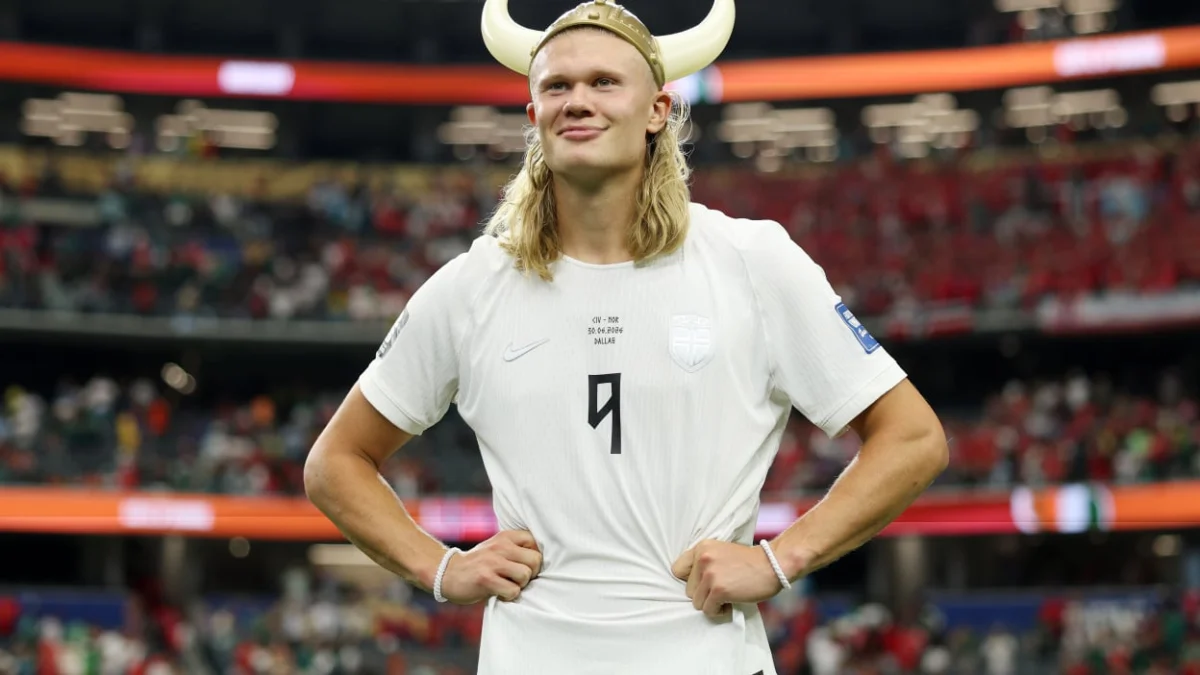
Erling Haaland has long been recognized as a physical anomaly on the football pitch—a "Nordic Cyborg" whose scoring record for Manchester City and the Norwegian national team defies traditional defensive logic. However, during the 2026 FIFA World Cup, the striker has transcended his status as a mere athlete. Across Chinese social media platforms, Haaland has been reimagined as everything from a high-fantasy romance lead to a viral slapstick comedian. This cultural metamorphosis, fueled by a mixture of brand partnerships and AI-driven creative fervor, marks a unique intersection of global sports, celebrity, and digital subculture.
The Genesis of the Meme: A Strategic Brand Pivot
The roots of this obsession can be traced back to early June 2026, when Haaland was appointed the global brand ambassador for Walovi, the international division of the legendary Chinese herbal beverage brand Wang Lao Ji. The marketing campaign was designed to resonate with local sensibilities, featuring Haaland speaking Mandarin and participating in lighthearted, summer-themed vignettes.
The campaign’s success was immediate. By leveraging a jingle that played on the phonetic similarity between his name and the brand’s marketing tone, the ads became an overnight sensation. For Chinese fans, seeing one of the world’s most intimidating athletes engaging in domestic, relatable, and sometimes goofy marketing collateral acted as a catalyst for a massive surge in online engagement. Within a month of launching his accounts on Weibo and Douyin, Haaland commanded a following exceeding 6 million users combined, with hashtags dedicated to his likeness generating hundreds of millions of views.

A Chronology of Digital Transformation
The transition from "professional footballer" to "internet mascot" occurred in several distinct phases:
- Early June 2026: The Walovi partnership launches. Fans begin to contrast his on-field "Cyborg" persona with his off-field "Baby Ha" (or Habao) moniker.
- Mid-June 2026: The first wave of creative edits hits Douyin. Fans begin stripping Haaland’s head and face from game footage, pasting it onto historical Viking warriors, anime heroes, and, most notably, the romantic protagonists of the hit mobile game Love and Deepspace.
- Late June 2026: The "Moskau" remix trend. Using the 1979 Dschinghis Khan track, fans create high-energy, rhythmic edits that solidify Haaland’s status as a pop-culture icon rather than just a striker.
- July 2026: AI-deepfake technology becomes the dominant medium. A viral video depicting a "restaurant incident" involving a flinching Haaland—later debunked as a face-swap of a Chinese comedian’s skit—reaches 31 million views, proving that the digital version of Haaland is now arguably more famous than the reality.
Supporting Data: The Scale of the Engagement
The sheer volume of content surrounding Haaland is staggering. Analysts monitoring Chinese social media trends have noted that the "Haaland Meme Ecosystem" functions independently of the World Cup tournament schedule. While his performance on the field—helping push Norway deep into the knockout rounds—provides the "main" narrative, the "fan-edit bracket" on platforms like Douyin is where the real cultural impact is measured.
Data from Weibo shows that "Haaland" consistently trends higher in search volume than even the most decorated legacy players of the tournament. The "Baby Ha" tag, which celebrates his unpolished, often awkward social media presence (ranging from Snapchat selfies to candid Q&As), has become a vessel for fans to project a sense of intimacy and humor onto a global superstar.
The Intersection of AI and Celebrity
Perhaps the most significant element of this story is the role of generative AI. The ease with which fans can now swap faces into high-production video clips has created a "reality-blurring" effect. When the video of "Haaland at a restaurant" went viral, many users were genuinely unable to discern whether the footage was authentic.

While the video was eventually identified as a parody featuring comedian Jin Long, the fact that it was shared as legitimate news for several days speaks to a growing trend in sports media: the "AI-ification" of icons. This is not limited to Haaland. Similar AI-driven trends have seen legends like Cristiano Ronaldo, Lionel Messi, and David Beckham reimagined as K-pop idols, complete with synthesized voices and choreographed dance routines. This suggests a new era of digital fandom where the athlete is no longer just a subject of news, but a malleable asset for fan-driven storytelling.
Official Responses and Strategic Silence
Neither Erling Haaland nor his management team have moved to suppress these edits. In fact, the striker’s own social media habits—which are famously unpolished and intentionally "memey"—suggest a tacit endorsement of the chaos. By interacting with AI edits, leaving comments on fan-made videos, and embracing the "Baby Ha" nickname, Haaland has effectively neutralized any potential PR fallout.
By leaning into the absurdity rather than fighting it, Haaland has secured a level of "cool" that money cannot buy. He has understood that in the modern digital economy, the ability to laugh at oneself—or at least to allow the internet to laugh for you—is a key performance indicator of modern celebrity.
Implications for Global Sports Marketing
The Haaland-in-China phenomenon provides a blueprint for future athlete branding. It demonstrates that:

- Localization is King: The success of the Walovi campaign proved that global stars must adapt to local platforms (Weibo/Douyin) with local humor to achieve true market penetration.
- The "Cyborg" vs. "Baby" Duality: Fans are no longer satisfied with the "invincible athlete" archetype. They crave a human, often vulnerable, or humorous secondary identity.
- AI as a Collaborative Tool: While deepfakes raise ethical questions, the "Haaland model" shows that, when used for harmless parody, AI can act as a massive force multiplier for an athlete’s global visibility.
As the 2026 World Cup reaches its climax, the footballing world watches Haaland to see if he can deliver the trophy for Norway. However, for millions of fans in China, the tournament has already been won. Whether he lifts the World Cup or merely continues to feature as the romantic lead in a Love and Deepspace fan edit, Erling Haaland has fundamentally altered the relationship between the elite athlete and the digital masses. He is no longer just a player; he is a permanent fixture of the global internet’s collective imagination.











